
NVIDIA unveils Nemotron-3-Ultra-550B, targets datacenters with 1M-token context
Serge Bulaev
NVIDIA has released Nemotron-3-Ultra-550B, which uses a hybrid LatentMoE design and may handle up to a 1 million-token context window. The model appears to be aimed at datacenter setups, needing multiple high-end GPUs, and NVIDIA suggests it can run much faster than some other large models. The NVFP4 version might offer similar quality to BF16 weights but at a lower cost, and differences between the two formats are often small in benchmarks. Long-context use cases could include loading full codebases or large document sets at once, but latency and weakened attention in very long inputs may still be issues. Reports suggest Nemotron 3 Ultra is strong in some areas but might not surpass every competitor in all tasks.

NVIDIA's release of Nemotron-3-Ultra-550B marks a significant milestone for datacenter-scale AI, delivering a substantial 256K-token context window and enhanced throughput. According to the official model card, this is achieved through a hybrid LatentMoE architecture that combines Mamba-2 state-space layers, sparse MoE routing, and classic attention. With a 550B parameter budget and 55B active parameters, NVIDIA reports this design enables up to 5.9× higher throughput than competing models in specific benchmark configurations.
Context and Hardware Footprint
Nemotron-3-Ultra-550B is a 550-billion-parameter model featuring a LatentMoE architecture that activates 55 billion parameters per inference. This design enables NVIDIA's NIM documentation lists a native context window of 262,144 tokens (256K) for Nemotron 3 Ultra 550B-A55B and delivers enhanced throughput compared to comparable models, targeting high-performance datacenter applications requiring both scale and speed.
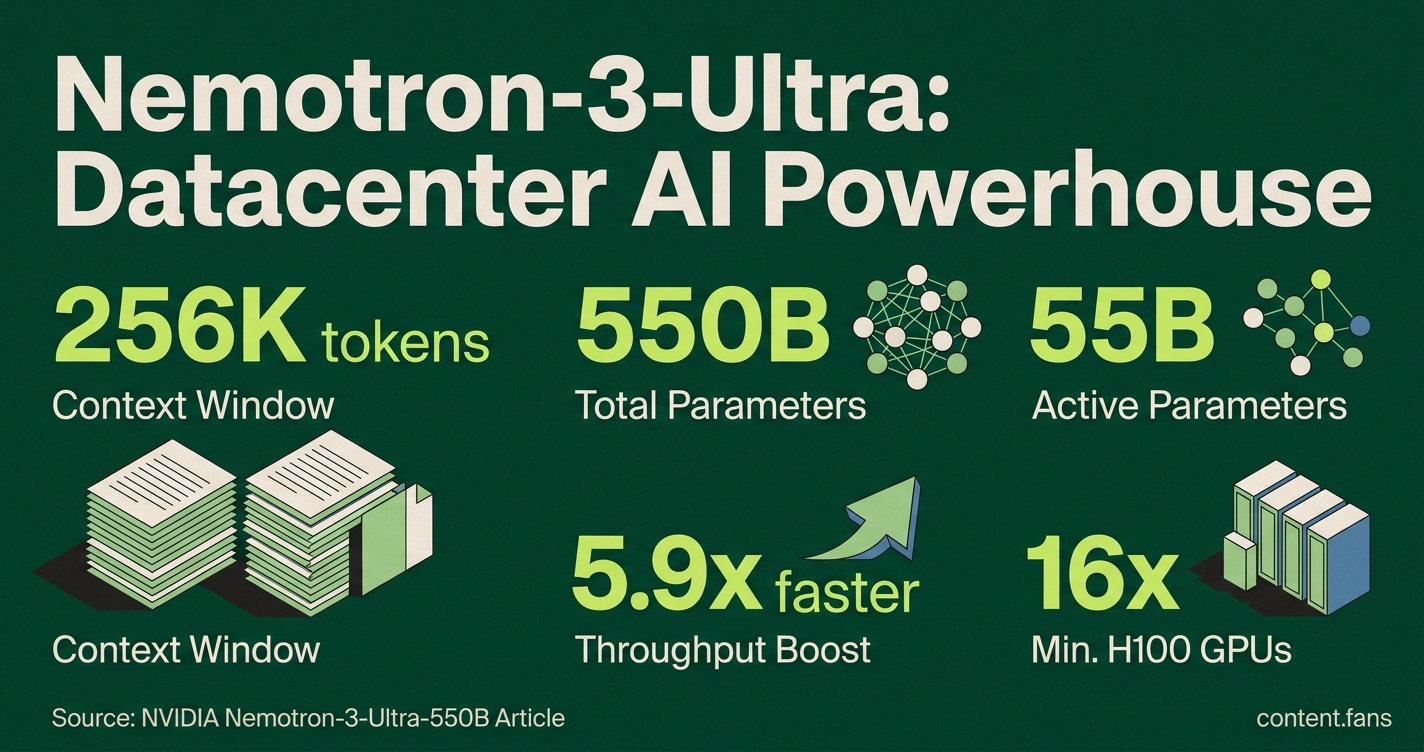
The model is explicitly designed for large-scale datacenter deployments, not single-GPU workstations. Minimum hardware configurations start at 8x GB200/B200/GB300/B300 or 16x H100 or 8x H200. In an 8K-input, 64K-output benchmark, NVIDIA shows Nemotron 3 Ultra running 5.9× faster than GLM-5.1-754B, with significant performance improvements over other competing models.
Comparing BF16 and NVFP4 Weight Formats
The model is available in two weight formats: the standard BF16 and NVIDIA's more efficient NVFP4. The NVFP4 variant is engineered to significantly reduce inference costs while maintaining performance that is nearly on par with the denser BF16 weights. Industry reports suggest minimal differences between the two formats, allowing organizations to prioritize inference speed without a substantial drop in quality.
Unlocking New Workloads with a 256K-Token Context
A 256K-token context window enables workloads that were previously impractical, allowing substantial codebases, large legal document sets, or extensive transcript archives to be processed in a single prompt. Key applications include:
- Comprehensive Code Analysis: Perform whole-repository refactoring and dependency tracing.
- Large-Scale Document Review: Conduct cross-document legal and compliance analysis.
- Advanced Agentic Workflows: Maintain extensive tool history for persistent, multi-step tasks.
- In-Depth Research Synthesis: Consolidate and analyze large volumes of research papers or financial reports.
While powerful, users should note that latency is tied to prompt length, and attention can weaken in the middle of extremely long inputs.
Competitive Landscape
Nemotron 3 Ultra establishes itself as a top-tier open-weight model, demonstrating particular strength in agent productivity, instruction following, and long-context reasoning. NVIDIA's technical report demonstrates strong performance across various benchmarks. While it may not hold the top score in every category, its overall performance profile is highly competitive.
Architectural Innovations: LatentMoE and Hybrid Design
The model's performance stems from its hybrid architecture, which is becoming a new standard for frontier models. NVIDIA's LatentMoE is a key innovation, routing compressed latent tokens to experts instead of raw tokens. This technique helps the 550B model perform like a much denser network without the associated compute overhead. The integration of Mamba-2 state-space layers alongside traditional attention further optimizes for long-sequence efficiency.
Ultimately, Nemotron-3-Ultra-550B serves as a practical showcase of three key trends driving modern AI research: expanding context length, the fusion of state-space and attention mechanisms, and the pursuit of efficient, scalable model capacity through sparse architectures.
What exactly is Nemotron-3-Ultra-550B and why is its 256K-token context a big deal?
NVIDIA unveiled Nemotron-3-Ultra-550B-A55B-NVFP4, a 550-billion-parameter model that keeps only 55 billion parameters active at any moment thanks to a hybrid LatentMoE architecture that mixes Mamba-2 layers, MoE gating, sparse attention, and Multi-Token Prediction.
The headline number is the 256K-token context window, big enough to drop substantial codebases, extensive meeting transcripts, or regulatory archives into one prompt.
This vaults the model past many open-weight competitors whose windows top out at smaller token counts and makes it practical to run comprehensive code reviews, end-to-end contract comparisons, or multi-step agent sessions without external retrieval.
How does performance compare with other open heavyweights?
NVIDIA's own technical report and an independent Artificial Analysis snapshot show the NVFP4 variant trading only small accuracy differences for significant throughput gains:
| Benchmark | Performance Notes |
|---|---|
| SWE-Bench Verified | Strong performance across variants |
| GDPVal | Competitive scores |
| RULER | Effective long-context handling |
When the workload is 8 k input / 64 k output, the model reports:
- 5.9× faster than GLM-5.1-754B-A40B
- Significant performance improvements over other competing models
The bottom line: strong accuracy with a commanding latency/cost edge on Blackwell-class hardware.
What hardware floor do you actually need to run it?
Forget desktops. The deployment sheet starts at:
- 8x GB200/B200/GB300/B300 (preferred for NVFP4)
- 16x H100 80 GB SXM or 8x H200 (alternative configurations)
Expect substantial GPU memory requirements, InfiniBand or NVSwitch fabrics, and liquid-cooled racks as the entry ticket.
In short, the datacenter is the minimum viable footprint; edge or on-prem gaming rigs need not apply.
Which real-world workloads benefit the most from 256K-token context?
- Codebase-wide refactor - feed substantial repos and ask for cross-module dependency rewrites
- Legal document marathon - load multiple related contracts and surface conflicting clauses in one shot
- Agentic workflows - preserve extensive tool-call history across many steps without state loss
- Research synthesis - concatenate reports, transcripts, and news dumps to generate consolidated market outlooks
Caveat: while 256K tokens provides substantial capacity, attention quality still decays toward the middle of very long contexts, so hybrid RAG-plus-long-context designs remain the safer architecture.
What do Mamba-2 and LatentMoE bring to the table?
- Mamba-2 layers slash per-token cost for long sequences by replacing some attention heads with state-space convolutions that scale linearly.
- LatentMoE compresses token representations into a latent routing space, cutting the number of active experts without sacrificing capacity, which NVIDIA claims yields higher accuracy than standard MoE at the same inference budget.
- Multi-Token Prediction lets the model output several tokens per forward pass, boosting wall-clock speed even more on Blackwell's FP4 Tensor Cores.
Taken together, the hybrid stack is less about "beating every benchmark" and more about delivering frontier-class scores while keeping the compute bill manageable on NVIDIA silicon.