
NVIDIA Integrates DiffusionGemma for Faster Local AI on RTX GPUs
Serge Bulaev
NVIDIA and Google DeepMind have worked together to make DiffusionGemma, a large language model, run faster on local RTX GPUs instead of the cloud. This approach may increase speed and privacy, as data stays on users' computers. The model uses a new method called parallel denoising, which appears to allow it to process many words at once and use less computer memory. Early tests suggest it can generate text much faster than previous models, and it might be easier to use for certain tasks such as editing whole paragraphs or fast chatting. Some experts warn that faster local models could make some types of attacks easier, so users may need to be more careful with security.

NVIDIA integrates DiffusionGemma, a groundbreaking diffusion-based model from Google DeepMind, to supercharge local AI on RTX GPUs. This partnership makes high-performance language generation practical on desktops by keeping all processing local, enhancing both speed and privacy. By overhauling kernels, memory, and precision formats, the model now achieves multi-kilotoken throughput on consumer hardware. This guide covers the technical architecture, performance benchmarks, and what this means for developers.
Technical Breakdown: How DiffusionGemma Achieves Record Speed
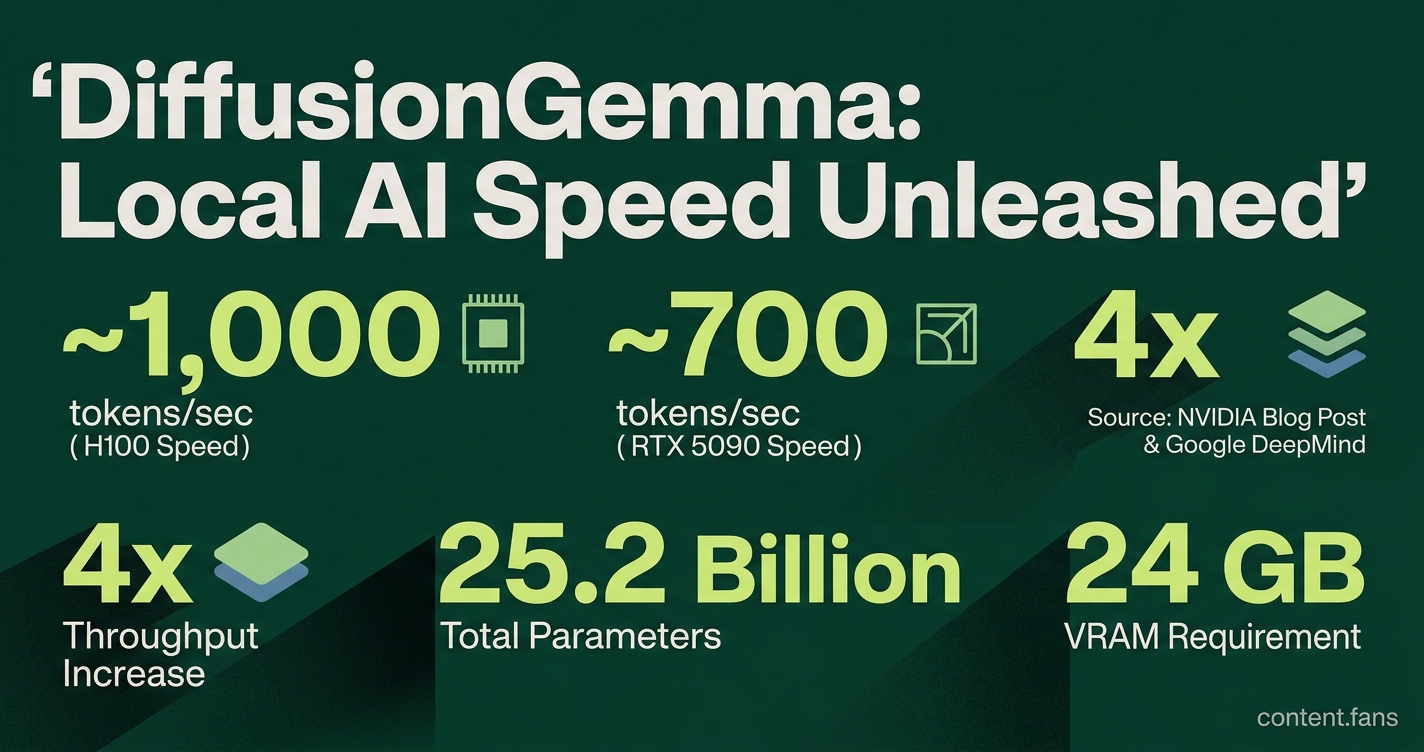
DiffusionGemma introduces a novel parallel denoising architecture, a significant departure from traditional sequential decoding. According to the NVIDIA blog post, the model generates and refines text in blocks of up to 256 tokens simultaneously. This approach, detailed on Google's model page, is built on a framework with 25.2 billion total parameters and 3.8 billion active parameters per step, dramatically reducing VRAM and memory bandwidth requirements.
Published benchmarks demonstrate impressive performance:
* ~1,000 tokens/second on a single H100 GPU.
* ~700 tokens/second on a GeForce RTX 5090.
* 4x higher throughput than comparable autoregressive models.
NVIDIA confirms immediate support in popular libraries like Hugging Face Transformers, vLLM, and Unsloth, allowing developers to get started without needing custom kernels.
NVIDIA's optimization of DiffusionGemma focuses on parallel processing for local RTX GPUs. By reworking compute kernels and memory layouts, the model can refine large blocks of text at once instead of token-by-token. This shifts the performance bottleneck to raw compute, where GPUs excel, delivering breakthrough speeds.
The Impact of Parallel Diffusion on AI Workflows
Autoregressive models generate text token-by-token, a sequential process that often underutilizes modern GPU power. DiffusionGemma's parallel refinement loop fundamentally changes this dynamic. It shifts the workload from memory-bound operations to compute-heavy tasks, playing directly to the strengths of today's massively parallel GPUs and avoiding common LLM bottlenecks.
This architecture unlocks several high-impact use cases:
1. Instant Code Infilling: Update hundreds of characters of code simultaneously.
2. Seamless Document Editing: Rewrite entire paragraphs in a single step instead of word-by-word.
3. Ultra-Low-Latency Chat: Achieve sub-50ms response times for a fluid, real-time user experience.
These performance figures rely on FP8 (Hopper) and the new NVFP4 (Blackwell) precision formats. With quantization, the model fits within 24 GB of VRAM, making it viable for high-end laptops equipped with an RTX 4090 mobile GPU.
Supported Hardware and Software Ecosystem
NVIDIA has enabled DiffusionGemma across a wide range of hardware, from consumer cards to enterprise-grade systems:
* Consumer GPUs: GeForce RTX 40- and 50-series for developers and small teams.
* Professional Workstations: RTX PRO series for demanding media and engineering applications.
* Data Center Nodes: DGX Spark and DGX Station for intensive, multi-user inference.
The integration is powered by NVIDIA's RTX AI software stack, which includes TensorRT-LLM for graph-level optimization, specialized cuDNN routines for the denoising loop, and AutoNCCL for efficient multi-GPU scaling.
Advancing Privacy and Edge AI
Running generative AI locally offers significant advantages for privacy and data security. By processing all data on-device, organizations in sensitive sectors like healthcare and finance can comply with strict data residency regulations without sacrificing performance. Furthermore, the model's efficiency lowers the economic barrier for on-premises deployment, making powerful AI accessible to smaller businesses.
However, security experts advise caution. While local processing enhances privacy, the model's speed could lower the cost of data extraction attacks if the model has memorized sensitive training data. This shifts the security responsibility to the end-user, highlighting the need for robust local security measures.
The Road Ahead: Future Developments and Getting Started
The collaboration between NVIDIA and Google is just beginning. Performance is expected to see another leap with the upcoming Blackwell GPU architecture and its native NVFP4 precision. Because DiffusionGemma already compiles with the open-source XLA runtime, support from other hardware vendors is also a possibility without needing to retrain the model.
For developers ready to start today: Checkpoints are available on the Hugging Face hub with FP8 and INT4 quantization. A session can be launched on a single GPU with just a few lines of code using vLLM. Early community tests on RTX 4090 desktops confirm the sub-40ms latency claims for generating 256-token blocks.
Both NVIDIA and Google have signaled ongoing work on multi-user serving optimizations, speed-preserving fine-tuning methods, and research into mitigating data memorization risks.
What exactly did NVIDIA optimize in Google DeepMind's DiffusionGemma?
NVIDIA retooled the entire inference path of DiffusionGemma so it now runs up to 4× faster on local RTX hardware. The work spans kernel tuning, precision calibration (NVFP4), memory-layout fixes, and GPU-specific scheduling, all packaged in the RTX AI stack. Benchmarks published by NVIDIA show 700 + tokens/sec on a single GeForce RTX 5090 and over 1 000 tokens/sec on an H100, figures achieved without touching cloud servers.
Why is this a big deal for local AI?
For developers, "local-first" is suddenly practical: the model with 25.2 billion total parameters (only 3.8 billion active per step) now fits inside a 24 GB consumer card after quantization. That means latencies low enough for real-time editing, copilot-style coding, or in-browser assistants while keeping every prompt, document, and generated token inside your own box - a direct win for privacy, cost, and regulatory compliance.
How does DiffusionGemma generate text differently?
Instead of autoregressive one-token-at-a-time decoding, the model parallel-denoises 256 tokens in a single block and refines them iteratively. This shifts the bottleneck from memory bandwidth to raw parallel compute, exactly where RTX Tensor Cores and NVFP4 math excel. The approach is why Google calls it "diffusion-style text generation"; NVIDIA then added the low-level plumbing so the technique runs fast on local GPUs.
Which hardware is officially supported?
Day-zero support is available for
- GeForce RTX 5090 / 4090
- RTX PRO workstations
- DGX Spark
- DGX Station (up to 2 000 tokens/sec)
- Any H100-class server card
Software hooks are already in Hugging Face Transformers, vLLM, and Unsloth, so you can pip-install and run with a one-line CLI.
What does this partnership signal for the wider industry?
The NVIDIA - Google DeepMind effort reflects a growing trend of vendor-research lab co-design. Similar moves include AMD's work with Imperial College on ROCm acceleration, IBM - UAlbany testing Spyre chips, and Intel - SambaNova targeting low-latency inference. Hardware vendors are no longer just shipping silicon; they are shipping tuned models and compiler stacks. The result is that open models arrive optimized for real hardware on day one, shrinking the gap between research release and production deployment on the edge.