
Nvidia commits $40B+ to AI investments, including $30B to OpenAI
Serge Bulaev
Nvidia has committed over $40 billion to investments in artificial intelligence for 2026, including a $30 billion pledge to OpenAI that is linked to future purchases of computing power. The company may be investing in many parts of the AI supply chain, like data centers, optical fiber, and photonics, which could help increase demand for its own hardware. Some observers suggest that many of these deals are "circular," because money may end up returning to Nvidia through hardware sales. Supporters say this approach might help Nvidia secure important components and speed up new technology, while critics worry it could blur the lines between customers and partners. The exact amounts and full list of Nvidia's investments may not be fully disclosed yet and could change over time.

Nvidia is committing substantial resources to strategic AI investments, solidifying its role as a top financier of the AI ecosystem. The strategy, highlighted by a major commitment to OpenAI tied to future compute purchases, involves seeding every layer of AI infrastructure to fuel long-term demand for its GPUs, networking hardware, and optical components.
Seeding the AI Stack with Strategic Capital
While the OpenAI pledge represents the portfolio's anchor, several other significant deals reveal a consistent strategy. According to industry reports, the company has committed substantial amounts to Corning for optical fiber and to IREN, a data center operator specializing in GPU cloud services. Further reporting from CNBC and TechCrunch outlines a significant investment in Nebius for AI factory design and $2 billion in Lumentum and $2 billion in Coherent, totaling $4 billion across these photonics firms.
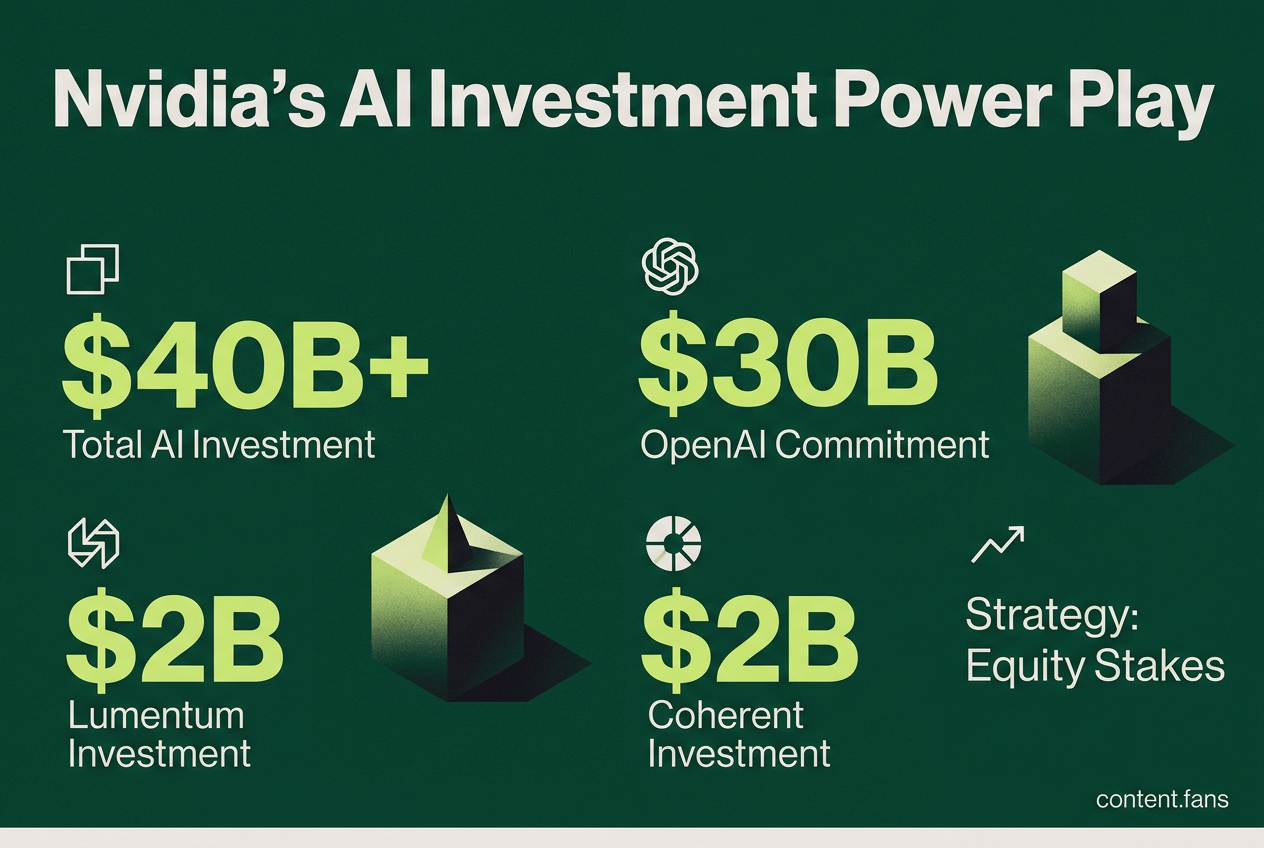
Nvidia's strategy involves taking substantial equity stakes across the AI supply chain. By financing data centers, component suppliers, and cloud providers, the company aims to accelerate infrastructure deployment, which in turn secures sustained, large-scale demand for its own GPUs and advanced networking hardware.
The "Circular Investment" Debate
This investment model has drawn scrutiny, with critics labeling it a "circular investment theme." Analyst Matthew Bryson of Wedbush told CNBC that capital may simply loop back to Nvidia through hardware sales, creating a self-reinforcing demand engine rather than a pure financial play. Proponents, however, argue the tactic is a necessary move to accelerate the deployment of scarce computing resources. By injecting equity, Nvidia secures priority access to vital components and data center space, bypassing critical supply chain bottlenecks.
Snapshot of Major Investment Commitments
- OpenAI - significant partnership
- Corning - substantial investment
- IREN - major commitment
- Nebius - significant investment
- Lumentum - $2 billion
- Coherent - $2 billion
Amounts are based on media coverage and may be adjusted as deals are finalized. Numerous smaller investments in private startups remain undisclosed.
Strategic Goals: Vertical Influence and Market Expansion
Industry analysis suggests these moves resemble vertical integration more than traditional venture investing, giving Nvidia influence over photonics, data centers, and software. The company is reportedly targeting significant "AI factory" capacity expansion - a goal that ensures sustained orders for its next-generation Blackwell accelerators and networking kits. Underscoring this synergy, a major CoreWeave hardware purchase agreement directly references Nvidia GPUs. This ecosystem financing helps solidify hardware backlog, supporting the company's ambitious growth projections.
While some observers raise concerns about inflated valuations and blurred customer-partner relationships, Nvidia's investment strategy signals a clear approach. The company is prepared to deploy significant capital to secure its supply chain and shorten lead times for essential AI infrastructure, from optical links to power-dense data halls.
What exactly is Nvidia funding with its major AI commitment?
According to industry reports, a significant portion is earmarked for OpenAI, representing one of the largest single investments Nvidia has made. The remaining capital is split across multiple publicly-listed firms and numerous private rounds, covering data-center operators (IREN, Nebius), photonics suppliers (Lumentum, Coherent), materials firms (Corning), and frontier labs like Anthropic. CNBC notes the goal is to finance the physical layer that will ultimately house and connect Nvidia GPUs.
Why is Nvidia investing in its own customers instead of just selling chips?
By taking equity stakes, Nvidia locks in future demand and lowers the capital hurdle for buyers. Example: CoreWeave signed a major initial order with Nvidia backing shortly after the investment framework was announced. Critics call this "circular financing," but supporters see it as securing a multi-year pipeline at a time when every hyperscaler is also exploring custom silicon.
How big is the infrastructure build-out that Nvidia is bank-rolling?
According to industry reports, the disclosed numbers point to significant new "AI factory" capacity targeted for the coming years. That translates into hundreds of thousands of Blackwell and Rubin accelerators, plus Nvidia's own networking and optics kits. Industry sources suggest Nvidia has ambitious internal revenue forecasts for these chips, implying the company expects the build-out to keep accelerating.
Which non-obvious companies are getting Nvidia money?
Beyond the headline names, Nokia and smaller radio-access partners are receiving capital to integrate Nvidia's AI RAN stack, while sovereign AI projects in India, Japan, France and Canada are being offered joint-financing vehicles. Even specialty glass-maker Corning is receiving substantial investment according to industry reports, underscoring how Nvidia is securing every choke-point from fiber bundles to GPU racks.
Could these investments backfire if AI demand slows?
Yes. If model-training budgets shrink or power constraints delay new data centers, Nvidia risks holding equity in cash-hungry infrastructure firms just as its own chip sales decelerate. Analysts at Wedbush warn the deals "appear to fit the circular investment theme", meaning the same dollars could simply rotate back into more Nvidia gear, masking true end-user demand.