
Google: Hackers Use AI Models to Find Security Flaw Before Mass Exploitation
Serge Bulaev
Google revealed that hackers used AI models to find a new security flaw and planned a mass attack, but Google's team stopped them before the attack code was released. The specific AI model used was not named, and Google said its own Gemini model does not appear to be involved. Reports suggest that both attackers and defenders increasingly rely on AI, and the number of attacks may be rising because of automation. Some experts believe this could mark a change, as AI may help find new vulnerabilities faster than before. It remains uncertain if current AI safety measures are enough, so companies are using multiple layers of defense and are closely monitoring AI usage.

Google's threat intelligence team revealed that hackers used AI models to find a new security flaw, a landmark incident confirming that threat actors are weaponizing AI for zero-day discovery. The attackers planned a mass-scale exploit, but Google researchers intervened before the code was released. The specific AI model was not named, but Google confirmed its own Gemini model was not involved. This event signals a critical turning point where commercial large language models (LLMs) can accelerate the discovery of vulnerabilities that once required deep human expertise.
Why the security community is watching
The security community is closely watching because AI is fundamentally reshaping cyber offense and defense. While defenders use AI for threat intelligence, adversaries are leveraging it to automate and scale attacks. This creates an accelerating arms race, forcing organizations to adapt to AI-enabled threats.
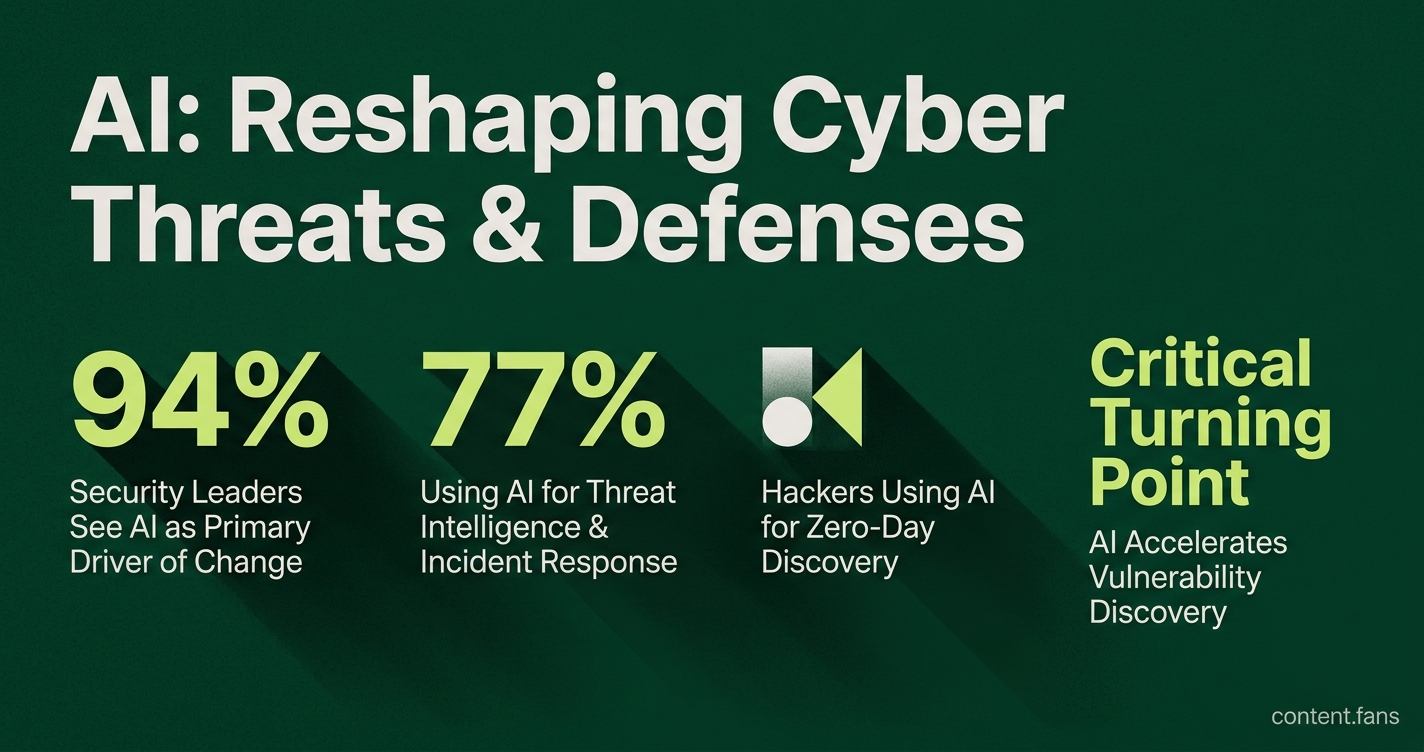
Recent industry analysis highlights how AI is transforming cybersecurity for both attackers and defenders. According to a World Economic Forum survey, 94 percent of security leaders view AI as the primary driver of change, with 77 percent already using it for threat intelligence and incident response (Libertify). Concurrently, industry reports indicate a significant increase in attacks from AI-enabled adversaries, signaling an arms race where automation drives the scale of conflict.
Early signals of AI-assisted offense
This incident is not the first sign of AI-assisted offense. Google's threat reports have previously documented state-sponsored groups from China and North Korea using AI chatbots for vulnerability research. Similarly, Anthropic blocked suspected Chinese state actors attempting to misuse its Claude model. These events confirm that malicious actors are actively using LLMs to accelerate reconnaissance. Furthermore, industry data shows organizations are facing a growing number of cyberattacks, with many analysts believing this surge in volume points to increased automation.
New attack surfaces appear
The integration of AI into business workflows and security tools inherently creates new attack surfaces. These include model poisoning, prompt injection, and the potential for AI systems themselves to be compromised, expanding the landscape that defenders must protect.
How labs and enterprises are responding
In response, major AI labs like Anthropic, OpenAI, and Google have implemented safeguards, though their effectiveness is debated. For example, Anthropic restricts access to powerful models, and OpenAI filters sensitive training data. However, few vendors provide public validation of these controls. Consequently, enterprises are not relying on these measures alone and are deploying layered defense strategies:
- Deploying AI-powered defensive tools for automated log analysis and threat containment.
- Mandating human oversight to verify any vulnerability findings generated by AI.
- Isolating AI model infrastructure to mitigate risks from prompt injection and data leakage.
- Monitoring model usage to detect anomalous queries that could indicate exploit research.
What the latest incident tells defenders
Google's intervention demonstrates that threat actors can now use commercially available AI to create effective attack plans. The next frontier in this arms race is speed, as offensive AI will rapidly generate exploit code, demanding equally fast defensive responses. While the efficacy of AI lab safeguards is still in question, this incident underscores a new reality: effective cybersecurity now requires a combination of skilled human oversight and highly tuned, automated defense systems.