
OpenAI unveils Enterprise Agent API, Microsoft integrates into Copilot 365
Serge Bulaev
OpenAI announced new Enterprise Agent APIs that may let companies use AI agents for complex, multi-day tasks. Microsoft appears to be adding these capabilities to Copilot 365, allowing agents to run longer workflows with more security. At the same time, new rules from the EU are making it necessary for businesses to track and control how they use AI, with key deadlines in 2026. Experts suggest that companies might see less manual work and more automated processes, but warn there could be risks if controls are not in place. The pace of change means firms that act quickly and follow new rules may gain an advantage.

The arrival of the OpenAI Enterprise Agent API signals a major shift, moving AI from a simple productivity tool to a core business operating system. Microsoft is integrating these autonomous agents, which can handle complex, multi-day back-office tasks, into Copilot 365 for Q2, as confirmed in a recent LinkedIn disclosure. As Google also advances its AI integration, new EU regulations are simultaneously creating a mandatory framework for AI governance. This convergence marks a pivotal moment where AI transitions from decision support to direct execution, fundamentally altering the landscape of competitive advantage.
Execution layer arrives
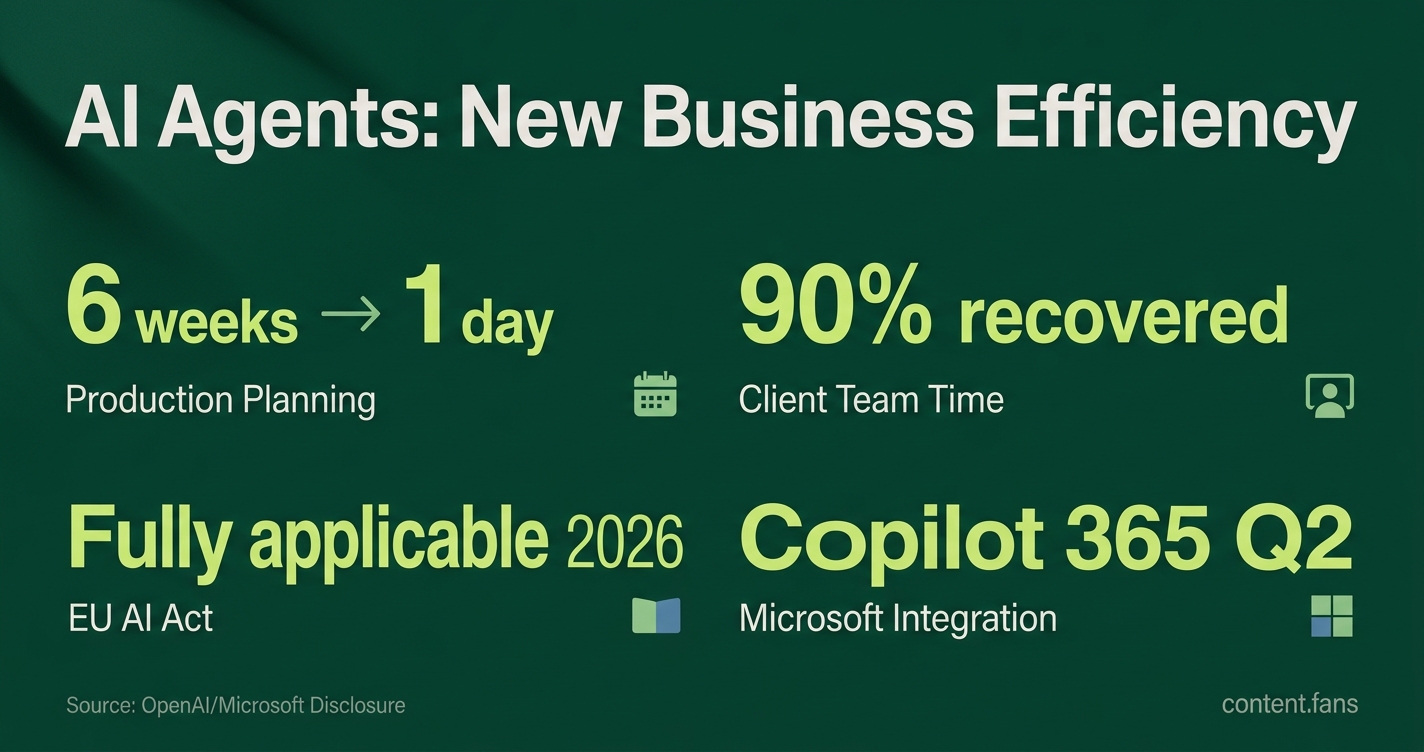
OpenAI's O-3 Enterprise Agent API empowers companies to deploy autonomous agents capable of monitoring, planning, and executing complex workflows without continuous human prompting. In tandem, Microsoft is integrating these "always-on" capabilities into 365 Copilot. According to The AI Insider, the pilot program focuses on long-running, multi-step tasks that maintain enterprise-grade security. This move suggests a new standard for office software, shifting the focus from providing recommendations to actively orchestrating work across multiple systems.
OpenAI's new Enterprise Agents are sophisticated AI models designed to operate autonomously within a company's software ecosystem. They can independently manage complex, long-running business processes, such as supply chain optimization or customer service workflows, by planning and executing a series of tasks without requiring step-by-step instructions.
Architecture and control
Microsoft has detailed a reference architecture integrating Copilot Studio, Azure AI, Power Platform, and Entra ID to manage these agents. This stack includes new governance tools like a Model Context Protocol server and a Work IQ API to ensure robust audit trails and policy controls. Microsoft acknowledges that as agents interconnect, "requirements for visibility, governance, and predictability become much more complex." Early adopters are already leveraging this framework with OpenAI's support to convert business challenges into automated agent workflows. Reported case studies highlight dramatic efficiency gains, with production planning cycles cut from six weeks to a single day and client-facing teams recovering over 90% of their time for core activities.
Rising regulatory pressure
As technology vendors accelerate AI deployment, regulatory bodies are keeping pace. The EU AI Act will become fully applicable on 2 August 2026, according to the European Commission's official timeline. This legislation introduces significant compliance obligations, with key requirements already phasing in. By the 2026 deadline, enterprises must inventory all AI systems, classify their risk levels, and maintain post-market monitoring or face significant enforcement actions at both national and EU levels.
A compliance consultant summarizes the core burden for businesses:
- Inventory every AI use case, classify by risk tier, document oversight, and enable incident response before 2 August 2026.
Strategic implications for operators
The rise of AI agents is forcing a strategic shift. Citing industry surveys, Virtual Assistant Automation reports that 78% of executives are re-evaluating their operating models. Forrester's 2026 outlook predicts enterprise software will evolve to support a "digital workforce" of specialized agents, reducing manual work in rule-based processes like sales pipeline management, document verification, and inventory control. However, this shift introduces risks like silent errors, permission creep, and unmanaged agent sprawl. Experts from Rivulet IQ advise organizations to mitigate these risks by starting with a single, well-defined workflow, mandating strict audit logs, and maintaining human approval until the system's reliability is proven.
The race ahead
With technology leaders embedding execution capabilities into their core platforms and regulators enforcing firm deadlines, competitive advantage now hinges on balancing rapid deployment with robust governance. The firms that successfully align their technology architecture, talent development, and compliance strategy will lead the market. Those who delay will find themselves struggling to adapt as the fundamental operating system of business is rewired around them.
What exactly is the new OpenAI Enterprise Agent API?
OpenAI's O-3 Enterprise Agent API lets companies deploy autonomous "workers" that run multi-day, multi-step workflows inside corporate systems. Early adopters such as HP, Intuit and Uber are already using the same stack to shrink hardware-troubleshooting cycles from four hours to a few minutes and to cut manufacturing-optimization timelines from six weeks to one day.
How is Microsoft integrating these agents into Copilot 365?
Microsoft has embedded the O-3 agents directly into 365 Copilot and Copilot Studio. Users can now trigger agents through natural-language prompts; the agents natively call Power Automate flows, read SharePoint data and post updates to Teams without leaving the Microsoft ecosystem. A new Work IQ API (public preview) exposes organizational context, memory and signals so IT teams can bolt enterprise-grade governance onto every agent action.
What governance guard-rails are included?
Microsoft ships each agent with:
- Model Context Protocol (MCP) server hooks for audit trails
- Entra-backed identity and permission checks
- Central dashboards that surface agent-sprawl alerts, permission creep and silent-error logs
Companies keep a human-approval step live until trust scores cross an internal threshold.
How does this change the EU AI Act compliance picture?
The Act's main enforcement date is 2 August 2026. Agents classified as "high-risk" (anything influencing pricing, credit, hiring or safety) must ship with:
- Technical documentation
- Human-oversight design logs
- Post-market monitoring plans
Microsoft's governance stack is positioned to satisfy most of these requirements out-of-the-box, but business owners still carry final liability for classification and incident reporting.
What business value can I expect - and what are the risks?
Gartner estimates the wave will redirect $40 billion in labor costs to software licensing by fiscal 2026 year-end. In pilots:
- Sales teams freed 90 % of prep time for customer-facing work
- Back-office agents cut document-handling queues by half
Risks mirror the speed: silent errors, permission creep and agent sprawl can compound quickly. Start with one well-mapped workflow, enforce audit logs and keep a human in the loop until performance metrics stabilize.