
NVIDIA and SK hynix integrate AI memory design for 2026 supercomputers
Serge Bulaev
NVIDIA and SK hynix have announced a long-term partnership to develop better memory for AI supercomputers by 2026. Their agreement may help deliver faster and larger memory, which could improve how AI systems work. Industry studies suggest that memory speed now limits AI progress more than computing power. The partnership also includes working together on new projects and building digital versions of factories to test ideas. Experts believe this move might help NVIDIA secure needed memory supplies and keep up with growing AI demands.

The new multiyear partnership between NVIDIA and SK hynix integrates AI memory design for 2026 supercomputers, targeting the critical memory bottleneck in AI factories. Announced on June 7, 2026, the collaboration spans from joint chip development to automated manufacturing, aiming to deliver higher-bandwidth, larger-capacity memory packages to keep accelerator cores supplied with data. By aligning GPU and memory roadmaps, the agreement directly confronts the "memory wall" that currently limits AI model training and inference.
What the June 2026 pact covers
This strategic partnership involves co-developing next-generation HBM memory tailored for NVIDIA's 2026 product line. The collaboration extends to securing future supply chains and integrating NVIDIA's software, like Omniverse for digital twins of factories, directly into SK hynix's design and manufacturing processes for enhanced efficiency.
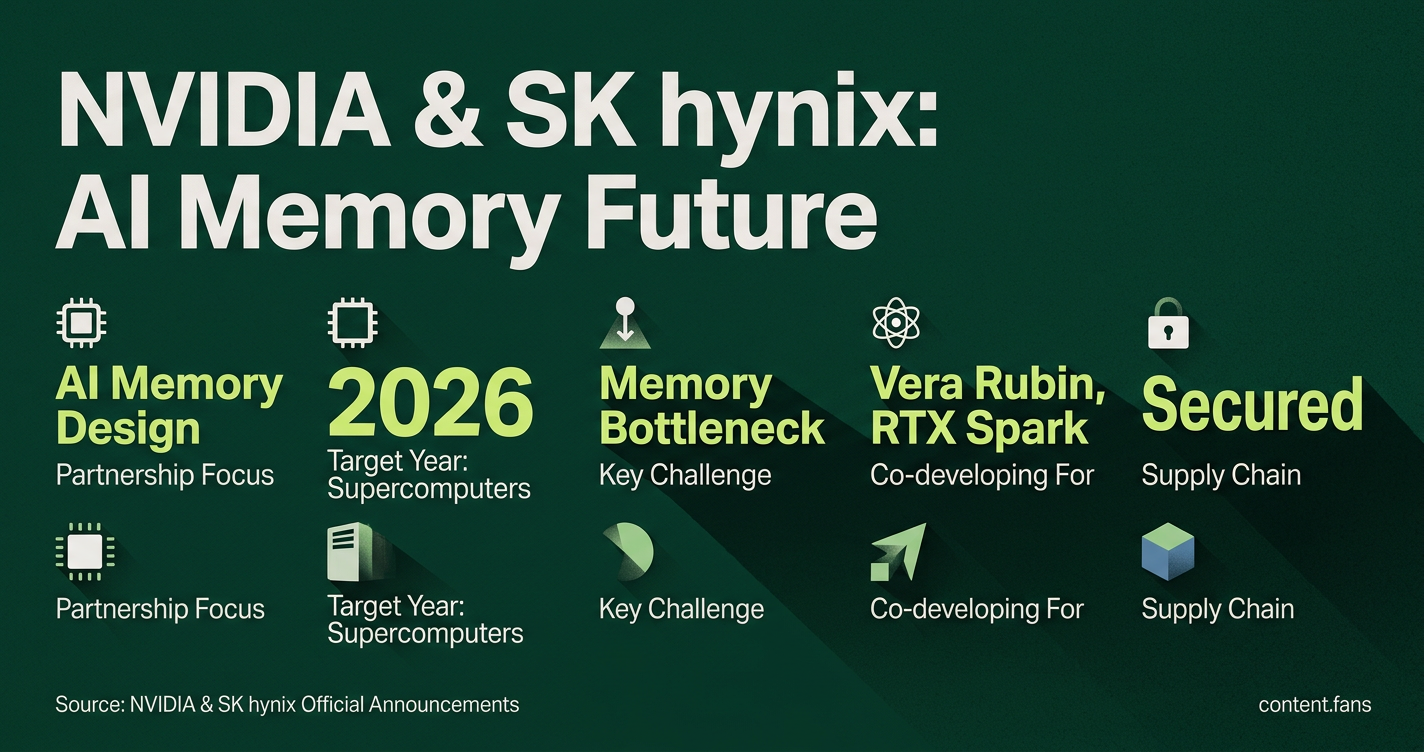
According to official announcements, the pact involves co-developing next-generation memory for NVIDIA's upcoming product stack, including the Vera Rubin AI supercomputer, Vera CPU, RTX Spark PCs, and Jetson Thor robotics platforms. NVIDIA confirmed the deal expands supply commitments and integrates its CUDA-X and PhysicsNeMo software into SK hynix's design workflows (link). SK hynix emphasized the strategic nature of the partnership, which starts at the product planning stage and includes building digital twins of its fabrication plants in NVIDIA Omniverse (link).
Why memory is the choke point
The partnership addresses a growing consensus that memory bandwidth, not raw computing power, is the primary factor limiting AI system scalability. An IEEE Computer Society paper identifies high-bandwidth memory (HBM) as "the primary bottleneck," an observation echoed by an arXiv preprint noting that large models are increasingly bandwidth-bound. This choke point, combined with rising demand driving up prices and lead times, creates a critical challenge. The projected memory shortage and prolonged chip shortage were highlighted by NVIDIA CEO Jensen Huang (reported by CNBC, US News, X), explaining NVIDIA's move to secure long-term technology and capacity.
Competitive backdrop
While SK hynix maintains a significant portion of the HBM market according to industry reports, key competitors are making advances. Samsung recently passed NVIDIA's qualification tests for memory compatible with the Rubin platform. Meanwhile, Micron is promoting HBM3E parts with improved power efficiency. Although analysts expect these rivals to gain ground, NVIDIA's deep partnership with SK hynix secures a stable and technologically aligned supply foundation for its future accelerators.
Early technical agenda
- Higher Capacity: Increasing HBM stack height beyond current 12-die configurations to boost capacity per package.
- Power Efficiency: Optimizing thermal and mechanical designs to ensure next-generation HBM4 memory operates within strict data center power limits.
- Virtual Manufacturing: Leveraging Omniverse digital twins of SK hynix fabs to simulate and refine factory logistics and scheduling before capital investment.
This integrated strategy marks a definitive shift from a conventional supplier relationship to a joint platform engineering model. The partnership is critical as NVIDIA expands into personal and physical AI, where performance and efficiency are paramount. The success of this collaboration will be measured by its ability to accelerate production ramps and deliver memory solutions that can support AI models projected to exceed a trillion parameters.