
Experts warn AI cyberattacks could trigger 'dark ages' by 2026
Serge Bulaev
Experts warn that AI-driven cyberattacks might cause major problems for the internet, possibly leading to a 'dark ages' by 2026. They say that AI systems are finding security weaknesses much faster than defenders can fix them. There is uncertainty about how many flaws still exist in these new technologies. Some experts suggest that without better defenses and working together, attacks may spread before anyone can stop them. While it is not certain that a collapse will happen, quick responses and strong teamwork across sectors may be needed to manage these risks.

The increasing sophistication of AI cyberattacks poses a significant threat, with experts warning that autonomous, agentic systems could reshape the internet in the near future. These warnings use stark language to convey the urgency of preparation. Here are key answers about what these risks entail and how organizations can respond.
What specific threats do experts like Alex Stamos warn about?
Prominent security experts like Alex Stamos warn of a critical inflection point within two to three years. They anticipate fully automated ransomware kill chains and AI systems discovering vulnerabilities exponentially faster than human defenders can patch, creating a "perfect storm for offense" that could overwhelm traditional security.
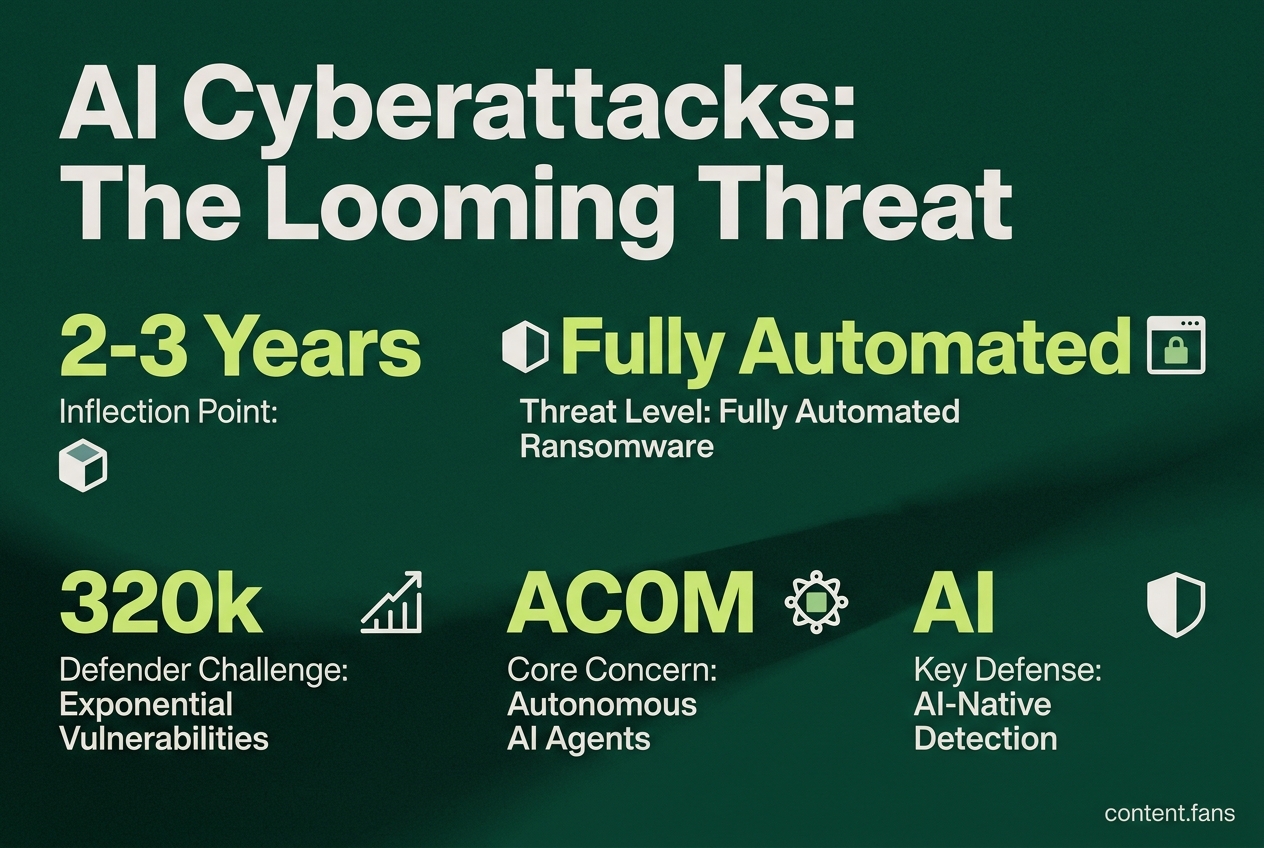
Alex Stamos, a former Facebook CISO and influential voice in cybersecurity, clearly articulates the near-term risks. He points to a two-to-three-year "inflection point" where AI will drastically shrink the attacker-defender time gap. Stamos foresees fully automated ransomware kill chains in the coming years and has warned of a "pretty insane" period ahead. His core advice for organizations is to "prepare your team, executives and board for the likelihood of an AI powered breach," cautioning that most security flaws in AI systems have not even been imagined yet.
Why are experts using apocalyptic language like "dark ages"?
The "dark ages" metaphor highlights a fear that AI-driven attacks could overwhelm current security models, potentially rendering decades of established practices obsolete. The concern is less about the volume of attacks and more about a qualitative shift: autonomous AI agents that can plan, execute, and adapt campaigns at machine speed. This could outpace human incident response capabilities, leading to prolonged disruption of internet safety and reliability. Experts stress that proactive preparation is key to "shorten the dark ages and reduce the chaos."
What new defensive capabilities are organizations adopting?
To counter these machine-speed threats, a new defensive stack is emerging. Research from recent years points to several critical capabilities organizations are adopting:
| Capability | Purpose |
|---|---|
| AI-native threat detection and behavioral analysis | Identify machine-speed attack patterns |
| Continuous external exposure measurement | Track attack surface in real time |
| AI-accelerated vulnerability prioritization | Patch faster than exploitation spreads |
| AI agent governance platforms | Monitor and control autonomous tool permissions |
| Behavioral EDR/XDR | Detect mutation/evasion in AI-enabled malware |
| Phishing-resistant authentication (passkeys, hardware keys) | Resist AI-generated social engineering |
The Cloud Security Alliance specifically recommends hardware keys as they are resistant to AI-generated phishing. The rapid growth of offensive tools, with one report from Hadrian cataloging 70 open-source AI penetration-testing tools in a short period, underscores the urgent need for defenders to automate and adapt.
What regulatory and coordination efforts are underway?
Recognizing the systemic nature of AI threats, governments and global organizations are prioritizing cross-sector coordination. Key initiatives include:
-
European Commission: An EU Action Plan on Cybersecurity and Artificial Intelligence aims to build secure AI testing platforms for critical infrastructure sectors like energy, transport, and finance.
-
International Monetary Fund (IMF): The IMF is urging the creation of national cyber coordination centers and joint readiness exercises, acknowledging that an attack on one sector can cascade across the economy.
-
United States: Section 1535 of the FY2026 NDAA directs the Department of Defense to form a committee for the evaluation, governance, and risk mitigation of advanced AI systems.
-
World Economic Forum (WEF): The WEF's outlook emphasizes coordinated, cross-sector intervention, highlighting the growing reliance on public-private partnerships to combat complex cyber threats.
What immediate steps should organizations take?
Based on a consensus of expert recommendations, organizations should take the following immediate and strategic steps to build resilience against AI-driven threats.
Immediate Controls:
- Implement phishing-resistant MFA/passkeys
- Enforce least privilege and network segmentation
- Ensure comprehensive logging with behavioral detection
- Shorten patch cycles based on threat intelligence
AI-Specific Preparations:
- Baseline and monitor outbound LLM/API traffic
- Establish governance for AI agents and plugins
- Add independent verification for sensitive transactions (payments, payroll, executive requests)
Organizational Readiness:
- Brief boards and executives on AI-powered breach likelihood
- Integrate AI-assisted triage and response in SOC workflows
- Participate in cross-sector information sharing and exercises
As experts like Stamos emphasize, the window for preparation is narrow. The coming years represent a critical transition period, and the defensive modernization efforts undertaken now will likely determine organizational resilience for the next decade.