
Notion unveils "Custom Agents" for no-code AI workflow building
Serge Bulaev
Notion is developing "Custom Agents" that may let users build AI workflows by describing their goals in plain English. This approach could allow people without coding skills to create and manage agents by following a chat-based process. Users might choose different AI models or let Notion pick automatically. Early reports suggest this may help more team members create automations and reduce the need for technical experts. However, it appears there is growing competition from other platforms offering similar no-code agent-building features.

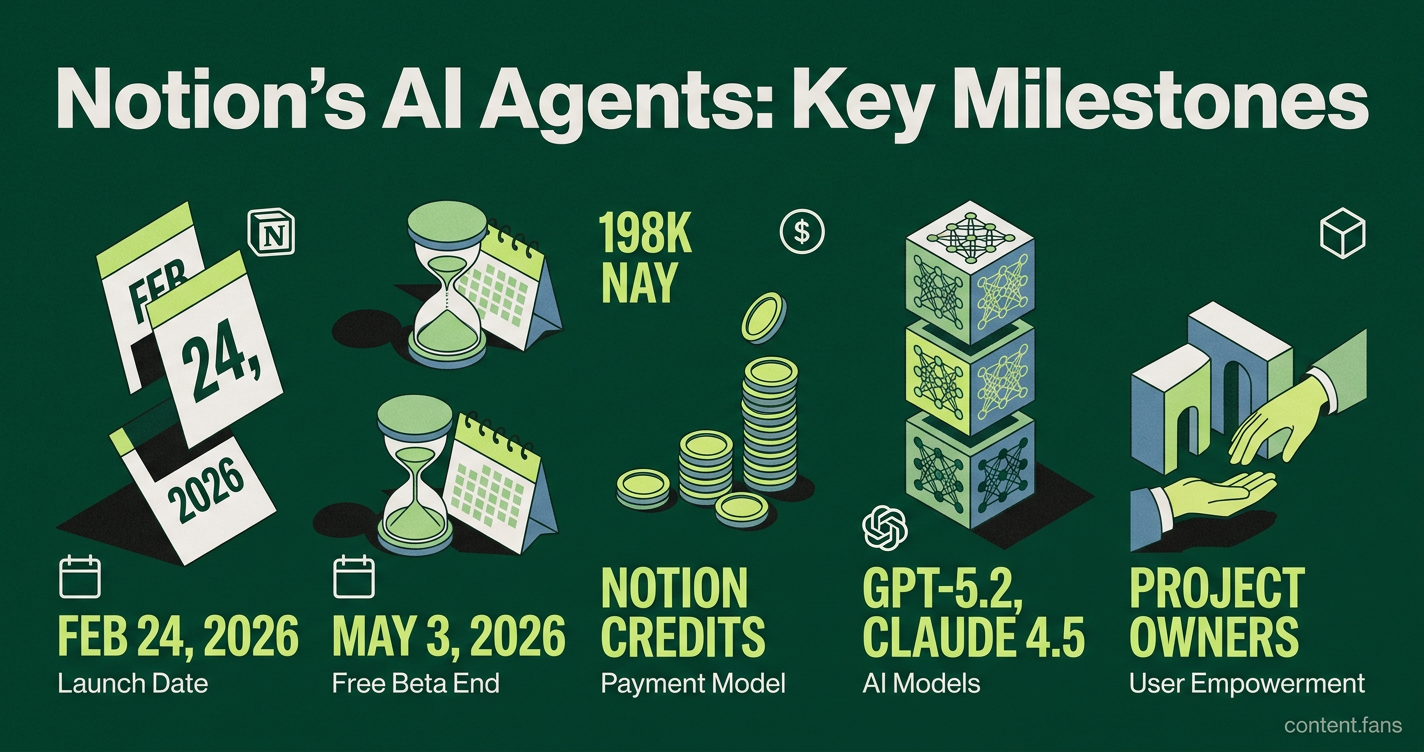
Notion Custom Agents launched on February 24, 2026. The free beta period ended on May 3, 2026. Since May 4, 2026, they require Notion Credits to run. This shift from complex code to simple conversation has democratized AI development for millions. The feature allows users to create powerful automations by describing goals in plain English through workflow logic generated directly from a chat interface.
This report breaks down how Notion's language-first approach is empowering teams and reshaping productivity.
Why Notion is Pivoting to Plain Language Agents
Since February 24, 2026, users can build automations using Custom Agents by describing goals in plain English without needing JSON or API knowledge. Notion executives aimed to eliminate technical barriers, arguing that any knowledge worker should be able to configure an AI agent without writing code. The process involves stating a goal, choosing a trigger, and confirming data access for Custom Agents in Notion, though this differs from the Personal Agent which is purely chat-based and does not require users to manually select triggers or data access in the same way. This approach moves agent creation from a few specialists to the project owners who best understand the workflow's needs.
Notion's Custom Agents are AI-powered tools that users can create without code. By describing a goal in natural language through a chat interface, the platform automatically generates the required workflow, including database connections, triggers, and logic, democratizing automation for all team members.
How a Natural-Language Build Flow Works
Prototypes reveal a conversational wizard that guides users through four key steps: Intake, Configuration, Optimization, and Validation. This process allows for detailed customization, from clarifying questions asked by the AI to tweaking an agent's tone. The system also offers significant flexibility, letting users manually select models like GPT-5.2 or Claude Opus 4.5, or use an "Auto" mode that picks the best model for the job. Notion's Custom Agents feature was officially launched in February 2026. This "Describe and Build" philosophy is already proving viable in third-party tools that connect to Notion, such as StackAI (StackAI walkthrough).
Early Impact on Roles and Metrics
The enterprise world is taking notice. Growing interest in multi-agent systems has been observed across various research groups. As this shift occurs, roles are evolving: business users become "outcome owners" who curate agent behavior, while developers become "AI-native engineers" focused on high-level system design. This empowers sales teams to build follow-up agents and HR teams to automate onboarding without waiting for IT support.
How Notion Compares to the Competition
Notion is entering a competitive landscape that includes AI-first builders like Relay.app and integration-centric platforms like Zapier Central. While rivals offer similar "describe it and build it" features, Notion's core advantage is its unified environment. By creating an agent inside the same workspace where documents, tables, and projects already exist, Notion reduces context switching and keeps intellectual property secure. This deep, native context allows agents to act with full knowledge of a project's history, team structure, and ongoing discussions without complex configuration.