
Notion unveils Custom Agents: Build AI with natural language
Serge Bulaev
Notion has introduced Custom Agents, a feature that may allow people to build AI tools using simple, natural language instead of writing code. Early tests suggest users can describe what they want in plain English, and the system builds an AI agent for them, which they can then adjust further. The new tools aim to make creating AI agents easier, while still giving advanced users options for more complex setups. Reports indicate this could let experts solve their own workflow problems more quickly, and developers might spend more time managing systems than writing basic code. The market for these tools appears crowded, so Notion combines easy setup with options for deeper customization when needed.

Notion Custom Agents are already available (launched in public beta late 2025, fully available 2026), allowing users to build AI teammates using natural language. This initiative, central to Notion's roadmap, empowers non-developers to create sophisticated AI agents by simply describing their requirements in plain English. The platform allows customization of triggers, data sources, and AI models like GPT 5.4 or Opus 4.7.
Notion's official AI Agents release highlights a conversational approach to agent creation with the promise to "just describe what you want." Notion offers enterprise-grade control, connections to custom MCP servers, and the ability to build end-to-end workflows, with an optional pro-code layer for complex logic when needed.
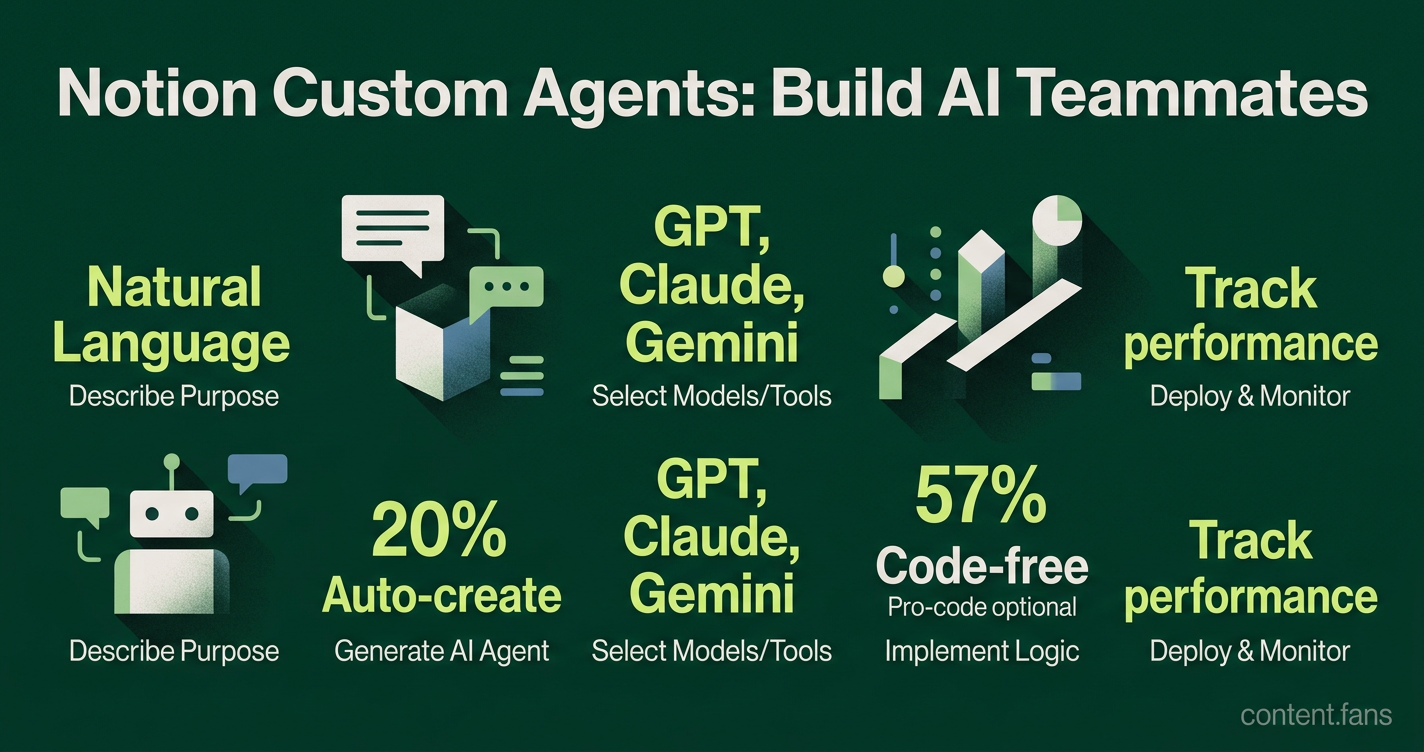
Five-step build flow
The process begins with a user describing the agent's purpose. The system auto-generates the AI agent (teammate) and handles workflows. From there, builders can select AI models and tools, implement agents code-free (with an optional pro-code layer for complex logic), and finally deploy them for monitoring.
- Describe Purpose: Instead of manual node mapping, users provide a brief scenario outlining the agent's goal.
- Generate AI Agent: The system automatically creates an AI teammate based on the description, handling workflows and connections.
- Select Models and Tools: Users can choose from models like GPT 5.4, Claude, or Gemini and integrate external services via the Model Context Protocol.
- Implement Logic: While standard tasks require no code, developers can use advanced features for complex logic.
- Deploy and Monitor: Agents can be scheduled to run continuously, with dashboards for tracking performance and enabling collaboration with other agents.
Development approach
Notion has announced AI Agents and pro-code features as part of their platform evolution. The introduction of no-code agents empowers domain experts to solve their own workflow challenges directly, leading to faster results and fewer development backlogs. This shift allows developers to focus on high-level architecture and governance. Industry analysts note a growing trend toward system orchestration over routine coding, signaling a move toward strategic, system-level responsibilities.
Competitive context
Notion enters the competitive landscape of prompt-based agent builders. Specialized tools like Lindy and Flowise offer dedicated platforms, while enterprise automation suites such as Tray.ai are integrating natural-language capabilities. This crowded market highlights Notion's dual strategy: providing an easy conversational setup for casual users while offering deeper extensibility for power users tackling complex edge cases.
What makes Notion's approach to AI agent creation different from traditional development platforms?
Notion is deliberately lowering the technical barrier that has historically restricted AI agent creation to developers with coding expertise. Users can now build agents by simply describing what they want in plain English, adjusting triggers, instructions, and data sources through conversational interfaces rather than complex configuration. This represents a fundamental shift from the current platform, which requires technical knowledge, to a future where domain experts become the primary creators. The company envisions a workflow where writing job descriptions, specifying triggers, and defining context all happen through natural language - eliminating the translation bottleneck between business needs and technical implementation.
How will natural language agent creation impact different roles within organizations?
The transformation affects both domain experts and developers in complementary ways. Domain experts - including sales managers, finance controllers, and operations staff - can now bypass traditional development cycles and build solutions directly, dramatically shrinking time-to-value. According to industry analysis, this eliminates the bottleneck of filing tickets and waiting for development teams, giving hands-on experts confidence to initiate solutions themselves. Meanwhile, developers are evolving from code writers to agent managers and system architects. Gartner predicts that by the end of 2026, a significant percentage of enterprise applications will incorporate task-specific AI agents. Junior developers face structural displacement from routine coding automation, while senior engineers who design AI-augmented systems and validate agent behavior are entering what analysts call a "golden era."
What competitors currently offer similar natural language agent building capabilities?
Several platforms are competing in this space with varying approaches. Lindy AI stands out as a leading dedicated platform for natural language agent building, allowing users to describe agent roles, tasks, and constraints in plain English with automatic configuration. Flowise offers strong capabilities, combining no-code features with enterprise-grade functionality. For enterprise automation suites, Tray.ai offers natural language workflow building capabilities, while Make's "Maia AI" assistant helps build and troubleshoot automation scenarios conversationally. Zapier Central also competes on integration breadth with natural language prompt features. Unlike these standalone tools, Notion's advantage lies in embedding agent creation directly within the workspace where teams already collaborate and manage knowledge.
What does Notion's roadmap include beyond the initial natural language creation feature?
The roadmap extends toward packaging common workflows for one-click adoption - what Akshay Kothari described as "the step after that is to package it up." This progression moves from individual agent creation to institutional knowledge capture, where frequently needed agents can be distributed across organizations instantly. The vision includes turning domain experts into agent creators who accelerate internal adoption across functions without consuming developer time. Long-term delivery encompasses not just the creation interface but the infrastructure for sharing, versioning, and deploying standardized agents throughout enterprises - essentially building an ecosystem where specialized AI capabilities propagate through organizations as easily as documents do today.
What risks and governance challenges emerge when everyone can build AI agents?
The democratization of agent creation introduces significant enterprise considerations. IT's role shifts from implementation to platform governance and security - as domain experts build their own tools, organizations must establish new guardrails to audit, monitor, and trust AI-generated outputs. Questions of ownership, compliance, and security become critical when non-technical users deploy autonomous systems. Industry analysis warns of accelerated "shadow IT" - if everyone can build apps by talking to an AI, the volume of software inside organizations explodes without centralized oversight. Additionally, enterprises face governance and trust challenges around who owns AI-generated code quality and how to ensure reliability in production environments. Organizations can realize significant savings using no-code platforms versus custom development, but these savings must be balanced against new risks in the ungoverned proliferation of AI agents.