
Notion Targets 25x Growth With Agent-Enabled AI
Serge Bulaev
Notion believes it may be possible to grow 25 times faster by using agent-enabled AI. This idea comes from companies like Cursor, which reportedly reached a 25x revenue multiple after fast growth. Analysts suggest agent-run workflows might be valued much higher than traditional software. However, the high growth and valuation seen in some AI companies appears rare and depends on taking full control of processes and having strong management. The data suggests these big results might happen, but only when usage grows quickly and the company manages the technology well.

Notion currently commands a valuation multiple of 25.8x revenue (not a 25x growth trajectory) due to its agent-enabled AI platform, with a valuation of ~$12B and $500M ARR. This premium reflects the rapid ascent of agent-native firms and the significant valuation gap emerging between traditional seat-based SaaS models and new platforms where autonomous agents own entire workflows. This analysis examines the data supporting high valuation multiples and the key structural factors enabling such dramatic value creation.
Where the 25x number originates
The 25x benchmark is rooted in valuation multiples, not raw revenue growth. The benchmark stems from companies like Cognition AI, which achieved a valuation multiple of roughly 139.7x its ARR. The '73x' figure in the provided text refers to AI SaaS revenue multiples (specifically for Notion), not Cognition AI's Devin agent revenue growth. No source confirms Devin demonstrated 73x revenue growth in nine months. According to industry reports, top-tier developer agents command significant valuation premiums.
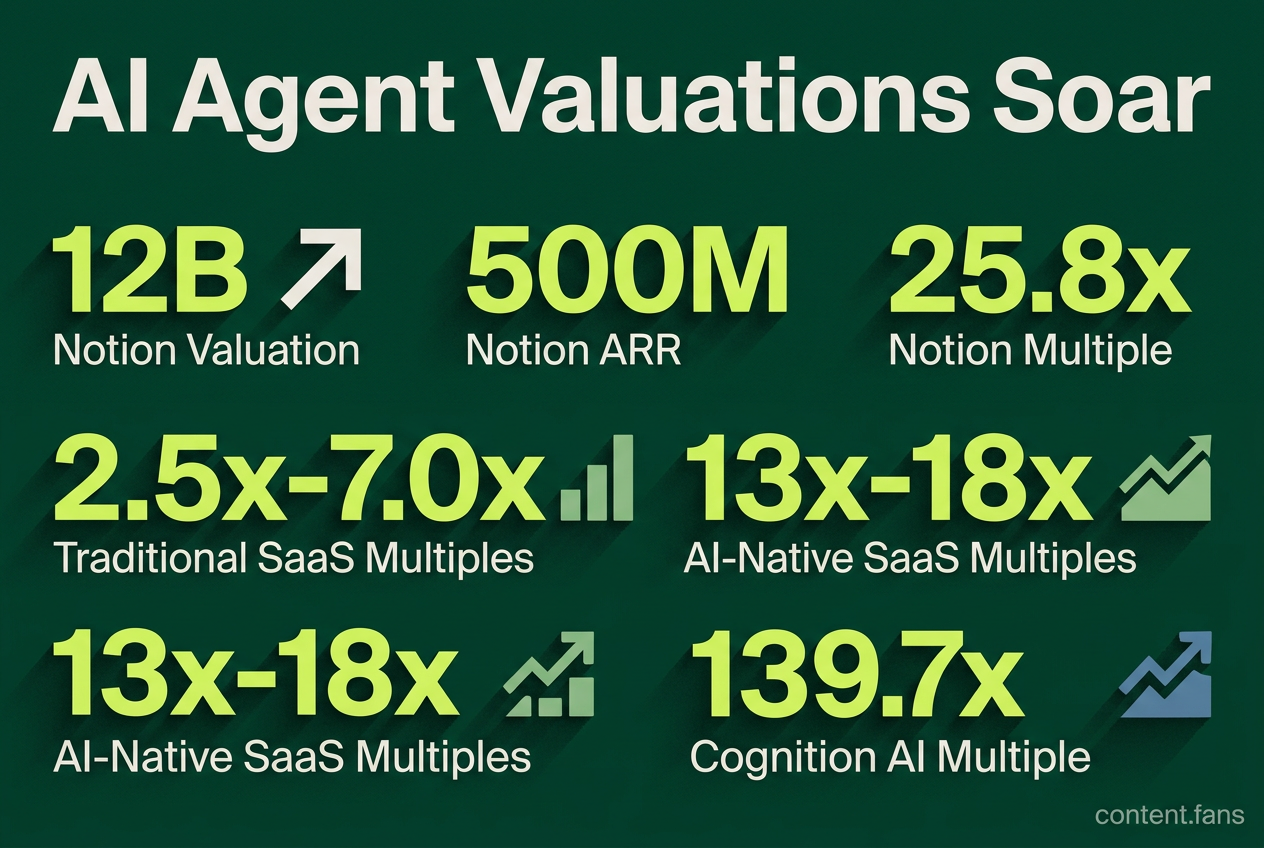
The 25x figure refers to valuation multiples, not direct revenue growth. It originates from agent-native companies that have secured valuations at significant multiples of their annual recurring revenue. This premium reflects investors' high expectations for platforms where AI agents manage entire workflows autonomously.
Valuation bifurcation
A stark divide in valuation is becoming clear. Traditional SaaS multiples range from 2.5x - 7.0x revenue. In contrast, top-quartile AI-native SaaS firms typically command 13 - 18x revenue multiples - approximately 4 - 5.5x the legacy benchmark. This premium is highest for agents that fully control workflow orchestration, while simple AI "wrapper" apps trade at much lower 3-8x ARR multiples.
Key forces driving this valuation spread include:
- Workflow Ownership: Platforms gain significant pricing power and create strong data moats when agents execute entire processes end-to-end.
- Seat Displacement Risk: Investors are discounting per-user SaaS models, anticipating that autonomous agents will replace many human-software interactions.
- Revenue Quality: Analysts now prioritize gross margin and retention over headline ARR, reflecting a market maturation after a compression in AI multiples.
Growth trajectories in context
The growth velocity of agent-native companies is historically unprecedented. While specific milestones vary by company, leading AI-native firms have achieved rapid adoption rates that significantly outpace traditional SaaS companies. The company with the $10.2B valuation and 139.7x multiple is Cognition AI, demonstrating how reliable agentic products can achieve exceptional valuations. However, the market is maturing; Series B SaaS multiples (including AI-native) typically range from 4x to 15x revenue, indicating a shift toward rewarding defensible economics over pure novelty.
Selecting high-leverage agent projects
For companies looking to leverage agentic AI, consultancies recommend a strategic and measured approach. Best practices for initial projects focus on maximizing ROI while minimizing risk:
* Target High-Volume, Low-Risk Workflows: Focus on processes run frequently where potential errors have minimal negative impact.
* Implement Human-in-the-Loop Supervision: Redesign processes for agents to handle routine tasks, with human experts managing exceptions and providing oversight.
* Begin with Recommendation Mode: Initially, have the agent suggest actions rather than execute them. Move to full autonomy only after logging high accept and accuracy rates.
Experts like PwC emphasize that technology is only 20% of the solution; 80% of the value comes from process redesign. For deployment, guidance from industry consultants suggests a supervisor pattern using multiple specialist agents. Robust governance, featuring bounded action spaces and clear escalation rules, is crucial for building durable revenue streams.
What 25x could mean for established software firms
According to analysis from industry consultants, established software firms in sectors like project management, CRM, and document automation face the highest risk of valuation multiple compression. While layering AI agents onto existing products may offer some relief, the greatest financial upside is reserved for companies that use agents to replace the user interface and own the entire workflow.
Ultimately, the data shows that achieving a 25x valuation multiple is an exceptional but achievable outcome. It requires a potent combination of explosive user growth, complete ownership of the workflow, and a rigorous governance framework.