
Notion integrates Git-like version control for AI agent work
Serge Bulaev
Notion added Git-like version control for AI agents in 2026, letting teams track, review, and undo every automated action in their workspace. Companies asked for these safety features because many chat agents had to be turned off or rolled back after mistakes, like data leaks or wrong answers. Notion's new tools include clear histories, easy rollback, and the ability to compare different agent versions, which may help with audits and compliance. The service started charging for custom agent automations after May 2026, and this change suggests Notion will keep using a pay-per-use model. Experts say these updates might show that safety and reversibility are becoming standard for business AI tools.

In May 2026, Notion introduced new developer platform features including Workers, External Agents API, and Database Sync, expanding how teams can build and manage AI agents within their workspace. These updates bring new automation capabilities to knowledge work, though the industry continues to grapple with AI safety and reliability challenges.
Why business users need better AI agent management
Enterprise teams are increasingly concerned about AI agent reliability and safety. While specific industry-wide statistics vary, many organizations report challenges with AI agent outputs, including data exposure incidents and hallucinations that require intervention. Without proper management tools, addressing these issues can be a time-consuming, manual process that causes significant operational disruption.
Research from Microsoft and industry reports highlight the growing need for better AI agent governance. Teams often need to reverse or modify agent actions, but without built-in management capabilities, this process can take considerable time and effort, whereas teams with proper rollback capabilities can recover much more quickly.
In response to these industry needs, Notion has been expanding its agent management capabilities, building on its existing document history and collaboration features. The platform now allows teams to better track and manage automated agent activities within their familiar workspace environment.
How the 2026 releases expanded automation capabilities
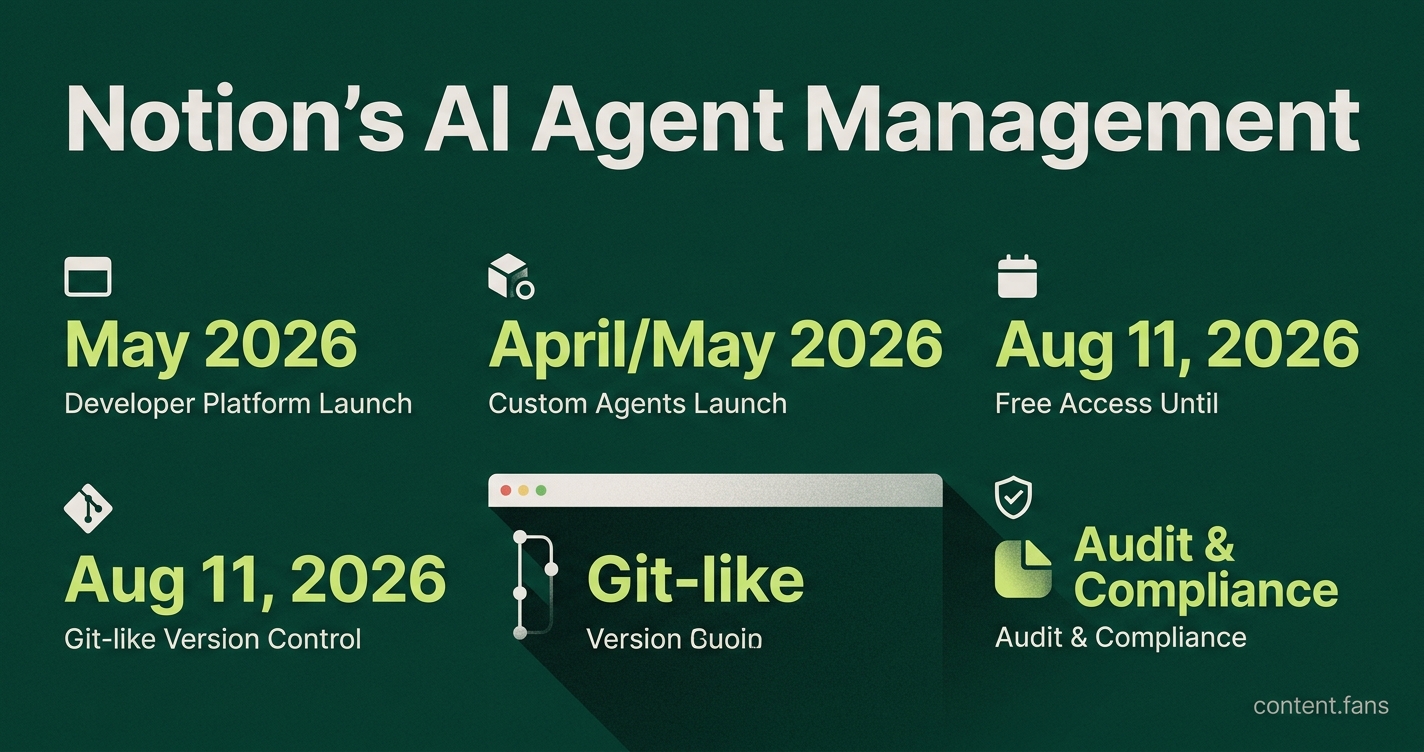
Notion rolled out the Developer Platform (including Notion Workers) in the May 13, 2026 update and Custom Agents in the April/May 2026 updates, enabling hosted runtime and autonomous tasks. The May 13, 2026 Developer Platform update introduced an External Agents API, allowing teams to integrate models like Claude or Codex. This enables users to create automated agents with text prompts, like "Create last week's sprint report every Monday." The platform tracks agent activities within the workspace's existing collaboration and versioning framework.
Management and audit features for enterprise users
For compliance and auditing needs, several key capabilities are emerging:
- Tracking of agent activities within workspace history
- Time-stamped records of agent actions and changes
- Integration with existing document sharing and permission controls
- Ability to manage and modify agent behavior through familiar interfaces
- Version tracking for agent configurations and outputs
Early adopters in regulated industries report that having clear records of agent activities is valuable for audits and compliance requirements. The ability to track which configurations were active at specific times helps meet regulatory documentation needs.
Access and availability
The Developer Platform features (Workers, External Agent API, Database Sync) are free until August 11, 2026. Custom Agents launched in February 2026 and became more widely available through the May updates. This approach allows teams to test and evaluate the capabilities before committing to expanded usage.
Position in the growing AI orchestration market
While competitors like LangGraph focus on developer-centric workflows and IBM watsonx Orchestrate offers pre-built governance features, Notion's approach emphasizes native integration within existing workspace workflows. By building agent capabilities into the same interface teams use daily, Notion aims to reduce the learning curve compared to specialized engineering platforms. As the industry continues to develop better AI safety and management tools, integrating these capabilities into mainstream productivity platforms represents a significant trend toward making robust AI governance more accessible to business users.
How do Notion's AI agent management features work?
Notion has adapted familiar collaboration concepts to AI agent management within workspaces. Instead of separate systems, agent activities are tracked within the same environment where teams manage documents and databases. When an agent creates content or updates information, these actions are captured within the workspace's existing versioning system. Users can review and manage agent activities through the same interface they use for regular collaboration, without needing specialized technical tools.
Why is agent management becoming critical for enterprises?
Many enterprises report challenges with AI agent reliability and consistency. Common issues include unexpected outputs, data handling concerns, and agents behaving differently than intended. Teams without proper management tools often spend significant time manually reviewing and correcting agent actions. Organizations with better agent oversight capabilities can identify and address issues more efficiently.
Can business users set up agents without technical expertise?
Since the May 2026 release updates, workspace members can create autonomous agents by providing instructions in plain English, such as "Create last week's sprint report every Monday." These agents operate within the workspace's existing permission structure and activity tracking systems. The May 2026 Developer Platform upgrade allows integration of external AI models (Claude, Codex, OpenAI) as tracked collaborators within the workspace environment.
How does Notion compare to other agent platforms?
Unlike developer-focused platforms such as LangGraph or CrewAI, Notion integrates agent capabilities directly into a workspace environment that teams already use for daily collaboration. While solutions like IBM watsonx Orchestrate or Amazon Bedrock Agents provide governance features, they typically require separate dashboards and technical integration. Notion's approach emphasizes using the same interface for both human collaboration and agent management.
What are current limitations and considerations?
Agent execution sessions have practical limits for continuous operation and data processing scale, making them suitable for typical knowledge work tasks but not large-scale data processing jobs. As organizations expand their use of AI agents, they should plan for potential scaling needs and budget considerations. The platform continues to evolve these capabilities, though specific timelines for expanded features have not been announced.