
Notion expands AI agent platform for SMBs, hitting 1 million agents in 2026
Serge Bulaev
Notion is making its platform for small and medium businesses (SMBs) more powerful by letting them use AI agents, aiming to lower technical barriers for companies without their own AI teams. Notion says over 1 million agents were built in the first three months after launching Custom Agents in early 2026, which may show strong demand, but does not guarantee lasting success. However, reports suggest about 88 percent of AI agent pilots still fail to become fully used, mostly due to unpredictable results and rising costs. Notion hopes its workflow-focused design could help, but this is based on early opinions, not proven results. Other companies like Taskade, Coda, ClickUp, and Monday.com also offer similar tools for SMBs, but it remains unclear if any can reliably help companies use AI agents in the long term.

As Notion expands its AI agent platform for SMBs, the company is repositioning its popular workspace as a central control plane for artificial intelligence. This strategy aims to give small and medium-sized businesses (SMBs) powerful AI capabilities, lowering the technical barriers for companies without dedicated machine learning teams. Notion is described as a 'control plane' for AI agents across small and medium businesses (SMBs), signaling a shift from a note-taking app. This analysis examines Notion's strategy, early adoption metrics, and remaining challenges for SMBs.
Inside the "AI Agent Hub" play
Notion's AI platform provides small and medium-sized businesses with a hosted environment to build and deploy custom AI agents. It integrates with models like Claude and offers workflow templates to streamline development, removing the need for server management and reducing the high costs typically associated with bespoke AI solutions.
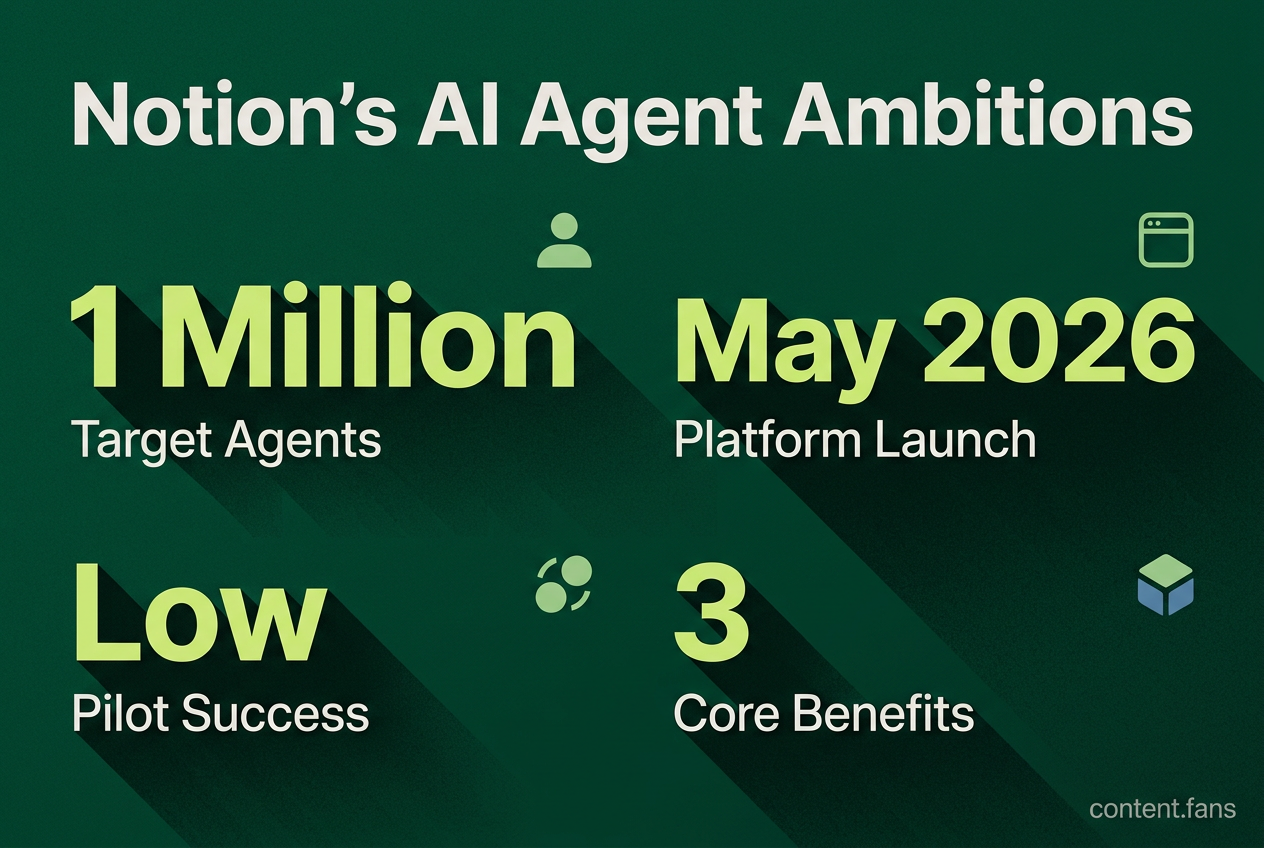
Pivoting from its origins as a note-taking app, the Developer Platform (released May 13, 2026) offers Workers (hosted runtime), an External Agents API (for custom/external agents), Database Sync, and Webhooks. The platform is designed for SMBs that previously could not afford bespoke AI agent development. Following the launch of Custom Agents, users built a significant number of agents in the initial months. While this indicates strong initial demand, it doesn't guarantee sustained adoption. Notion highlights three core benefits for resource-limited teams:
- A hosted runtime that eliminates server management.
- Templates that promote workflow scoping before coding.
- Integrated evaluation tools to monitor agent performance and accuracy.
Why SMB uptake still stalls
Despite the hype, industry benchmarks reveal significant adoption challenges. According to industry reports, a significant portion of AI agent pilots fail to reach production. The primary barriers cited by business leaders are unpredictable, non-deterministic outputs and escalating costs. Industry data shows many pilots show poor ROI after one year. Notion aims to mitigate these risks with its workflow-first design. Proponents argue that by focusing on clear scoping, ownership, and evaluation metrics within the workspace, SMBs can close the gap between pilot and production. However, these benefits are based on early analysis and are not yet supported by audited results.
Competitive options for agent workflows and SMB budgets
The market for SMB-focused AI workflow tools is highly competitive, with several platforms vying to solve the adoption problem. Key alternatives to Notion include:
- Taskade Genesis: Specializes in no-code custom agent and application building.
- Coda AI: Focuses on formula-driven document and database hybrids.
- ClickUp Brain: Integrates agent automation directly into project management tasks.
- Monday.com AI Work Platform: Often preferred for CRM-centric workflows.
- Mem AI: Automates knowledge organization.
Most of these platforms offer entry-level pricing under ten dollars per seat to attract cost-conscious SMBs. Each vendor approaches the challenge differently - from Taskade's no-code focus to Coda's flexible data models - but the shared goal is to make AI agents reliable and valuable for the mass market. It remains to be seen which platform can consistently bridge the pilot-to-production gap.
What is Notion's real target market?
Notion's actual focus is on becoming the control plane for AI agents across small and medium businesses, not just the Fortune 500. Since the launch of Custom Agents, a significant number of agents were built in just three months - a rate that rivals the fastest-growing developer platforms of the past decade. This milestone tracks real adoption rather than hypothetical goals.
How does Notion make AI agents usable for resource-constrained SMBs?
Traditional enterprise-grade agents demand heavy infrastructure and integration budgets. According to industry reports, a significant portion of AI pilots fail to reach production, with the primary causes being unclear scoping/ROI (with many citing 'expecting too much, too fast'), data quality issues, and lack of defined problems. Infrastructure costs are a contributing factor but not the sole barrier. Notion's answer is a hosted runtime with no servers to manage, plus pre-built connectors to third-party agents like Claude and Cursor. In other words, SMBs extend the tools they already use daily, eliminating adoption friction and up-front capital outlays.
What measurable efficiency gains do SMBs see from AI productivity tools?
The broader SMB market shows promising value according to industry reports:
- Significant time savings per employee each week
- Notable productivity lifts in teams that embed AI in daily workflows
- Many SMBs report reduced costs in at least one function, while a substantial portion record higher revenue per employee
These benefits come from growing adoption across small and medium businesses.
Which competitors are also targeting SMBs with low-code AI agents?
Several platforms compete directly with Notion for the same SMB segment:
- Taskade Genesis (starting at $6/month) - strongest for custom agent and app building
- Coda AI (from $10/month) - excels at formula-driven document-database hybrids
- ClickUp Brain (from $7/seat/month) - emphasises project-management automation
- Monday AI Work Platform (from $9/seat/month) - best for CRM-heavy workflows
Each is marketed on ease-of-use and low total cost of ownership, matching Notion's strategy.
What keeps SMBs from scaling AI pilots to full production?
Despite user-friendly platforms, industry data confirms stubborn barriers. Industry data shows that a significant majority of generative AI pilots report zero measurable ROI, with the primary failure driver being unclear scoping rather than poor models. Common issues include:
- Non-deterministic outputs: Many leaders cite unpredictable results as a top production blocker
- Cost creep: Compute, integration, and maintenance expenses often balloon beyond estimates
- ROI failure: Many pilots report poor returns after extended periods
Notion's workflow-first approach - "design the workflow before the agent" - directly addresses the scoping gaps that drive these failures.