
Noam Shazeer leaves Google for OpenAI; US blocks Anthropic's new AI models
Serge Bulaev
Noam Shazeer, a key researcher from Google, will join OpenAI, which may help OpenAI and hurt Google's AI work. The U.S. government forced Anthropic to stop giving access to its newest AI models to foreign users, and Anthropic had to disable them for everyone because it could not separate users by nationality. Some U.S. officials are discussing whether the government should own shares in big AI companies, but no clear decision has been made yet. These events suggest the U.S. is treating advanced AI like important infrastructure, not just regular software.

The news that Noam Shazeer leaves Google for OpenAI while the US blocks Anthropic's new AI models signals a tectonic shift in the industry. These recent developments demonstrate how top talent, major capital flows, and government policy are now intertwined, revealing the high stakes of frontier AI development. This convergence suggests advanced AI is now viewed as strategic infrastructure rather than ordinary software.
Talent signals: Shazeer crosses Silicon Valley's trench
The move of a senior Google AI researcher Noam Shazeer to OpenAI represents a major win for OpenAI and a significant blow to Alphabet's AI program. As a co-author of the seminal 2017 paper on transformer models, Shazeer's transition is a powerful industry signal. It highlights that elite research talent remains the most critical, scarce resource in AI, a factor that compute power alone cannot replace. His new role in model-architecture research is expected to bolster OpenAI's ability to attract other top-tier scientists.
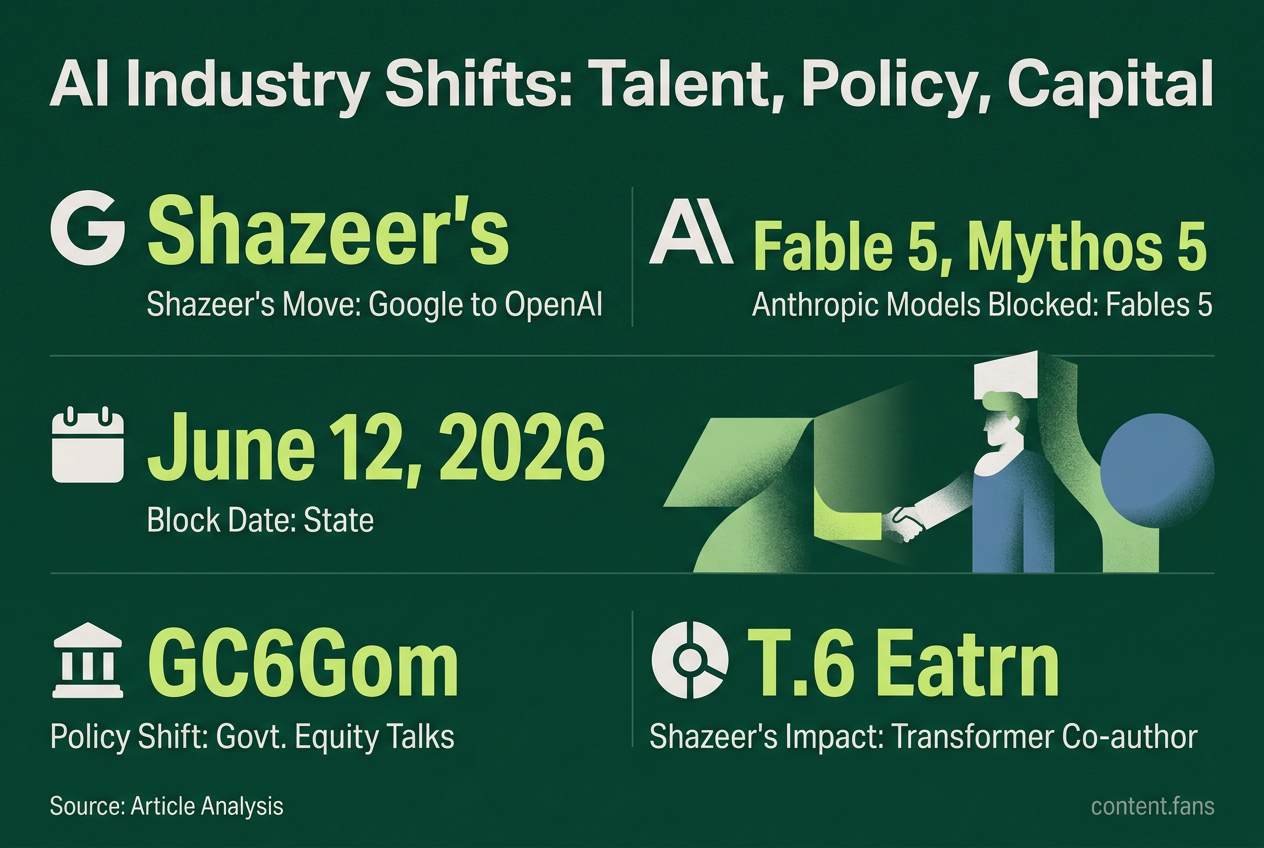
Recent events, including Noam Shazeer's high-profile move to OpenAI and U.S. export controls halting Anthropic's newest models, reveal a significant shift. These developments show that advanced AI is now treated as strategic national infrastructure, directly influencing talent competition, investment flows, and government policy.
Regulation hits production: Commerce pulls the switch on Anthropic
In a move with immediate global impact, Anthropic disabled its Fable 5 and Mythos 5 models globally on June 12, 2026, following a U.S. Commerce Department export control directive citing national security concerns. Described as a "global kill switch," this marks the first time export controls have shut down a live, commercial AI system, likely redirecting demand to competitors like OpenAI and Google DeepMind.
Washington weighs a slice of the upside
Government intervention in AI is expanding beyond security reviews. According to industry reports, senior U.S. officials are now discussing taking voluntary equity stakes in leading AI firms like OpenAI, Anthropic, and xAI. This potential move, possibly managed through a government fund to distribute AI's economic benefits, raises significant questions about valuation and potential conflicts of interest.
Cross-currents to watch
- Talent: High-stakes personnel moves like Shazeer's will escalate salaries and intensify the competition for elite researchers among top AI labs.
- Capital: While cloud providers are crucial investors, the Anthropic shutdown proves that national security concerns can override these strategic financial partnerships.
- Policy: Government actions are evolving from regulation to direct participation, with equity talks and export controls forcing AI firms to negotiate their very ownership structure with the state.
Why did Noam Shazeer's move from Google to OpenAI make such immediate headlines?
Shazeer is not just another engineer - he was a senior researcher at Google who co-authored the influential 2017 transformer paper that helped ignite the modern generative-AI boom. According to industry reports, his resignation to join OpenAI was framed by analysts as both a technical gain and a powerful talent-recruiting signal: OpenAI now has one of the architects of today's LLMs, while Google must scramble to fill a leadership hole just as it tries to narrow the gap with ChatGPT.
How will the U.S. export-control order on Anthropic's newest models affect businesses already using them?
On June 12, 2026 the Commerce Department served Anthropic with a directive to block access to its models citing national security concerns. Anthropic pulled the plug on Fable 5 and Mythos 5 worldwide, making this the first time U.S. export rules shut down a commercial AI model already in public use. Enterprise customers that had integrated the models into chatbots, coding assistants, and research pipelines suddenly lost access, forcing them to fail over to OpenAI or Google DeepMind services and re-negotiate licensing terms.
What role did Amazon play in triggering the federal action against Anthropic?
Amazon had previously invested $8 billion in Anthropic, and in April 2026 announced an additional $5 billion investment with up to $20 billion more contingent on milestones; Anthropic also committed to spend over $100 billion on AWS over 10 years. According to industry reports, internal security teams inside Amazon discovered that carefully crafted prompts could coax Anthropic's latest models into producing cyber-attack instructions, and these findings were reportedly relayed to senior officials. The episode illustrates the tangled incentives when a strategic investor supplies both capital and the infrastructure that the same models run on.
Is the Trump administration really considering owning a slice of OpenAI, and what would that mean?
According to industry reports, senior White House officials have been in discussions about asking frontier labs to voluntarily cede shares to a new government-managed fund. The goal would be to let American households share in AI-driven economic upside rather than a taxpayer-funded buy-out. While no terms are set, the optics alone move AI policy from "regulation" toward state participation and strategic leverage, echoing how semiconductors and telecom are treated as critical infrastructure.
How do these events together re-shape the competitive frontier-AI landscape?
Talent, capital, and policy are now tightly interlocked. OpenAI's recruitment of Shazeer signals to other elite researchers that the firm is the new gravity center, while Google faces the double hit of losing a technical leader and watching its partner Anthropic sidelined by export rules. Amazon, despite its Anthropic stake, reportedly demonstrated it will prioritize security compliance over alliance loyalty, pushing demand toward OpenAI and Google. Meanwhile, the possibility of federal equity stakes raises the stakes for every remaining independent lab to stay on Washington's good side, accelerating a shift from pure software startup to strategic national asset.