
News Trust Hits Record Lows: Only 1 in 4 Americans Trust News
Serge Bulaev
Recent surveys suggest that trust in news among Americans has dropped to record lows, with only about 1 in 4 people saying they trust most news most of the time. Studies also show that while some still trust certain news sources, overall trust in the news as an institution keeps falling. This decline may lead to fewer people paying for news and more advertisers being cautious about where they place ads. Audiences say they want more transparency, accuracy, and engagement from news organizations. Experts believe that steps like clearer corrections and open communication might help rebuild trust, but there is no guarantee these actions will quickly improve public confidence.

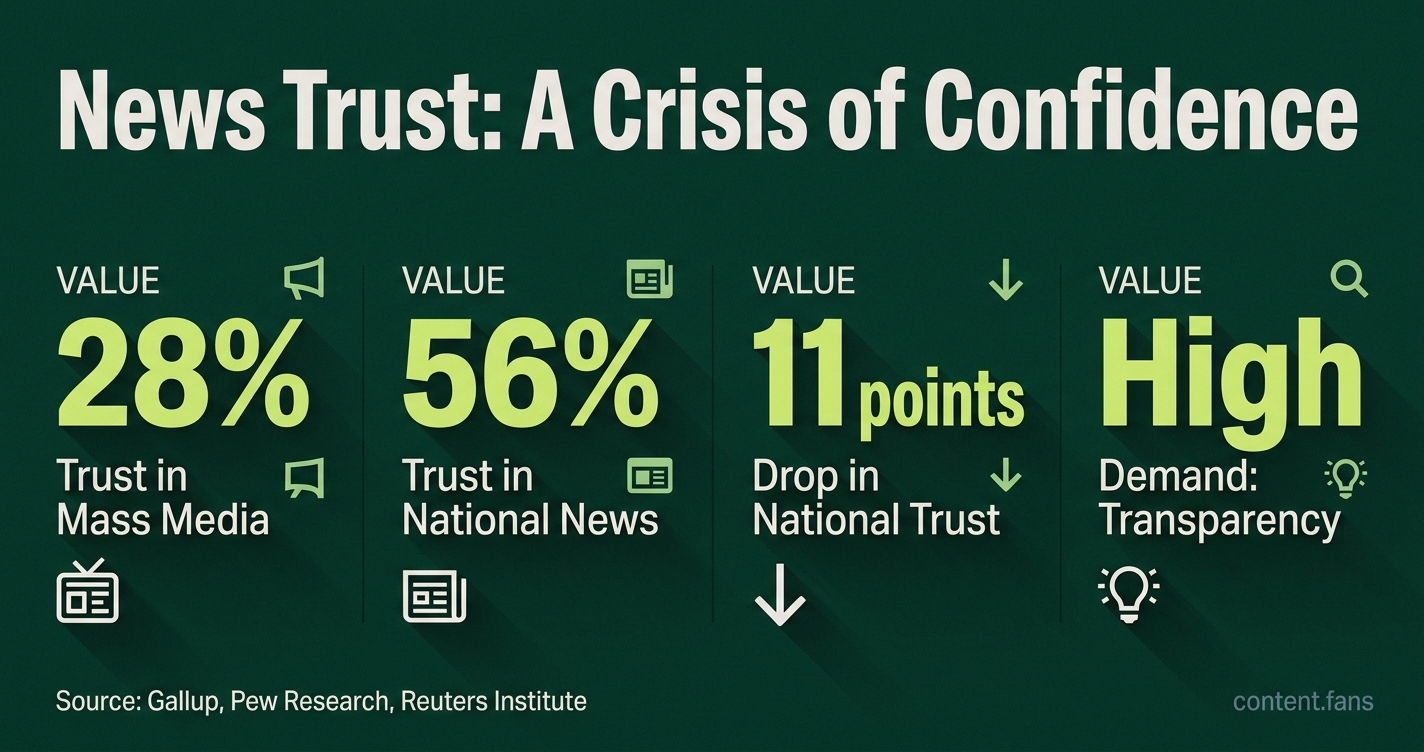
As news trust hits record lows, new data confirms the alarming trend of declining public confidence in media. A recent Gallup poll shows only 28% of Americans have confidence in the mass media to report news "fully, accurately and fairly," tying a historic low (Gallup).
While these headline figures are stark, research from the Pew Research Center adds nuance. Although 56% of people still have some trust in national news organizations, this figure has dropped 11 points since early 2025. This indicates that while audiences differentiate between outlets, overall faith in the institution of news continues to slide.
The Financial and Behavioral Impact of Low Trust
This erosion of trust has direct financial consequences for publishers. Lower audience confidence leads to stagnating subscription growth and increased advertiser reluctance to place ads in news environments. This creates a challenging financial reality where both reader revenue and advertising income are under significant pressure.
The decline in credibility directly impacts publisher revenues and audience habits. Industry analysis highlights stagnating digital subscription growth, particularly among younger audiences who increasingly turn to social media creators for information. Concurrently, eMarketer reports rising advertiser skepticism about brand safety in news, creating a direct financial penalty for perceived bias or unreliability.
Publishers now face a dual threat:
- Fewer site visitors are converting into paying subscribers.
- Advertisers are questioning the value of placing ads in low-credibility contexts.
- Platform algorithms often prioritize social video and AI-generated summaries over traditional news links.
What Audiences Demand from News Organizations
According to industry reports, a clear consensus emerges on what audiences want: greater transparency, accuracy, and engagement. The Reuters Institute Digital News Report emphasizes the public's desire for full disclosure of sources and funding. Meanwhile, research from the University of Oregon points to a demand for solutions-focused journalism and better representation of local communities. The Aspen Institute advocates for "radical transparency," which includes clearly labeling news versus opinion and issuing rapid, visible corrections.
Actionable Steps for Rebuilding Credibility
Based on evidence from INMA, Future Media Hubs, and academic researchers, newsrooms can take several concrete steps to signal accountability and rebuild credibility:
- Publish a Public Corrections Policy: Maintain a corrections log that is prominent and easily accessible on all platforms.
- Show Your Work: Include methodology notes with investigations so readers can understand the verification process.
- Engage with the Community: Host recurring listening sessions and move beyond one-way comment sections to foster genuine dialogue.
- Clearly Separate News and Opinion: Use distinct visual and organizational cues to eliminate audience confusion.
- Define Editorial Values: Post a public statement outlining standards for accuracy, anonymous sources, and funding disclosure.
While these measures are not a guaranteed fix for headline trust figures, experts agree they are essential for demonstrating accountability that audiences can verify over time.
Navigating a Low-Trust Future
The crisis of confidence is forcing a strategic pivot away from traditional business models. Industry analysis warns that "subscription-first models may not scale" amid persistent low trust. In response, publishers are exploring diversified revenue streams, including bundled memberships with lifestyle perks, content licensing for AI development, and specialized data products. On the advertising front, WAN-IFRA data shows slowing growth for news publishers as ad spend shifts toward platforms.
Ultimately, trust metrics remain fragmented. Recent Pew research from October 2025 shows that many Americans have low confidence in journalists acting in the public interest. The Gallup data shows 28% trust in mass media overall. This fragmentation suggests that recovery depends less on grand campaigns and more on consistent, transparent practices that prove a newsroom's value to its community one story at a time.