
New York Law Adds Disclosure Duty for AI Synthetic Performers in Ads
Serge Bulaev
New laws in New York and other places may require companies to clearly label ads that use AI-generated performers and get consent from people whose likenesses are used. Different countries and states have different rules; for example, the EU focuses on transparency, while the U.S. may treat likeness as a kind of property. Companies might need to follow special contract rules and give visible warnings to consumers when AI is used in ads. Platforms could face deadlines to remove flagged content, and not following these rules could lead to legal trouble. There does not yet appear to be a single global approach, so compliance may need to match each area's laws.

The New York law adding a disclosure duty for AI synthetic performers in ads reflects a global regulatory shift, making the legal implications of AI-generated celebrity likenesses a primary concern for advertising, music, and platform compliance teams. The supplied sources show New York expanding post-mortem publicity rights to cover digital replicas and Tennessee prohibiting unauthorized voice cloning; they do not establish the same rule across the EU and China.
While courts have not established a unified global test, the clear trend points toward consent and disclosure as the twin pillars of compliance. According to industry reports, federal legislation is being considered that would require platforms to remove flagged non-consensual intimate deepfakes within specified timeframes. For legal and risk managers, this new landscape demands proactive strategies, including contract language that addresses publicity rights, clear consumer disclosures, and cross-border conflict checks before synthetic talent assets go live.
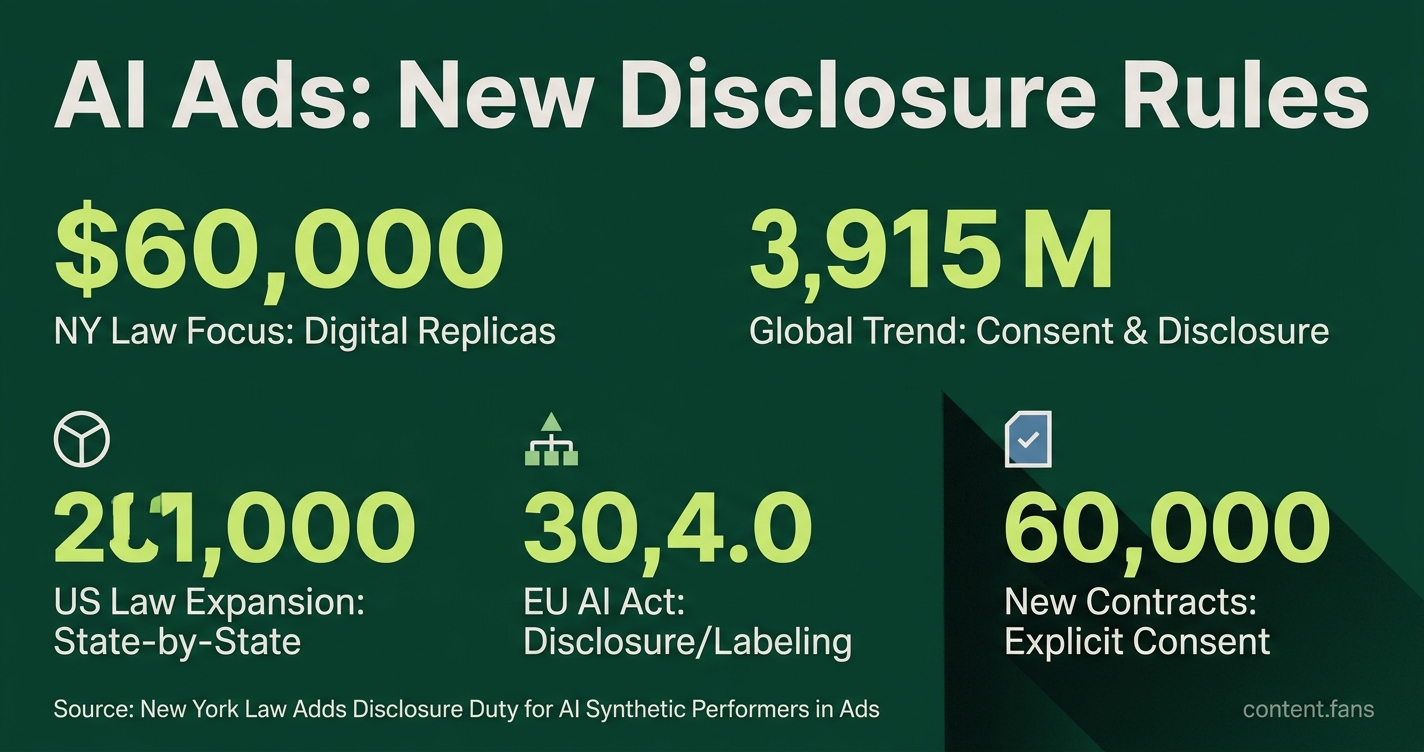
Licensing Scope and Right of Publicity
Companies using AI performers must navigate a complex legal framework. Key requirements often include obtaining explicit consent from the individual whose likeness is replicated, providing clear on-screen disclosures to consumers, and ensuring license agreements specify the exact scope of use, including territory, medium, and duration.
In the U.S., right of publicity laws are expanding on a state-by-state basis. Tennessee's ELVIS Act prohibits unauthorized AI voice mimicry. The New York law described in the linked source is a digital-replica/right-of-publicity framework that includes disclosure obligations in certain ad uses and posthumous publicity protections, but the exact scope in the claim is overstated. These statutes empower talent to negotiate separate fees for AI replicas, requiring brands to meticulously track usage against license terms.
Cross-border enforcement remains uneven. The EU focuses on transparency rather than a property-style right; the EU AI Act requires disclosure/labeling for specified AI outputs and interactions under Article 50, but it does not create an image or voice ownership claim. According to industry reports, many jurisdictions are developing rules that mandate provenance labels and audit logs but place primary liability on distributors, not the entity that created the digital likeness.
Contract Toolbox
Reflecting these legal shifts, entertainment unions and talent agencies are embedding explicit consent requirements into new contracts. According to industry reports, many recent agreements require clear written consent before any employment-based replica is used. A model clause now circulating in fashion endorsements states:
"Talent grants Company a non-exclusive, revocable license to create and use AI-assisted digital replicas of Talent's likeness solely for the approved Project and Channels listed in Exhibit A, within the Territory and Term specified. Any new context - including political or sensitive health content - requires prior written consent."
Consumer-Facing Disclosure Rules
Advertising regulators increasingly treat undisclosed synthetic endorsements as a deceptive practice. Current best-practice guidance calls for a layered approach: a visible label near the asset, a plain-language note explaining the AI's role, and machine-readable provenance such as C2PA metadata. Failure to apply a "Synthetic influencer" label may trigger liability under both New York's commercial disclosure rule and the Federal Trade Commission's clear-and-conspicuous standard.
Bullet checklist for operational risk assessment:
- Verify written consent for every digital replica, including voice cloning.
- Confirm license scope: territory, medium, duration, training use.
- Apply point-of-consumption AI and commercial disclosures.
- Record provenance data and takedown contacts for each asset.
- Map differing takedown deadlines (federal rules versus immediate local demands).
Enforcement Outlook
Platforms face the most immediate enforcement pressures, with proposed federal legislation requiring removal of flagged non-consensual intimate imagery within specified timeframes once notice is deemed complete. State publicity laws give talent statutory damages pathways when an AI ad exceeds its license. This mix of disclosure-first regimes in the EU and property-right models in the U.S. means multi-territory campaigns will require parallel compliance tracks, not a single global playbook.
Who must disclose an AI synthetic performer in New York?
Any ad, promo or public communication that is broadcast, streamed or otherwise published in New York and contains a computer-generated or "materially altered" face, voice or performance must carry a clear, on-screen statement such as "Synthetic performer created with AI". The rule applies to brands, agencies, influencers, streamers and even non-profits if the message is aimed at New York consumers. No disclosure is required for internal training footage or for content that is indistinguishable from a human performance.
When does the duty kick in?
According to industry reports, the disclosure obligation is expected to begin for ads released after a specified future date. For campaigns already in the can, the safest move is to re-edit and splice in the label before release. Civil penalties can be sought by the state Attorney General and range from $500 to $1,000 per day per ad once the grace period ends.
How "clear and conspicuous" is clear enough?
New York follows the FTC-style "clear and conspicuous" standard: the text must appear within the main frame, be readable on a mobile screen, use plain English (avoid "deepfake" or "neural render"), and stay on screen long enough for the viewer to read it once. For video, a persistent lower-third or first-frame card is the safest route; audio-only spots must open with a verbal statement before any synthetic voice speaks.
Does this replace talent consent?
No. The disclosure is separate from the right of publicity. If the synthetic performer evokes a real person (living or deceased within 40 years) you still need written consent from the individual or the estate. According to industry reports, many recent campaigns show the operational split: companies work with talent representatives for likeness approval and then run "Created with AI" labels on every cut-down.
What if my campaign is global?
For cross-border campaigns, stack the strictest rule set: EU AI Act needs a "AI-generated" label, many jurisdictions require both visible and hidden metadata, and proposed U.S. legislation demands prompt removal for non-consensual intimate deepfakes. Build a single master asset that carries the New York wording plus EU/China icons, then geo-filter the render at serve time. Keep an internal log of which label was shown where; regulators are increasingly asking for audit logs and documentation, and some compliance guidance recommends preparing governance and record-keeping evidence through Q3 2026, but the specific ad-tech claim is not directly supported by the provided sources.