
New Playbook Prepares Enterprises for 80x AI Demand Spikes
Serge Bulaev
Enterprises may not realize how quickly demand for generative AI can grow, as Anthropic reportedly faced 80 times more traffic than expected. A new playbook suggests teams should prepare for this by forecasting big growth, using flexible and diverse cloud contracts, and building systems that can work both on cloud and on-premises. It also recommends making clear service agreements that cover uptime and performance, and having plans ready before demand spikes. The guide says teams should regularly update their plans based on real usage and keep adjusting their strategies as things change.

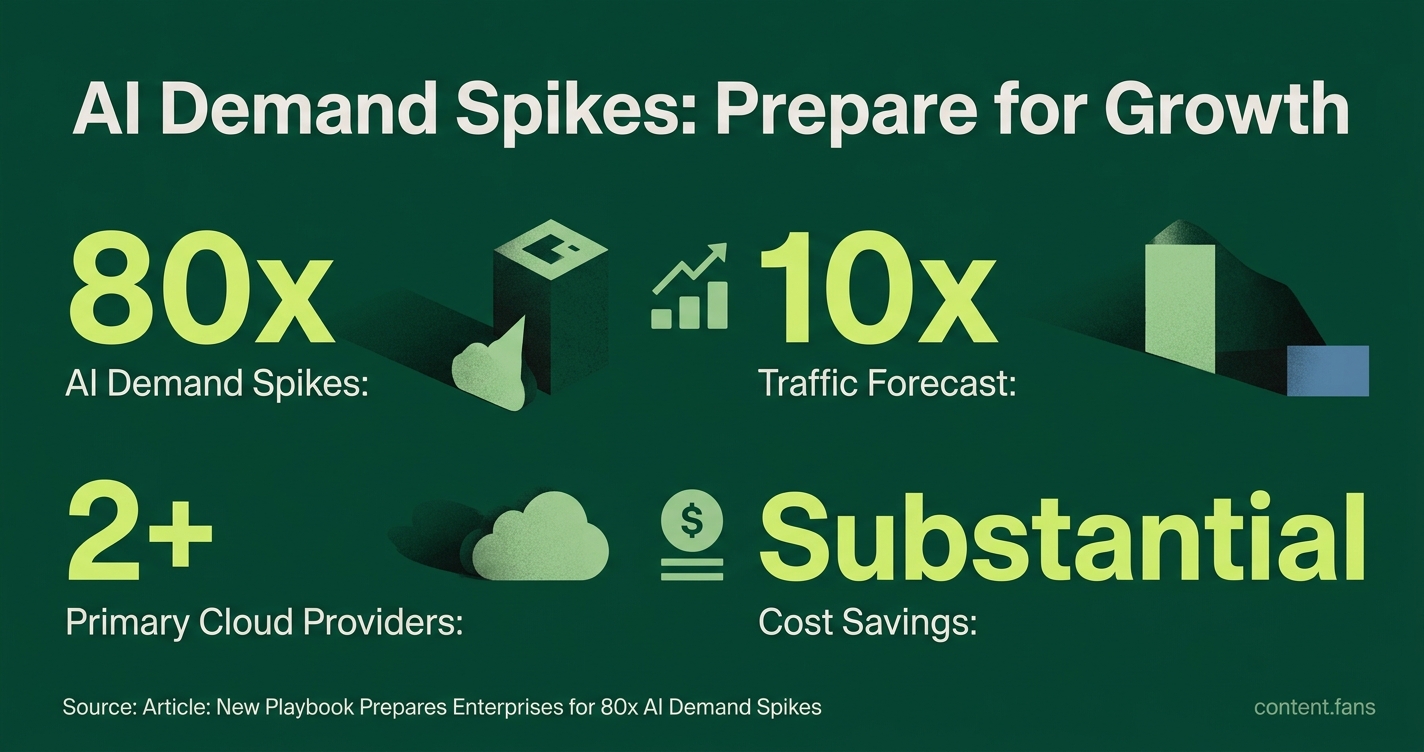
This new playbook prepares enterprises for 80x AI demand spikes from generative AI, a scenario many teams underestimate. For instance, Anthropic reportedly faced 80x more traffic than its 10x forecast, leading to emergency capacity purchases (LinkedIn analysis). To prevent similar crises, this guide provides a strategic framework for treating extreme growth as a core design principle, not an anomaly. It offers actionable steps based on current procurement, architecture, and SLA best practices that should be treated as a living document, evolving with your usage data.
Build Elastic and Defensible AI Demand Forecasts
Effective AI planning involves modeling multiple growth scenarios, from baseline increases to surprise surges. By capturing key metrics like token usage and GPU hours during pilot phases, teams can establish data-driven forecasts and avoid signing unprepared volume deals, ensuring scalability.
- Establish Baselines: Capture essential metrics - including token consumption, API calls, and GPU hours - for every active model. Without this metered pilot data, you are not prepared to negotiate high-volume contracts.
- Model Multiple Scenarios: Develop forecasts for distinct outcomes including steady growth, upside cases, and surprise surges. Concentrated demand spikes are plausible, even as global AI compute grows.
- Assess Vendor Risk: Proactively map your vendor concentration risk. Many industry experts suggest that buyers should be prepared to pivot between providers to maintain capacity access.
Diversify Procurement Before Capacity Vanishes
Anthropic's strategy of securing parallel deals with providers like AWS, Google, and Nvidia serves as a powerful template (Substack breakdown). To secure your supply chain, replicate the approach:
- Maintain Diverse Contracts: Secure contracts with at least two primary cloud providers and have a secondary provider on standby.
- Negotiate Flexible Tiers: Structure deals with commitment credits and consumption bands that scale favorably as your usage increases.
- Implement Cost Controls: Embed "circuit breaker" clauses in contracts to automatically pause non-essential workloads if spending exceeds predefined limits.
Adopt a Hybrid Architecture to Balance Cost and Performance
A hybrid architecture can yield significant savings, with many organizations reporting substantial cost reductions by routing production inference to on-prem or edge clusters. This approach allows you to keep sensitive data local while bursting to public cloud GPUs for experimentation. Key design elements include:
- Unified Control Plane: Manage all cloud and on-prem resources from a single plane with consistent resource tagging.
- Portable Model Packaging: Ensure models can be redeployed across diverse hardware like GPUs, TPUs, or AWS Trainium without requiring code changes.
- Transparent Unit Economics: Utilize FinOps dashboards to track real-time cost-per-model and other critical unit economics.
Negotiate SLAs That Measure What Truly Matters
Standard availability metrics are not enough. Your Service Level Agreements (SLAs) must independently track API uptime, model serving health, and response latency. A robust SLA package should specify:
- Guaranteed Uptime: High monthly uptime targets calculated on a rolling basis.
- Performance Targets: Clear p95 end-to-end latency goals and clauses that define degraded performance.
- Automatic Service Credits: Credits that are automatically applied and escalate over time during extended breaches.
- Model Lifecycle Policies: Notice periods vary: Azure OpenAI GA models get 12-18 months; general API deprecation recommendations are 60-90 days minimum but not guaranteed.
Prepare Operational Runbooks Before a Demand Spike
Proactive planning is essential for managing service interruptions and traffic surges. Your operational runbooks must define clear, pre-approved procedures for:
- Intelligent Queueing: A strategy to route overflow traffic to a lower-cost model or temporarily degrade response speeds for non-critical services.
- Automated Failover: Pre-configured DNS or service mesh rules that can instantly shift traffic between regions or vendors without manual intervention.
- Systematic Post-Mortems: A standardized template for post-incident reviews that quantifies business impact and feeds insights back into your forecasting models.
This playbook is not a one-time setup; its value lies in continuous iteration. Establish a cadence of quarterly reviews to compare forecasts against actual usage. Use these insights to refine your strategies across procurement, architecture, and operations by updating contracts, capacity reservations, and runbooks to reflect the evolving AI landscape.
How should enterprises forecast AI demand when historical data ranges from 10x to 80x growth?
Start by building three parallel capacity models: baseline 10x, stretch 40x, and black-swan 80x. Lock in the first 12 months with firm purchase orders, then negotiate rolling quarterly true-ups that let you adjust volume within reasonable ranges without price penalties. Track token-per-active-user and GPU-minutes-per-workload every week; these two metrics flag inflection points weeks before a spike. Finally, pre-approve a "shadow budget" equal to a significant portion of annual AI spend that finance can release quickly - this is the type of top-up Anthropic needed during its 80x surge.
What clauses matter most in large AI compute contracts?
Push for separate SLA clocks: one for API availability, one for model serving, and one for human escalation. Require high uptime targets on each clock independently; vendors often report high availability while the model itself is degraded. Insist on automatic service credits triggered by telemetry data, not customer tickets, and escalate the credit rate as outages persist. Cap scheduled maintenance with advance notice, and negotiate adequate notice before any model deprecation. These terms are already being granted to Fortune 500 buyers who ask early.
Cloud, on-prem, or hybrid - which path controls cost at 80x scale?
Move to hybrid by default once monthly cloud GPU spend crosses significant thresholds; many organizations save substantially versus cloud-only at this scale. Place training and batch inference on reserved on-prem GPUs where you lock in multi-year pricing, and keep burst or experimental workloads in the cloud with spot instances. Use edge nodes for low-latency use cases; reduced latency can improve conversion rates in customer-facing AI products. Finally, tag every workload with a data-gravity score; if moving the dataset costs more than a significant portion of the compute bill, keep the model next to the data.
How do you stop agentic AI from causing a budget overrun?
Insert "circuit-breaker" clauses in every consumption-based contract: daily spend caps, hourly API call ceilings, and automatic shut-off when cost-per-inference significantly exceeds recent averages. Some enterprises have seen substantial over-runs when agent loops go viral; circuit breakers can halt runaway costs. Require vendors to expose real-time usage dashboards and give finance read-only API keys so procurement can monitor without engineering tickets. Review caps monthly, not quarterly; agentic spikes can happen rapidly after launch.
What fallback sequence keeps the product live when the primary model is down?
Design a three-tier fallback:
1) Same-vendor model swap (e.g., GPT-4 to GPT-3.5) in under 30 seconds
2) Cross-vendor failover (Claude, Gemini) via a traffic-splitting gateway within 5 minutes
3) On-prem small model (7-13 B parameters) for read-only features within 15 minutes
Maintain a golden test suite of production prompts; any fallback model must score within acceptable ranges of the primary on this suite or the tier is considered unavailable. Run a chaos test monthly where you kill each tier for limited periods; teams that practice this significantly reduce revenue-losing outages.