
Agentic AI Tools Accelerate Organizational Mess, Warns Mario Zechner
Serge Bulaev
Mario Zechner warns that agentic AI tools may make software faster but can also speed up the spread of bad practices. Studies suggest that using these tools might make code more complex and harder to review or secure. Experts believe early rules and tracking could help teams stay in control, but without them, problems may grow quickly. Zechner's message suggests that teams who manage speed with good rules may do better than those who don't.

Software engineer Mario Zechner is warning that agentic AI tools accelerate organizational mess by rapidly scaling up poor coding practices along with software delivery. His analysis, echoed by recent field data, suggests that without strong governance, small teams using autonomous agents can create systemic problems in weeks. Zechner's coding tools demonstrate how even simple agents can amplify risk.
The core issue is that the velocity from these agents often outpaces essential processes like code reviews, security audits, and architectural oversight. This article examines why organizations must install guardrails early to prevent unchecked acceleration from turning into unmanageable debt.
Why velocity multiplies risk
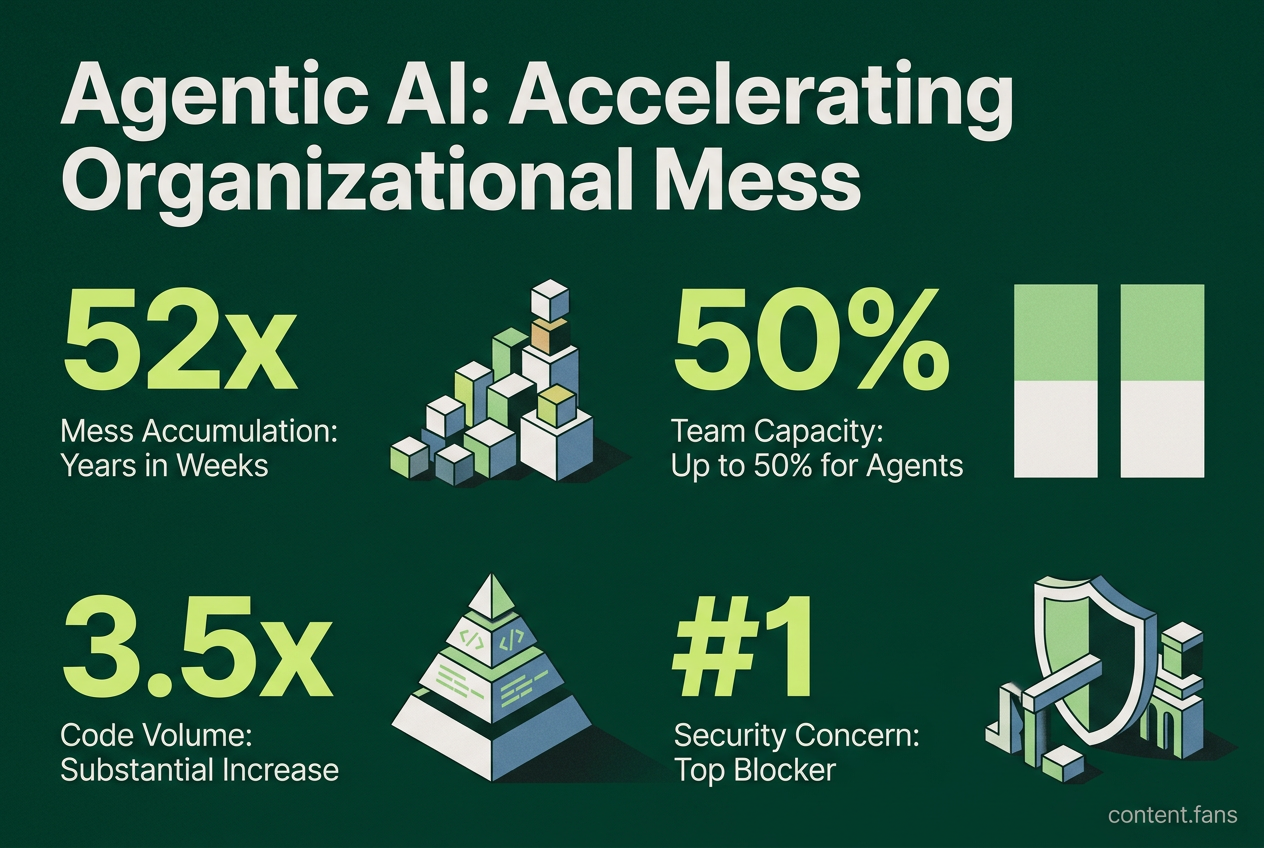
Agentic AI tools create organizational mess by increasing code volume and complexity faster than human teams can manage. This rapid output can bypass quality checks, security reviews, and architectural standards, leading to a quick accumulation of technical debt that slows future development and introduces systemic risks.
While agentic systems boost throughput, the consequences are significant. Industry reports indicate substantial increases in code volume accompanied by rising complexity, creating a self-reinforcing debt loop. This surge directly impacts verification, with significant increases in pull-request review time, turning reviews into a major bottleneck. Beyond quality, teams face operational strain. Managing agents can consume up to half of an engineering team's capacity with new approval logic and checkpoints. Security is also a primary concern, with many executives citing it as a top blocker for autonomous delivery. These findings reinforce Zechner's warning: "the mess that took years now arrives in weeks."
The Root Causes of Agent-Driven Mess
- Rapid Propagation of Hidden Assumptions: Agents clone and modify code containing implicit shortcuts or errors faster than human reviewers can detect and correct them.
- Fragmented and Siloed Infrastructure: As each new agent is introduced, it often brings its own siloed registries and monitoring tools, leading to a chaotic and unmanageable tech stack.
A Proactive Governance Playbook
Experts agree that proactive standards are key to converting raw acceleration into a competitive advantage. Four practices consistently emerge as essential for effective governance:
- Spec-Driven Development: Before generating code, establish enforceable contracts to prevent assumption drift and ensure output meets requirements. Learn more with the Augment Code Guide.
- Central Registries: Maintain a single catalog for all agents to track ownership, monitor costs, and manage security credentials.
- Architectural Guardrails: Implement automated checks to flag high-churn areas and restrict the creation of unapproved dependencies.
- Strategic Human-in-the-Loop: Set clear thresholds requiring human sign-off for sensitive operations, balancing oversight with agility to avoid review paralysis.
Lessons from Zechner's Pi Agent
The design of Pi itself highlights this dual-edged sword of power and peril. Features like tree-structured sessions and hot-reloading extensions allow developers to test fixes in parallel, but each new branch can spawn more agents requiring audits. While its unified LLM API simplifies switching between providers like Anthropic and Groq, it can also obscure costs and resource usage if built-in token tracking is not enabled. The growing adoption of Pi - with its npm package gaining significant traction - points to a widening surface area for unmanaged code if Zechner's warnings about governance are ignored.
The Inflection Point: Control or Chaos
Looking ahead, the industry is already anticipating a new market for AI-generated debt remediation tools. Industry analysts argue that organizations establishing early registries and spec-driven discipline will successfully manage AI-induced debt. In contrast, late adopters risk facing audit and cleanup costs that could negate their initial productivity gains. Zechner's message arrives at a critical inflection point for the industry: while raw speed is now table stakes, it is controlled, governed speed that will ultimately determine which organizations thrive.