
New Laws Force Brands to Disclose AI-Generated Celebrity Likenesses by 2026
Serge Bulaev
New laws in some U.S. states will require brands to clearly say when they use AI-created versions of celebrities in ads by 2026. There is no single federal rule yet, but states like Tennessee, California, and New York have put in or will put in special rules to protect celebrity rights and require clear labels. Brands may need written consent from the celebrity or their estate if the fake image or voice can be recognized and looks like an endorsement. Companies are encouraged to keep careful records, add labels, and be ready to act if there is confusion or complaints. This approach suggests that safe AI advertising may depend more on good permission, open labeling, and record-keeping than on new technology.
New York law requires disclosure when synthetic performers are used in ads distributed to New York audiences, effective June 9, 2026. This creates compliance challenges for advertising teams who must develop new workflows to meet disclosure requirements and navigate varying state regulations around AI-generated content.
Core Legal Checkpoints (2024-2026)
With no single federal rule, brands must navigate overlapping state laws. Key legislation includes Tennessee's ELVIS Act, New York's synthetic-performer disclosure law effective June 9, 2026, and California laws governing digital replicas/publicity and AI transparency; the provided sources do not support the specific identification of California 'AB 1836' as the post-mortem-rights law link, link.
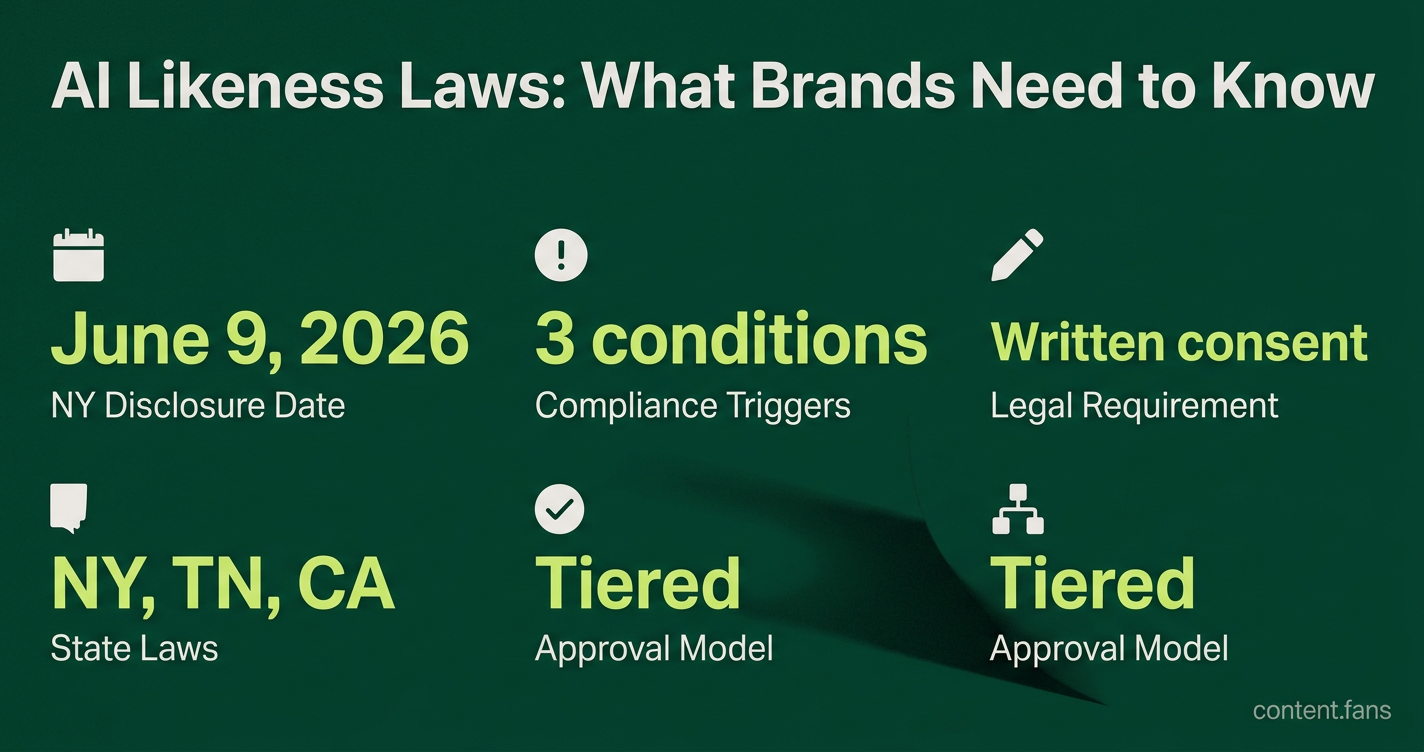
A patchwork of state laws, not a single federal rule, governs the use of AI celebrity likenesses. By 2026, New York requires conspicuous disclosure for synthetic performers in ads, while California and Tennessee have related but not identical publicity-rights and AI-rights rules; the consent and disclosure requirements are not uniform across all three states.
These laws share three triggers for compliance: the likeness is clearly identifiable, its use is commercial, and it implies an endorsement. If these conditions are met, securing written consent from the talent or their estate becomes a non-negotiable legal requirement.
Operational Workflow: Keeping AI Ads Brand-Safe
Effective governance relies on a tiered approval model. A risk-assessment form should flag any asset using a real person, voice clone, or celebrity-adjacent style, routing high-risk content to legal teams. Best practices, such as those outlined in The Invisible Playbook, emphasize preserving provenance metadata and requiring dual sign-offs for all celebrity-like content link.
Integrate a pre-flight checklist into your Digital Asset Management (DAM) or project management tools:
- License Verification: Confirm written licenses for images, voices, and all digital replicas.
- Provenance: Embed C2PA or similar metadata before export.
- Disclosure: Add legally required disclosure language.
- Approvals: Log all human approvals with dates, roles, and version IDs.
- Monitoring: Establish a 24-hour monitoring protocol for public comments and takedown requests.
Monitoring, Escalation, and Auditability
Post-launch vigilance is critical. Brands must actively track social media feedback and formal complaints for signs of consumer confusion. A pre-approved crisis plan, including takedown scripts and a clear escalation matrix with owners in legal, creative, and comms, ensures swift action.
Robust audit trails are your best defense. Maintain immutable logs that show who approved each asset, when they did it, and which license file was referenced. This documentation is essential for demonstrating good-faith compliance to regulators or in the event of a legal challenge.
Ultimately, responsible AI advertising relies on foundational marketing principles, not technological solutions. Success hinges on securing clear permissions, providing transparent disclosures where required, and maintaining meticulous documentation throughout the entire campaign lifecycle.
What counts as an "AI-generated celebrity likeness"?
It is any synthetic image, voice, or digital replica that an average consumer would recognize as a specific real person. The key factor is recognizability, not the technology used to create it. This includes deepfakes of living stars and photorealistic models resembling deceased icons, both of which can trigger disclosure duties under new state laws.
Which new laws force the 2026 disclosure deadline?
The primary driver is New York's A8887-B, which requires a "conspicuous disclosure" for synthetic performers in ads starting June 9, 2026. This is supplemented by Tennessee's ELVIS Act, which protects people's voice, image, and likeness from unauthorized AI cloning or simulation, and California laws governing digital replicas. With no federal standard, brands must comply with the strictest state laws and general FTC truth-in-advertising rules.
How can brands secure proper consent from a celebrity or their estate?
Use a detailed, three-point consent letter that specifies: (1) rights to face, voice, and all derivative digital replicas; (2) all channels, geographies, and campaign durations; and (3) explicit permission for post-production AI edits. For deceased celebrities, ensure the estate provides signatures. Store all signed agreements and communication logs in an auditable folder.
What is an effective pre-approval workflow for AI content?
Implement a tiered review process. Tier 1 (Automated): Use an identity-matching tool to flag resemblances to real people. Tier 2 (Human Review): Have a brand safety manager assess risk and escalate sensitive assets. Tier 3 (Legal Sign-off): Require legal approval for any content using a synthetic performer or implying an endorsement. Document every step with timestamps and C2PA provenance data.
How should we monitor campaigns for misuse after launch?
Establish an "always-on" monitoring system. Combine social listening tools to detect audience confusion, regular reverse-image searches to find unauthorized uses, and an escalation playbook with pre-written takedown notices. This allows your team to respond to issues within hours, not days. A quarterly third-party rights audit can further ensure ongoing compliance.