
New AI Regulations Threaten Competition, Favor Large Firms
Serge Bulaev
New AI rules may make it harder for small companies to compete because testing and certification can be expensive. Research suggests that strict entry rules often lead to fewer competitors and help large companies stay ahead. Experts suggest that to keep markets open, rules should match the level of risk, be clear, and allow one test to count in many places. Some believe it is possible to make AI both safe and fair, but this will require rules that can be updated as things change.

Emerging AI regulations threaten competition by potentially favoring large, established firms over smaller innovators. The specifics of new rules - such as testing thresholds, evaluator accreditation, and certification costs - can create significant barriers to entry. This analysis explores how these regulatory design choices function, their historical impact on competition, and what safeguards can preserve market openness while ensuring AI safety.
Why compute thresholds and third party tests matter
Anthropic co-founder Dario Amodei, in his essay "Policy on the AI Exponential," proposes mandatory third-party testing for frontier models exceeding a certain compute threshold. This framework would cover key risks like cybersecurity, with government-accredited organizations conducting tests and regulators having the power to block deployment (Amodei essay). While targeting only the largest AI systems, the process could impose high fixed costs, disadvantaging smaller newcomers.
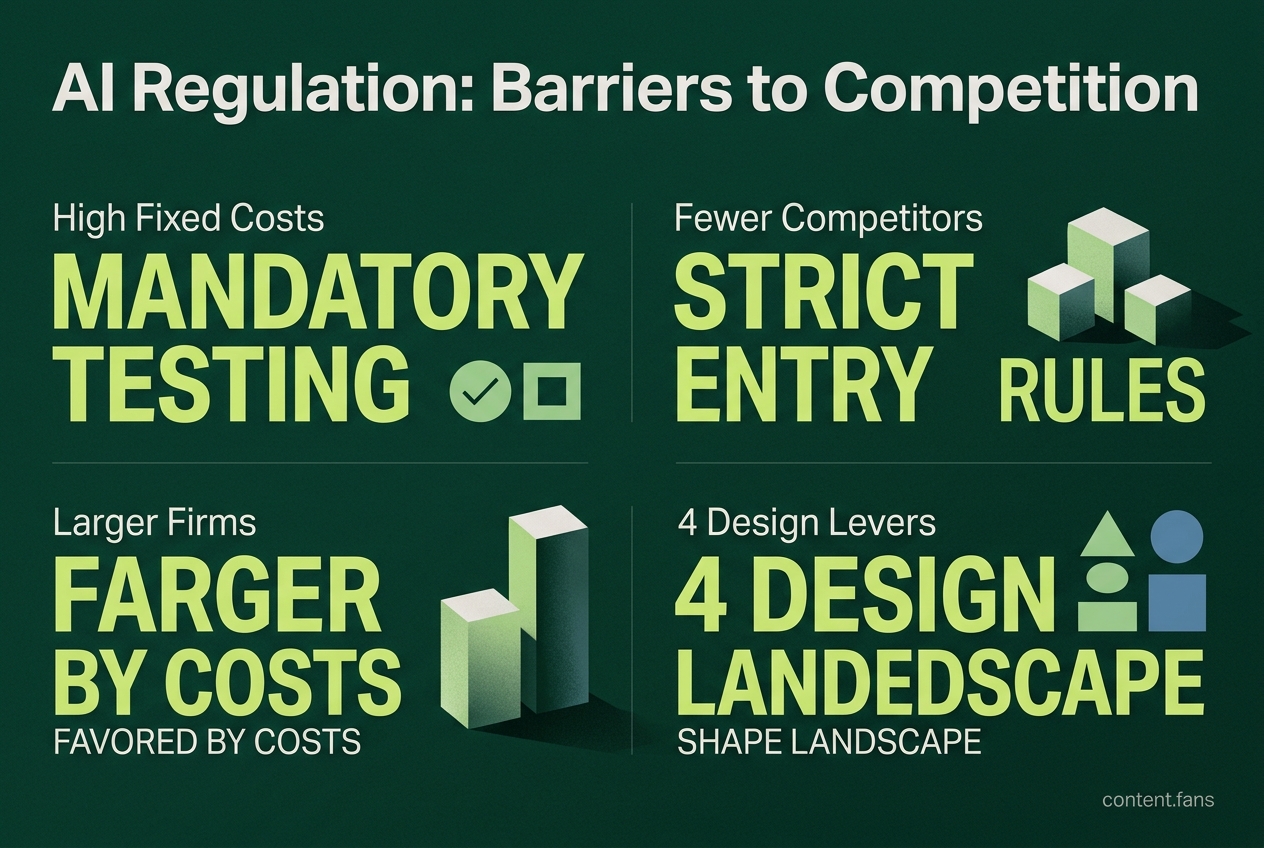
AI regulations can threaten competition by imposing high fixed costs for mandatory testing and certification. These expenses are often easier for large, well-funded firms to absorb than for smaller startups. This disparity can create significant barriers to entry, reduce the number of competitors, and entrench market leaders.
This concern is supported by historical data. A comprehensive IMF industrial study across 64 nations found that strict bureaucratic entry rules correlate with fewer competitors and larger average firm sizes, especially in industries that would otherwise have low entry barriers. Similarly, industry reports suggest that rising regulatory costs have been linked to challenges for smaller firms relative to larger ones, indicating that safety rules can inadvertently favor incumbents if compliance costs are not scalable.
Thought Leadership - Who Designs AI Regulation Will Decide the Competitive Landscape
An analysis of current regulatory proposals reveals four key design levers that can determine the competitive landscape as much as they ensure safety:
- Threshold Setting: At what level of computational power or capability does a model trigger a mandatory review?
- Evaluator Accreditation: Who is authorized to certify AI models, and how transparent and accessible are the accreditation criteria for these certifiers?
- Test Portability: Can a single safety and compliance audit be recognized across multiple jurisdictions, or must firms undergo redundant, costly testing?
- Revision Clauses: How frequently are regulatory thresholds and standards reviewed to account for rapid advances in hardware and AI capabilities, preventing outdated rules from stifling the market?
Design principles that may preserve openness
To mitigate the anti-competitive side effects of regulation, policymakers and industry experts have proposed several core principles:
- Proportionality: Regulatory burdens, such as documentation, red-teaming, and disclosure requirements, should scale directly with the model's assessed risk level.
- Transparency: The standards for licensing evaluators and the specific evidence required for model certification must be published and made clear.
- Portability: Create a framework where an accredited test report from one recognized body is accepted by multiple regulatory authorities to avoid duplicative efforts.
- Time-Bound Rules: Implement "sunset clauses" or mandatory review schedules for compute thresholds and audit standards to ensure rules evolve with technology and do not permanently lock in market structures.
A balanced implementation path
A balanced implementation path would integrate these principles directly into the regulatory framework. This could involve dynamic compute thresholds indexed to hardware progress, the development of open-source reference tests by independent bodies, and streamlined accreditation for new, qualified evaluators. Economic theory suggests that lowering fixed compliance costs fosters market entry and innovation. By focusing the most stringent audits on high-risk frontier models while reducing barriers for others, it is possible to achieve the dual goals of safety and a competitive, dynamic AI ecosystem. Success, however, will depend on continuous empirical review and adaptation rather than a static set of rules.