
New AI Red-Teaming Framework Defines 2026 Release Standards
Serge Bulaev
Companies aiming to launch strong AI systems in 2026 may face unexpected safety problems and strict legal deadlines. A new Red-Teaming and Release Framework suggests that careful security testing and regulatory steps should happen before and after each release. Experts believe continuous testing, rotating testers, and careful tracking of issues could help catch problems early. Phased rollouts and detailed documents for regulators may reduce the chance of large recalls. These steps may point to a shift where steady safety checks and teamwork are as important as quickly releasing new features.

In March 2026, NIST published AI agent red-teaming guidance and announced an AI Agent Standards Initiative focused on security and interoperability for agentic AI systems. Faced with unpredictable safety failures and evolving legal deadlines, firms must now treat this operational checklist as a primary launch blocker, on par with model quality. This guide distills the requirements from regulators and security experts.
Red-Teaming and Release Framework: building a pipeline that never sleeps
This framework mandates continuous adversarial testing, starting before the first beta and repeating after every significant update. It requires a detailed operational checklist to scope risks, assemble prompt libraries, test in isolation, classify findings, and block releases until critical issues are resolved.
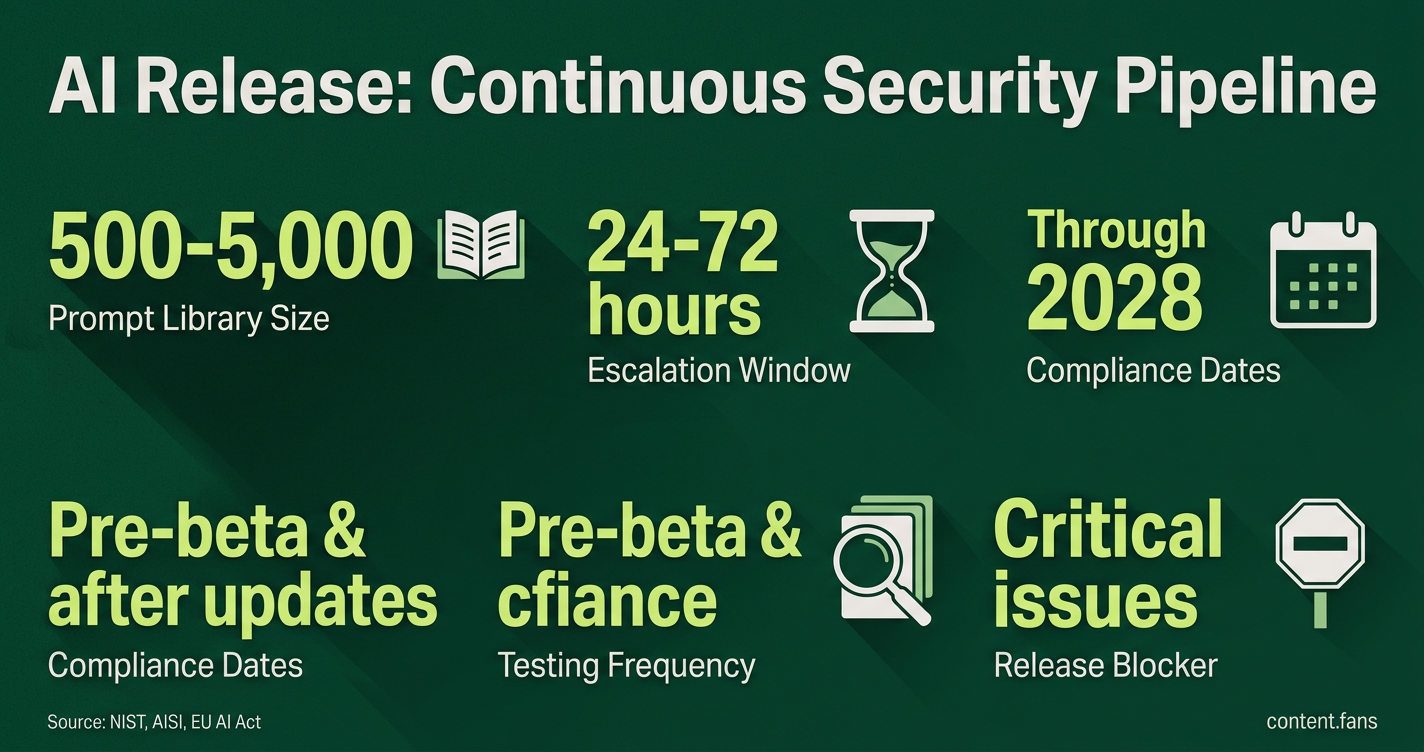
While early guidance favored one-off penetration tests, current playbooks mandate that adversarial testing begins pre-beta and continues after every update. The AISI methodology guide requires red teaming "before the release of the target AI system" (AISI methodology guide), while industry reports suggest growing adoption of automated gates to block releases if regressions occur.
Key workflow elements stay consistent across sources:
1. Scope the model, abuse cases, and legal exposure.
2. Assemble 500-5,000 curated and generated prompts mapped to risk categories.
3. Test in isolated staging, logging exact prompts, outputs, and traces.
4. Classify findings by exploitability and potential harm to users or bystanders.
5. Fix, retest, and release only when no critical issues remain.
These prompt libraries must test for vulnerabilities like jailbreaks, hallucinations, data leaks, bias, and tool misuse. To enhance coverage and credibility, experts recommend rotating independent testers for high-risk models. This emphasis on continuous retesting whenever components change signals a move toward security standards on par with traditional software.
Phased rollouts, regulator packets, and deprovisioning risk
Phased rollouts transform a high-stakes global launch into a manageable, controlled experiment. This approach allows vendors to align release waves with legal milestones, such as deadlines in the EU AI Act, which has staggered compliance dates through 2028. This strategy significantly reduces the risk of a forced total withdrawal by regulators.
A standard deployment packet provided to regulators and enterprise customers now contains:
- Technical documentation, version history, and intended-use statement.
- Training-data summary and copyright compliance notes.
- Red-team evaluation report with reproducible evidence.
- User notice text and content-labeling method.
- Incident reporting workflow with 24- to 72-hour escalation windows.
U.S. federal agencies are also requesting these evidence bundles before awarding contracts. The sourced material describes proportional, scalable oversight and continuous monitoring for agentic AI systems.
Coordinating legal, security, and product teams in one rhythm
Effective coordination between security, legal, and product teams is essential to prevent last-minute launch delays. By integrating security gates and test pass rates directly into CI/CD pipelines, teams can create a synchronized workflow. If a safety regression is detected, the release is automatically paused for remediation, prioritizing institutional resilience over sheer launch velocity.
The message is clear: continuous red-teaming, phased rollouts, and proactive regulatory communication are not separate tasks but a unified, cyclical process. Each model version must pass through this lifecycle, creating an auditable history and ensuring that capabilities can be throttled or retired without disrupting the entire platform.
What exactly is red-teaming and why do many 2026 frameworks emphasize it before powerful models go live?
Red-teaming is a structured adversarial test in which internal or external experts try to break the model - jailbreak it, extract private data, or force toxic output. Some 2026 red-teaming guidance recommends using automated quality gates and blocking release on critical findings, but this is guidance rather than a universal mandatory rule across all powerful models. Teams must run 500-5,000 curated prompts, log every output, and block shipment if any critical vulnerability regresses. This turns a once-informal hackathon into a continuous, audit-ready process that regulators can inspect within hours.
How does the framework's "phased rollout" lower the chance of a government takedown?
Instead of flipping a switch for the whole user base, companies ship to successively larger rings - internal, beta, region, then global - while keeping the most capable weights offline until oversight sign-off. If a regulator objects or a vulnerability appears, only the current ring pauses, so the majority of the service stays up. EU and U.S. agencies already endorse this staged approach because it replaces a possible platform-wide deprovisioning with a contained, reversible hold.
Which documents are commonly requested by regulators under emerging 2026 standards and when?
The minimum bundle is model documentation, training-data summary, adversarial-test results, and a copyright-compliance statement. The EU AI Act becomes part of the overlapping compliance stack in August 2026; U.S. federal procurements now ask for similar artifacts up to 30 days pre-release. Keep everything in a single Git-tracked folder so updates can be re-sent automatically when the model, prompt template, or guardrail changes.
Does the framework help product, security, and legal teams speak the same language?
Yes. The playbook maps every requirement to three owner tags - Prod, Sec, Legal - and gives each a one-sentence definition plus a checklist item. Example: a hallucination finding is "Sec-sev-2, Legal-unlikely, Prod-block", meaning security remediates, legal monitors, and product cannot ship until the case passes retest. This shared scoring rubric prevents last-minute surprises and creates a paper trail auditors can replay.
Is the extra bureaucracy worth it - are staged rollouts actually reducing enforcement actions?
Early evidence is encouraging. Industry reports suggest that models following phased approaches have experienced fewer regulatory challenges, while some releases that skipped structured protocols faced government scrutiny. Internally, many companies report longer time-to-market but significant drops in emergency rollback volume, a trade-off that growing numbers of boards now accept as insurance against total deprovisioning.