
New AI Policy Briefing Tracks Federal and State Regulations
Serge Bulaev
A new newsletter or briefing may help track major AI policy changes at both federal and state levels, especially as the 2026 election approaches. Congress appears to be working on several draft laws about AI, but no single plan has passed yet, and state rules are already in effect in some places like Colorado and California. This patchwork of rules might make it harder for companies to follow all the different laws. The newsletter would likely offer clear summaries of bills, state actions, and compliance tips to help legal and policy teams stay updated. This approach suggests it could help people keep up with the fast-changing AI policy landscape, though the situation is still uncertain.
As the upcoming election cycle intensifies, the landscape of AI policy is rapidly evolving at both federal and state levels. With Congress debating multiple draft bills and states implementing their own rules, policy teams, in-house counsel, and executives need a reliable way to track high-impact developments. This briefing distills verified legislative text, agency guidance, and state-level activity into actionable intelligence for strategic decision-making.
Federal AI Legislation: Key Drafts and White House Positions
The federal government is navigating a complex path toward AI regulation. Key activities include the White House's non-binding policy framework, which advocates for federal preemption, and competing congressional bills like the TRUMP AMERICA AI Act and the GUARDRAILS Act. No comprehensive law has passed yet.
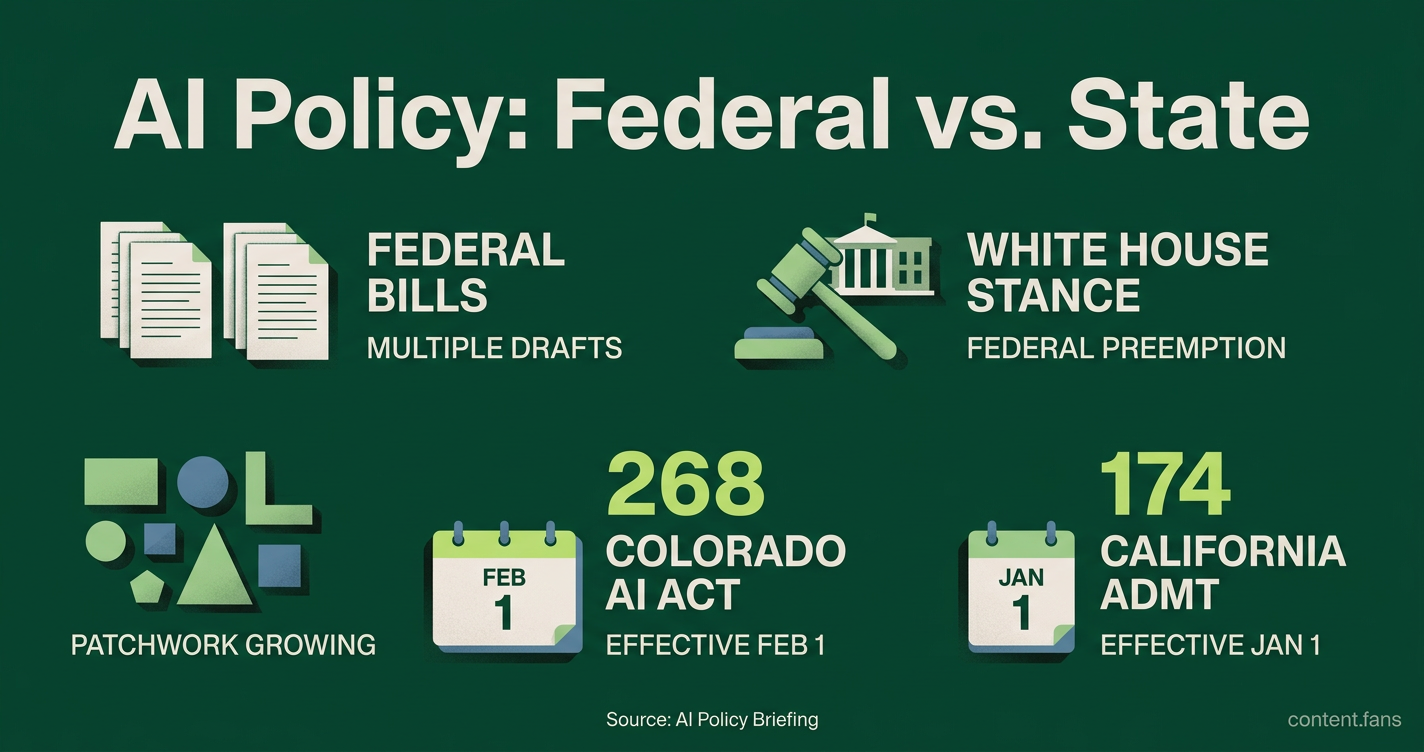
At the federal level, Congress is actively considering several discussion drafts that both align with and challenge the administration's stance on AI. The White House released 'Ensuring a National Policy Framework for Artificial Intelligence' in December 2025, outlining themes like child safety and federal preemption while cautioning against inconsistent state rules.
Competing legislative efforts highlight the partisan divide. Senator Marsha Blackburn's TRUMP AMERICA AI Act largely reflects the administration's framework. In contrast, Representative Don Beyer's GUARDRAILS Act aims to preserve state authority. While no single bill has passed both chambers, bipartisan interest is evident in proposals like codifying a Center for AI Standards and Innovation (CAISI).
The Growing Patchwork of State AI Regulations
While federal legislators debate the scope of a national AI law, a complex patchwork of state-level regulations is already taking shape. According to industry reports, a significant number of states have enacted rules for AI in elections, and comprehensive frameworks are now in effect. Key examples include:
- Colorado: The Colorado AI Act became effective on February 1, 2026, with enforcement beginning June 30.
- California: Rules for automated decision-making technology (ADMT) took effect on January 1, mandating pre-use notice and consumer opt-out rights.
This state-by-state divergence increases compliance costs and intensifies the debate over federal preemption.
Key Areas of Analysis in AI Policy Tracking
A thorough analysis of the AI policy landscape requires focusing on several critical areas:
- Federal Bill Tracking: Monitoring bills by sponsor, committee status, and scheduled actions to anticipate legislative momentum.
- State Law Mapping: Maintaining a clear map of state-level enactments, including crucial effective dates and compliance deadlines.
- Preemption Conflict Analysis: Identifying "red-flag" conflicts between proposed federal legislation and existing laws in key states.
- Advocacy Strategy: Developing playbooks for effectively briefing lawmakers and stakeholders on policy implications.
- Compliance Roadmapping: Creating actionable 90-day compliance checklists to address upcoming regulatory requirements.
Methodology: Ensuring Authoritative and Verifiable Insights
All analysis is grounded in primary sources and established legal commentary to ensure accuracy. This includes full reviews of executive actions, such as the June 2 presidential directive on innovation and security, alongside bill summaries derived from official committee documents and non-partisan legislative trackers. This rigorous methodology ensures every data point is verifiable and trustworthy.
Strategic Value for Legal, Compliance, and Government Affairs Teams
This focused approach provides distinct advantages for key corporate functions:
- Legal Teams: Gain crucial early visibility into statutory language likely to advance through the legislative process, enabling proactive risk assessment.
- Compliance Officers: Receive deadline-driven checklists that simplify adherence to new rules and reduce last-minute scrambling.
- Government Affairs: Obtain precise talking points tied to specific bill clauses, ensuring consistent and effective lawmaker outreach.
Ultimately, this structured analysis provides a workable model for navigating the deluge of information as the AI policy landscape continues to shift.
What exactly is the latest bipartisan AI regulatory draft and where does it stand?
The clearest cross-aisle signal so far is the GUARDRAILS Act, introduced by Rep. Don Beyer and Democratic co-sponsors to counterbalance the White House's National Policy Framework for Artificial Intelligence. The framework itself is a set of nonbinding legislative recommendations that calls for federal preemption of fragmented state AI laws, urges Congress to avoid "vague standards and open-ended liability", and centers on child safety, community protections, free-speech guarantees, innovation incentives, and workforce readiness. On the Republican side, the TRUMP AMERICA AI Act would codify many White House principles and create the Center for AI Standards and Innovation (CAISI) as a permanent federal entity. According to industry reports, neither bill has cleared committee, so no comprehensive federal statute is yet in force.
How will upcoming elections shape AI regulation?
AI already tops the list of talking points: millions of dollars tied to artificial intelligence have poured into recent races, according to ABC News. The outcome will determine whether Congress passes, blocks, or rewrites any of the current drafts. If Republicans keep both chambers, expect alignment with the White House's preemption-focused approach and continued reliance on executive action plus agency guidance. If Democrats flip one or both chambers, look for stiffer oversight, resistance to federal preemption, and possible focus on narrower bills covering transparency, deepfakes, and consumer protection. A split result almost guarantees legislative gridlock, leaving companies to navigate a patchwork of state rules on election-related AI alone.
Which state laws are already in effect and why should companies care?
According to industry reports, a significant number of state-level AI bills have been introduced in recent legislative sessions, and several have hard effective dates:
- Colorado's AI Act became effective February 1, 2026, with enforcement starting June 30, 2026.
- California ADMT rules (automated decision-making technology) are live January 1, 2026, with some provisions extending to January 1, 2027.
- California Transparency in Frontier AI Act (SB 53) imposes incident-reporting and whistle-blower protections on frontier-model developers.
- California AB 2013 mandates public training-data summaries for generative-AI systems.
Because these statutes include risk assessments, opt-out rights, and disclosure mandates, businesses cannot wait for federal clarity; implementation timelines are measured in weeks, not years.
What are the top compliance pitfalls legal teams are reporting?
- State-by-state fragmentation: A single product can trigger notice, appeal, and risk-assessment rules across multiple jurisdictions.
- Tight deadlines: Controls must be in place to meet upcoming enforcement dates and regulatory expansions.
- Overlapping sector regimes: Healthcare, finance, and HR uses face privacy, civil-rights, consumer-protection, and industry-specific rules simultaneously.
- Documentation exposure: Drafting impact assessments and training-data summaries can expose proprietary methods and vendor relationships.
- Enforcement uncertainty: State attorneys general have already begun inquiries, making "wait and see" a high-risk strategy.
What practical steps should a compliance or government-affairs team take immediately?
- Build a state-law inventory: Map every AI use case against applicable statutes in California, Colorado, Illinois, Texas, New York, and any state where you have users or employees.
- Tier systems by risk and jurisdiction, then design notice, opt-out, and appeal workflows that scale across multiple regions.
- Prepare incident-reporting and whistle-blower channels aligned with California's Frontier AI obligations.
- Draft model-training documentation and vendor audit trails early; AB 2013 requires covered developers to publicly post training-data documentation on their websites, including a high-level summary of datasets used to train the model, and to update it for new models or substantial modifications.
- Form an internal advocacy task force tracking federal-preemption debates and weigh in with trade associations to shape harmonized thresholds, safe harbors, and enforcement-delay requests.