
New AI governance checklist updates for 2026
Serge Bulaev
The new AI governance checklist for 2026 gives teams a simple way to spot and respond to major risks. It highlights signals like legal changes, price spikes, or new buyer requirements, and assigns who should act and what to do next. Laws like the Colorado AI Act may require companies to pause new features and prove fairness before selling to enterprise customers. The checklist may help teams respond quickly to problems, like cost changes or fairness test failures, by following pre-set actions. The list is reviewed each month so it can stay up to date as new risks appear.

The 2026 Colorado AI governance updates focus on transparency, documentation, and limited consumer rights (pre-use notice, post-adverse notice, human review), removing the proactive 'stop, reassess, and act' risk management framework of the 2024 law. For teams managing production AI, a robust AI governance checklist provides a critical framework to respond when risks emerge. This checklist translates abstract governance policies into concrete triggers and pre-defined responses. Each identified signal is mapped to a specific risk tier, an owner, and a required action within a set service-level objective.
Regulatory shock as a Level-1 signal
An AI governance checklist establishes clear "red flag" signals for AI systems, such as new regulations, cost overruns, or performance degradation. It assigns specific owners and pre-approved actions for each signal, enabling teams to respond to incidents with speed, consistency, and reduced operational disruption.
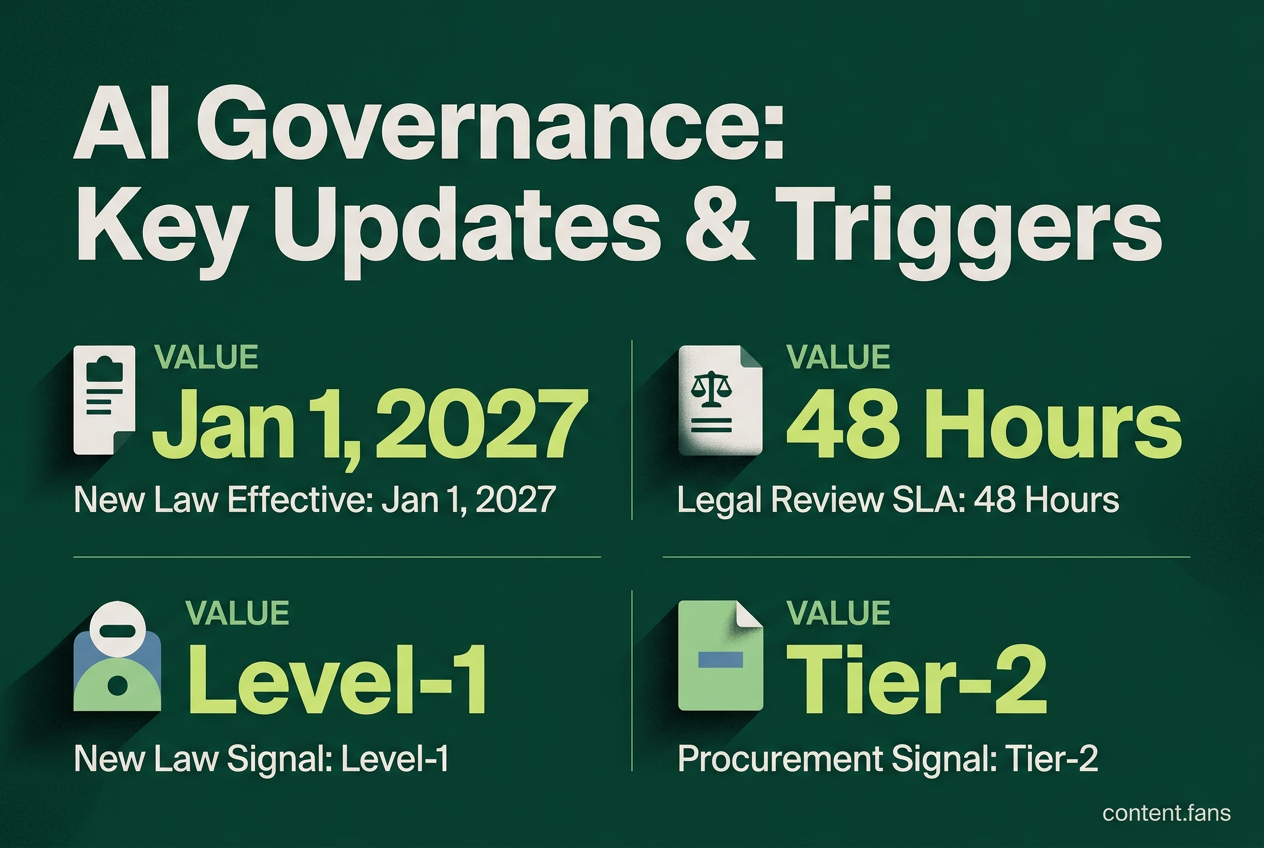
Legislative changes and new lawsuits can create sudden liabilities that derail an AI roadmap. The Colorado AI Act (SB 24-205) was passed in 2024 and focused on high-risk AI systems. It was repealed and replaced by SB 26-189 (Automated Decision-Making Technology Act), which takes effect January 1, 2027. The new law mandates transparency, notice, and disclosure for Covered ADMT, not a 'reasonable care' standard. Consequently, enterprise customers started requiring new fairness documentation before contract renewals. The checklist designates any new law tightening developer duty of care as a Level-1 signal, triggering an immediate freeze on new feature launches until a full compliance review is completed.
Price and capability spikes
Unexpected spikes in token prices or major provider capability updates introduce significant cost and dependency risks. According to industry reports, token price increases following model upgrades have impacted profit margins for some SaaS companies. The governance checklist automatically routes significant price alerts to the CFO, triggering a playbook to apply cost caps and switch to a more economical fallback model.
Enterprise procurement pressure
Enterprise buyers are becoming powerful de facto regulators through their procurement demands. AI Bill of Materials (AI-BOM), data provenance, and incident reporting SLAs are emerging best practices and recommendations in the AI supply chain. While some forward-looking RFPs may include them, they are not yet mandated by many RFPs as of 2026. The checklist classifies these new contractual requirements as a Tier-2 signal, requiring legal review within 48 hours and product verification that the model registry can generate the necessary AI-BOM exports.
Checklist: Signals That Your AI Bet Is Wrong (and What to Do Next)
| Signal | Detection mechanism | Owner | First action |
|---|---|---|---|
| New state law adds private right of action for AI harms | Daily legal feed monitor | Head of Risk | Pause feature rollouts; schedule compliance sprint |
| Token cost rises significantly above recent averages | Usage billing alert | Finance | Apply customer billing caps; fail-over to cheaper model |
| Provider publishes frontier-model capability w/out stability SLA | Release watch | ML Lead | Lock current model version; run regression tests |
| Enterprise RFP demands AI-BOM and incident reporting | Deal desk intake | Legal | Update contract template; verify registry export |
| Fairness test fails on live traffic | Continuous bias monitor | ML Ops | Auto-isolate model; enable manual review mode |
Using the matrix to decide whether to pivot, hedge, or double down
A decision matrix helps leadership determine whether to pivot, hedge, or double down by cross-referencing signal severity with the team's adaptation speed. A high-impact regulatory shock coupled with slow internal remediation may necessitate a pivot to lower-risk features. In contrast, a cost spike that can be quickly addressed might only require a short-term hedge. This framework guides strategic decisions based on objective data, preventing reactive, inconsistent responses.
Incident response SLA
The checklist incorporates a formal incident response SLA, aligning with industry best practices that recommend a five-phase process from automated alert to post-mortem. For instance, detecting a fairness failure in a live model automatically blocks new deployments and alerts the risk officer. The framework includes pre-approved communication templates with clear, plain-language explanations for customers affected by model-driven decision reversals.
The checklist is a living document. The governance committee convenes monthly to review new regulatory actions, procurement trends, and runtime performance metrics, determining if any warrant promotion to official trigger status. This iterative process ensures the framework remains relevant and effective without overburdening product teams.