
New AI Framework Integrates Human Judgment, Automates Low-Risk Decisions
Serge Bulaev
A new AI framework may help teams decide when to use automation and when to require human oversight by using a clear checklist. The framework suggests that when the risk is low and the AI model is confident, decisions can be automated, but higher risk or impact means a human should be involved. Teams look at user impact, safety, brand sensitivity, and model confidence before choosing the level of automation. There are three main workflows: fully automated, human-in-the-loop, or human-only, depending on the situation. Continuous monitoring and clear guardrails appear to make sure that if something goes wrong or risks rise, humans can quickly review or reverse decisions.

A new AI framework that integrates human judgment to automate low-risk decisions is providing teams with a concrete checklist for balancing AI efficiency with human oversight. This emerging standard dictates that AI can act autonomously when potential harm is low, but human intervention becomes mandatory as risk increases. This approach replaces improvised oversight with a formal system, relying on the explicit classification of use cases and pre-defined guardrails to ensure decision-making is consistent and safe.
The framework's core is a decision matrix that assesses each AI-driven action by its potential user impact and safety or brand risk, balanced against the model's confidence. Full automation is reserved for high-confidence, low-risk scenarios, with human checkpoints required as risk levels rise.
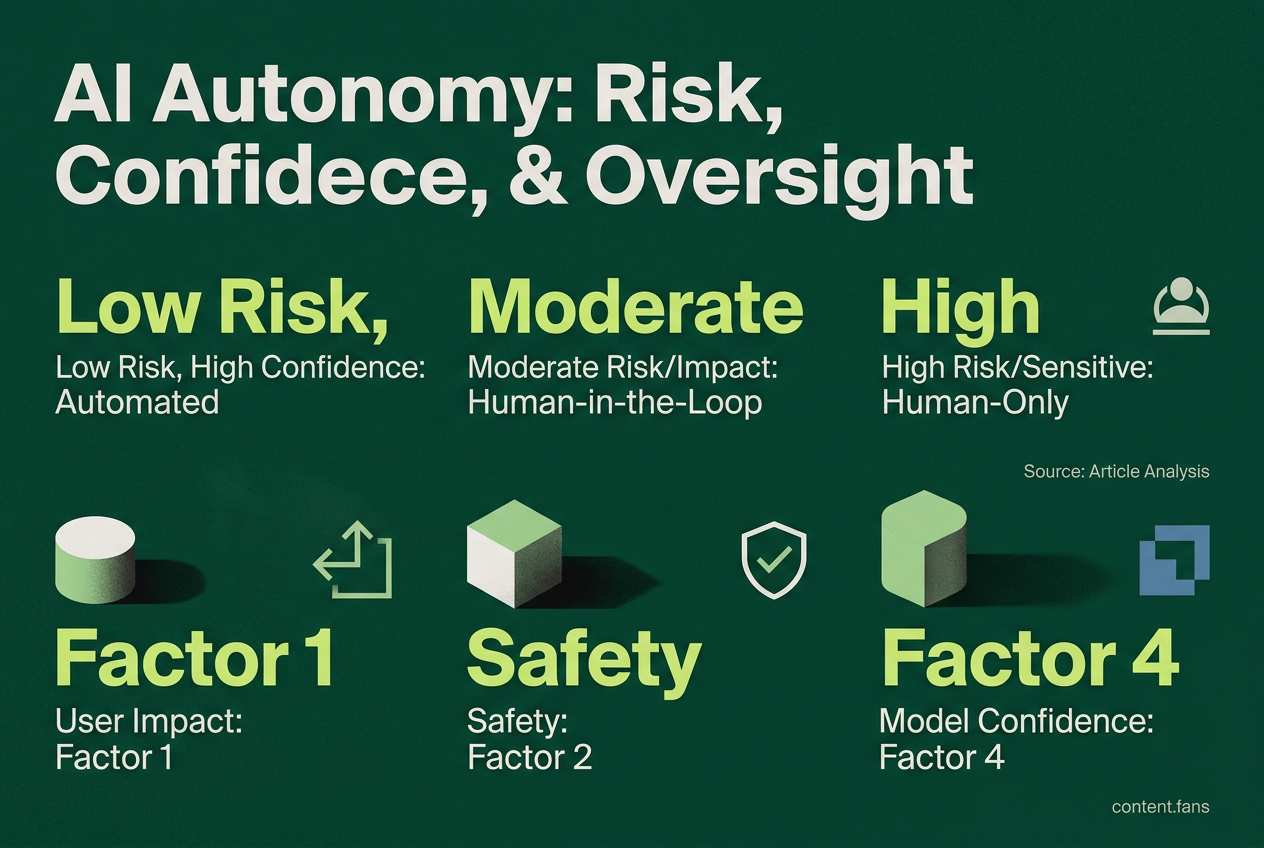
Operational Axes of the Decision Matrix
This decision-making framework evaluates AI recommendations against four core criteria: user impact, safety, brand sensitivity, and model confidence. When risk is low and confidence is high, the system automates the decision, but any elevated risk or uncertainty requires explicit human approval before the action is taken.
Teams evaluate four key factors before assigning a level of autonomy:
- User Impact: Does the recommendation only aid discovery, or could it affect a user's spending, wellbeing, or access to services?
- Safety: Could the output be biased, privacy-invasive, or otherwise harmful?
- Brand Sensitivity: Would a mistake upset users or trigger public controversy?
- Model Confidence: How well-calibrated is the probability that the recommendation is correct?
Industry guidance suggests organizations should classify decisions, assign owners, and establish pre-set guardrails like bias audits and rapid rollback links. Furthermore, engineering best practices state that personalization should optimize for measured user value rather than click maximization.
Three Tiers of AI Autonomy in Workflows
Once these factors are scored, the matrix defines three standard workflows:
- Automated: For low-impact, low-risk, high-confidence tasks. Standard A/B testing and live drift monitoring are sufficient.
- Human-in-the-Loop: For moderate impact or risk. AI drafts or ranks options, but a human reviewer must approve the final decision before exposure.
- Human-Only: For high-impact or sensitive areas like health, finance, or content involving minors. AI may assist with analysis, but a human retains full decision-making authority.
Case studies show this model enables threshold-based escalation, routing any decision above a set risk score to a human approval queue. Many financial services teams have reported significant reductions in review costs by using AI for triage while reserving final approval for staff.
Monitoring, Guardrails, and Rollback Triggers
Continuous observability is essential for maintaining the framework's integrity. Production guides recommend tracking several confidence-linked metrics:
| Metric | Typical Trigger for Escalation |
|---|---|
| Expected Calibration Error | Increase beyond launch baseline |
| Low-confidence rate | Volume exceeds agreed review capacity |
| Human override rate | Spike relative to weekly average |
| Guardrail activation rate | Rise suggests safety filters are firing more often |
| Hallucination rate (for LLMs) | Growth above control limit |
If any metric crosses a predefined threshold, the policy dictates either an immediate human review or an automatic rollback to a safer model version. To ensure full auditability, all prompts, context, and reviewer decisions should be logged.
Adopting this matrix requires shared accountability. Typically, product managers own the decision classification, data scientists are responsible for model calibration and bias, engineers manage logging and fail-safes, and legal or compliance teams approve high-risk applications.
The framework thus acts as a living contract, tying AI autonomy to quantifiable risk, mandating robust monitoring, and clearly defining how and when humans must intervene.
What criteria does the new framework use to decide when AI can act on its own?
The matrix evaluates four axes in every use case: user impact, safety risk, brand sensitivity, and model confidence. When all four signal low risk - for example, generic product suggestions on a retail homepage - the system auto-approves the recommendation. As soon as any axis moves into medium territory, the item is routed to human verification, and once any axis is high (health, finance, minors, crisis topics, etc.) the AI is locked out and a human must act.
How are "low-risk" decisions actually handled without people?
They run under a fully automated workflow that includes:
- Pre-defined SLAs for monitoring (e.g., every 15 minutes for traffic spikes).
- Confidence-based gating: only predictions above a tuned threshold ship.
- Rollback triggers such as sudden drops in calibration or spikes in human overrides.
These rules are codified in templates so engineers do not have to build controls from scratch for each new feature.
What happens on medium-risk recommendations?
They follow an explicit human-in-loop path:
1. The AI drafts the recommendation but pauses at a checkpoint.
2. A reviewer sees a concise risk card summarizing safety, brand, and confidence scores.
3. The reviewer can approve, edit, or escalate within the SLA (often < 2 hours).
Industry reports show this pattern can significantly reduce review costs while preserving human veto power over every consequential choice.
Who owns the governance and audit process?
A lightweight cross-functional review board is recommended:
- Product manager owns the decision class and user outcome.
- Data scientist owns model quality, bias tests, and calibration.
- Engineering owns latency, logging, rollback switches, and access controls.
- Legal / compliance vets regulated or brand-sensitive contexts.
Industry guidance emphasizes that these roles and checkpoints must be assigned before launch, not improvised later.
How often is the framework itself reviewed?
The framework mandates periodic audits on a fixed cadence (most teams choose quarterly) and immediate spot audits when any guardrail metric crosses its limit. If the override rate or calibration error jumps beyond the baseline, the feature can be disabled in < 5 minutes through a documented kill-switch procedure.