
Neuberger Berman: AI Spending Shifts Investor Focus to ROIC
Serge Bulaev
Recent analysis by Neuberger Berman suggests that investors are now focusing more on return on invested capital (ROIC) rather than just return on equity because AI spending raises the stakes for capital efficiency. Companies may need to make sure their AI investments are covered by free cash flow and meet higher standards before going ahead. Experts recommend breaking up AI spending into stages based on actual customer use and tracking clear metrics for adoption and financial impact. There also appears to be a continued reward for companies that keep strong balance sheets and return extra cash to shareholders if AI projects do not show clear benefits. These steps may help finance leaders balance the risks and opportunities of AI in a fast-changing market.

With rising AI spending, investor focus is shifting to return on invested capital (ROIC), raising the stakes for capital efficiency. Analysis from Neuberger Berman indicates CFOs must now justify every AI investment against tougher hurdles, moving beyond simple return on equity.
A clear framework is now guiding capital allocation. Experts advise that AI capital expenditures must be covered by free cash flow, as debt-funded spending can strain leverage and threaten dividends (Investing.com). Furthermore, KPMG advises using a 'return-on-compute' screen to ensure projects do not become stranded assets if token economics fail sensitivity analysis.
Thought Leadership - How the AI Race Is Reshaping Corporate Capital Allocation
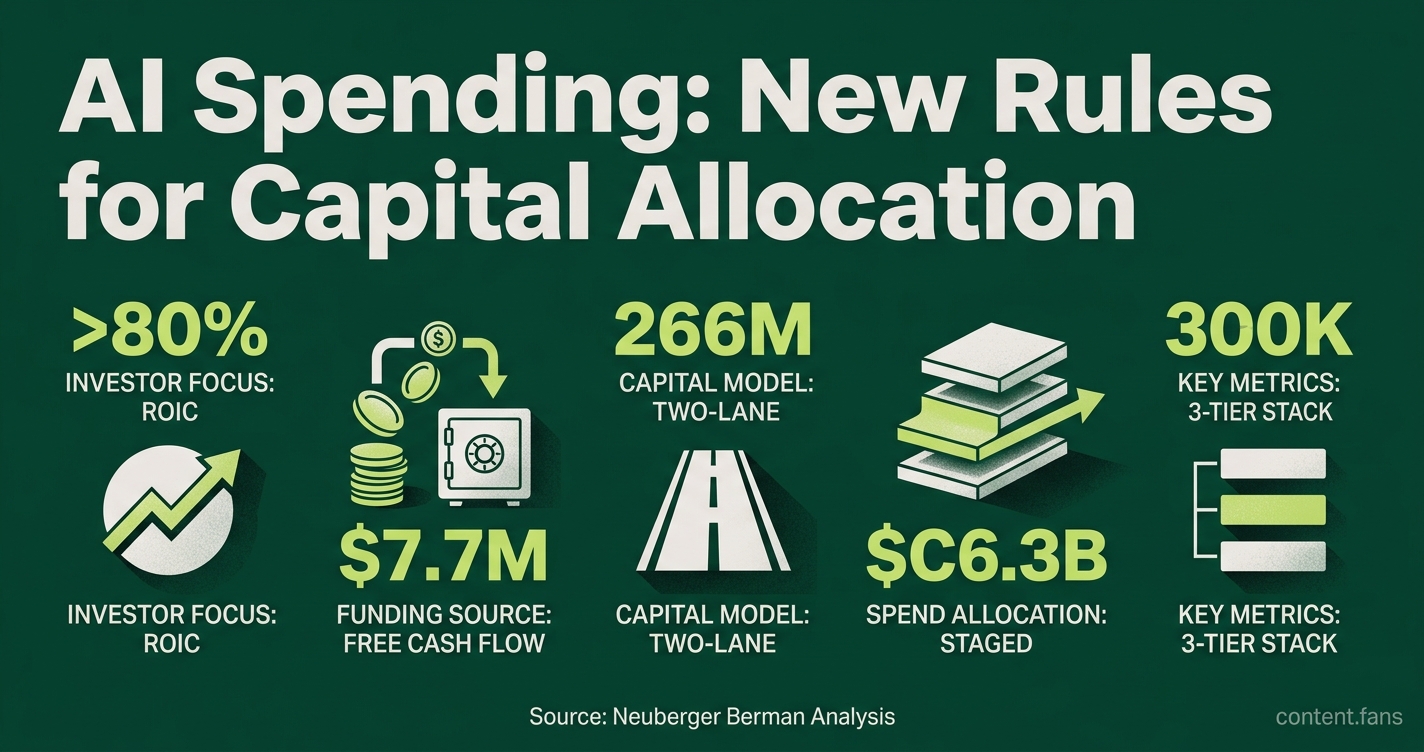
Finance leaders are adopting a disciplined framework for AI capital allocation. This involves prioritizing investments that exceed ROIC hurdles and are funded by free cash flow, while staging the spend in tranches tied to clear performance milestones. The goal is to balance innovation with financial prudence and balance sheet strength.
-
Build a two-lane model. Adopt a two-lane capital model: Lane A for AI capex that surpasses the weighted average cost of capital (WACC) while preserving cash, and Lane B for shareholder returns, funded only after Lane A commitments are met.
-
Stage the spend. Allocate funds in stages, tying expenditures to utilization, customer adoption, and monetization milestones to align capital drag with real demand.
-
Track a three-tier metric stack. Implement a three-tier metric dashboard to monitor activity (e.g., daily users), efficiency (e.g., hours saved), and financial results (e.g., revenue uplift). Deloitte notes leaders target reasonable payback periods on AI pilots.
-
Communicate with clarity. For investors, detail the strategy, governance, and milestones. For employees, explain role shifts and training. The World Economic Forum's investor playbook advises disclosing responsible-AI oversight before scaling.
-
Guard the balance sheet. Protect the balance sheet, as Reuters reports markets still reward firms that return excess cash when AI upside is marginal, signaling the continued value of conservative capital structures.
A rules-of-thumb table can speed decisions:
| Decision factor | Green-light AI capex | Favor shareholder returns |
|---|---|---|
| Expected ROIC/NPV | Above hurdle after stress test | Below cost of capital |
| Funding source | Organic free cash flow | Requires new debt |
| Monetization path | Clear route to revenue or productivity | Uncertain or distant |
| Capital structure | Low leverage, strong coverage | Tight covenants, upcoming maturities |
| Market signal | Growth rewarded | Growth narrative saturated |
Quick reference list for board packets:
- Minimum ROIC target: WACC + significant premium
- Payback window: reasonable timeframe based on project scope
- Free-cash-flow coverage ratio: adequate post-capex coverage
- Milestone cadence: quarterly KPI review
- Communication cadence: investor call every six months, employee town hall quarterly
By implementing these guardrails, finance chiefs can navigate the tension between AI-driven growth and shareholder returns, ensuring every capital allocation decision is strategic, disciplined, and defensible in a dynamic market.
How did CFOs balance AI CAPEX and returning cash to shareholders in 2025?
CFOs in 2025 balanced AI CAPEX with shareholder returns based on ROI and strategic value, not a strict binary rule where failure to clear a hurdle automatically mandates shareholder rewards. Leading firms used a four-point screen:
- Expected ROIC above WACC - AI projects must show a positive NPV after stress-testing token economics and depreciation curves [KPMG].
- Free-cash-flow coverage - Neuberger Berman warns that the market is shifting from ROE to ROIC because heavier AI spend makes capital efficiency more important than headline profit [Neuberger Berman].
- Debt tolerance - Investing.com finds CAPEX funded from organic cash rather than debt is the only version investors tolerate without penalizing near-term buybacks or dividends.
- Monetization path - Allianz Trade reminds boards that capital intensity only lifts value when backed by revenue monetization, not merely capacity expansion [Allianz Trade].
When projects failed these tests, many CFOs chose buybacks or special dividends instead.
What KPI dashboard should executives use to prove AI is delivering?
A three-tier dashboard aligned to Activity, Efficiency, and Financial Impact has become common at Fortune 500 companies [Clarity Arc].
| Tier | Sample KPI | Industry Observations |
|---|---|---|
| Activity | Daily active users, API call volume | High adoption rates in target user groups |
| Efficiency | Hours saved per workflow, FTE equivalent freed | Significant processing time improvements |
| Financial | Revenue uplift, cost per unit of work, margin improvement | Positive ROI with reasonable payback periods |
While AI adoption and efficiency gains are reported, the specific 2025 benchmarks and exact ROI figures vary significantly across implementations and industries.
How can leadership communicate AI investment strategy to investors without triggering skepticism?
Investor decks vary by company, but successful presentations typically include:
- Strategic rationale - tie AI to the firm's core competitive moat, not hype.
- Governance model - name the executive owner and the model-review cadence [World Economic Forum].
- Use-case map - show concrete pilots, expected revenue uplift, and risk controls [Amundi].
- Capital discipline - state the ROIC/WACC hurdle and confirm funding from free cash flow [Neuberger Berman].
- Milestones & metrics - publish quarterly KPIs and next-stage funding gates.
Firms that replaced vague "AI transformation" language with structured presentations saw improved investor reception relative to peers [McKinsey].
What is the most effective employee-facing narrative to accompany AI roll-outs?
Winning internal campaigns have four elements:
- Purpose first - "AI augments your day-to-day work, it does not replace you" [Grant Thornton].
- Training guarantee - managers receive toolkits and every employee gets a baseline AI literacy module within a reasonable timeframe.
- Feedback loops - Slack or Teams channels monitored daily to surface model failures or training gaps.
- Success stories - celebrate teams that saved client hours or lifted sales using the new tools, reinforcing efficiency metrics over job cuts.
Companies that invested in this two-way communication significantly reduced change-management resistance compared with those that announced AI as a cost-saving measure [Deloitte].
How can boards manage the risk of stranded AI assets?
Board playbooks in 2025 involved staged funding and NPV analysis:
- Phase 1 - Seed funding secured only after thorough financial modeling and sensitivity tests.
- Phase 2 - Additional tranches released when utilization, customer adoption, and incremental cash flow hit pre-agreed thresholds.
- Phase 3 - If any KPI slips below hurdle, remaining CAPEX is diverted to shareholder returns or defensive buybacks.
Neuberger Berman argues that boards which codify these gates protect the balance sheet and preserve option value by avoiding large, irreversible GPU or data-center commitments [Neuberger Berman].