
Nestlé cuts 18 underperforming brands, eyes full portfolio reshape by 2026
Serge Bulaev
Nestlé is reviewing its product lines and may cut 18 underperforming brands, which make up about 20% of its sales but are not growing much. The company wants to focus more on four main areas: Coffee, Petcare, Nutrition, and Food & Snacks, while it might sell or leave other businesses like ice cream and packaged water. Nestlé suggests these changes may help put more money and effort into its stronger brands and make its business simpler. Some businesses, like vitamins and baby food, may also be sold or restructured. Analysts think 2026 could be an important year for Nestlé as it decides how to reshape its group of brands.

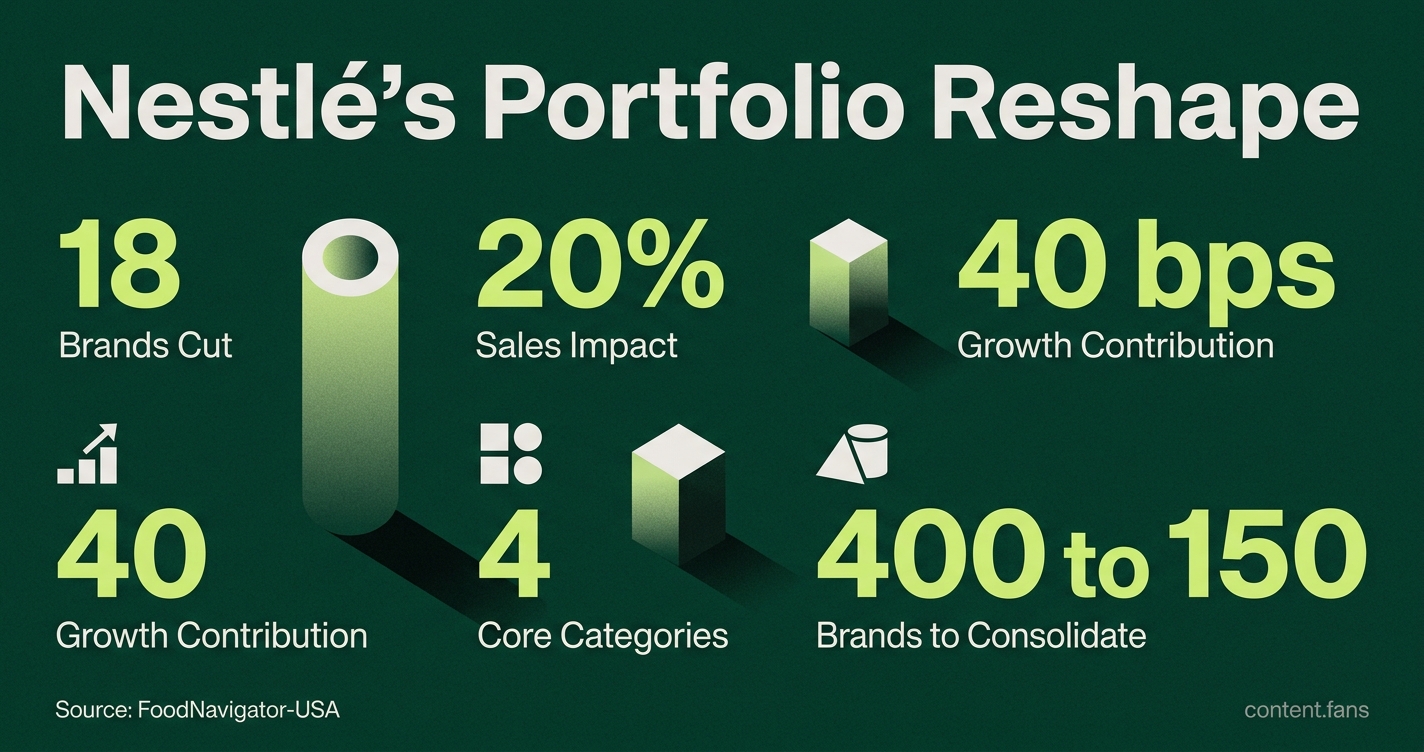
As part of a major portfolio reshape, Nestlé plans to cut 18 underperforming brands that currently account for 20% of sales but deliver minimal growth. An internal review found these brands produced just 40 basis points of organic growth in Q3 FY2025, lagging far behind the 60 basis points from priority investments, as cited by FoodNavigator-USA. This move aims to trim the company's long tail of brands and reallocate resources more effectively.
This strategic shift is part of CEO Philipp Navratil's "winning portfolio" agenda for 2026. The company will concentrate its capital and marketing efforts on four core categories: Coffee, Petcare, Nutrition, and Food & Snacks. According to FoodNavigator-USA, this involves reviewing or exiting lower-priority assets, including ice cream, packaged water, and some vitamin and supplement lines.
Why the 18 cells matter
Nestlé is streamlining its portfolio to focus investment on high-growth areas and improve overall profitability. By divesting from 18 underperforming "cells" that tie up significant capital for minimal returns, the company can redirect resources to its core categories of Coffee, Petcare, Nutrition, and Food & Snacks.
These 18 cells represent specific brands or regional business units with prolonged sales stagnation. Despite management efforts that lifted their growth from negative 2.5% to flat, this only contributed a modest 40 basis points to Q3 organic growth. Analysts view this as evidence that significant working capital is trapped in these slow businesses, which could be better used to fund high-return platforms.
Early divestment signals
Market coverage indicates several businesses are already under strategic review:
- Ice Cream: Talks are reportedly at an advanced stage to sell Nestlé's remaining ice cream businesses to its joint venture partner, Froneri. The move would remove an asset described as a "strong, but small and a distraction."
- Packaged Water: The company is reportedly exploring partnerships or a full sale of its packaged water division, with a potential deconsolidation from 2027.
- Vitamins, Minerals, Supplements (VMS): Official shareholder materials state that the VMS segment "may result in divestment" after a thorough review.
Completing these three major divestments would allow Nestlé to channel capital directly into its four core categories. This would also mark a significant step in simplifying a brand portfolio that has historically included over 2,000 distinct global brands.
Brand architecture squeeze
An internal program called "Fuel for Growth" aims to slash the number of active brands from over 400 to approximately 150. This consolidation is designed to simplify supply chains, eliminate redundant marketing expenses, and improve brand clarity on shelves. The strategy mirrors the success seen with flagships like Nescafé and Purina, which receive a large share of R&D and media budgets, demonstrating the power of focusing resources on fewer, stronger brands.
Financial backdrop
The company's financial performance underscores the strategy's potential. Nestlé reported an acceleration in organic sales growth to 4.3% in Q3 FY2025, with 60 basis points of that lift directly attributed to its priority investments. This highlights how targeted spending drives superior results. However, challenges remain, with management identifying the US baby-food brand Gerber as "one of our more stubborn underperformers," signaling that some legacy brands may require more than just incremental support.
What analysts will watch next
- The timing and valuation of any announced deals for the ice cream and water businesses.
- Clear evidence of marketing budgets shifting toward coffee, pet nutrition, and functional nutrition post-divestment.
- Further disclosures on the 18 underperforming cells, particularly if more are slated for disposal.
Ultimately, 2026 is shaping up to be a pivotal year. Observers are watching to see if Nestlé translates its strategic review into significant balance sheet changes, transforming the 157-year-old food giant into a more agile, focused, and profitable enterprise.
What is the scale of Nestlé's planned brand cuts?
Nestlé is targeting 18 underperforming business "cells" for review or divestment. While these units represent approximately 20% of group sales, they contributed only 40 basis points to organic growth in Q3 FY2025. This move is part of a broader portfolio reshape to be completed by 2026, which will shrink the company's 2,000+ brands to focus on the four core categories of Coffee, Petcare, Nutrition, and Food & Snacks.
Which brands or categories are most likely to be sold?
According to the company's 2026 guidance, ice cream is the most likely category to be divested, with advanced talks underway to sell the business to joint venture partner Froneri. Packaged water and vitamins, minerals, and supplements (VMS) are also under strategic review. Additionally, parts of its U.S. infant nutrition business face scrutiny, with executives calling Gerber "one of our more stubborn underperformers."
How is Nestlé prioritising which brands to keep?
Nestlé is using a "winning portfolio" strategy to determine which brands to retain, prioritizing those with strong competitive advantages and synergies. The company now uses activity-based costing to assess the true profitability of each brand and SKU. This rigorous process is part of the "Fuel for Growth" program, which aims to reduce the active brand count from roughly 400 to about 150.
What impact will these divestments have on future growth?
The primary goal is to improve growth quality, not just increase overall size. This strategy has a strong track record; since 2017, Nestlé has completed over 75 transactions affecting ~18% of its portfolio. The current focus on high-return categories is already showing results, with Q3 FY2025 organic growth accelerating to 4.3%, a significant increase from 3.0% in the prior-year period.
Where can investors track ongoing portfolio moves?
Investors can follow official announcements on Nestlé's investor page, while industry analysis and ongoing updates on the shake-up are available through FoodNavigator-USA's rolling coverage.