
Nadella's Test: How Companies Build AI Moats With Learning Loops
Serge Bulaev
Satya Nadella warns that relying too much on outside AI models may hurt companies by making them lose their unique expertise. He suggests that lasting value comes from a learning loop made of private data, human input, and feedback, not just the AI model itself. Reports suggest that companies should keep their own data, use human checks for risky decisions, and make sure their systems are always being tested for problems. Firms that manage their own learning and data systems may be better prepared if AI models become easy for everyone to get. The research suggests that the real advantage comes from how companies use and protect their knowledge, not from owning the AI model itself.

Microsoft CEO Satya Nadella has issued a stark warning about over-reliance on third-party AI and the risk of surrendering a company's core expertise. This gives rise to "Nadella's Test," a critical question for building AI moats: if you swapped your AI model tomorrow, would your competitive advantage remain? The answer lies not in the model, but in creating a proprietary learning loop - a defensible system of private data, human judgment, and feedback mechanisms.
Why concentration risk matters
Nadella warns of a future where value is ceded "to a few models that eat everything they see," creating significant economic and political risk as customers and regulators push back against vendor lock-in (TheStreet). Microsoft's own strategy focuses on operational excellence rather than just model ownership. Industry reports suggest that ROI comes from managing utilization, optimizing workloads, and maintaining customer diversity, highlighting software leverage as the true driver of long-term value.
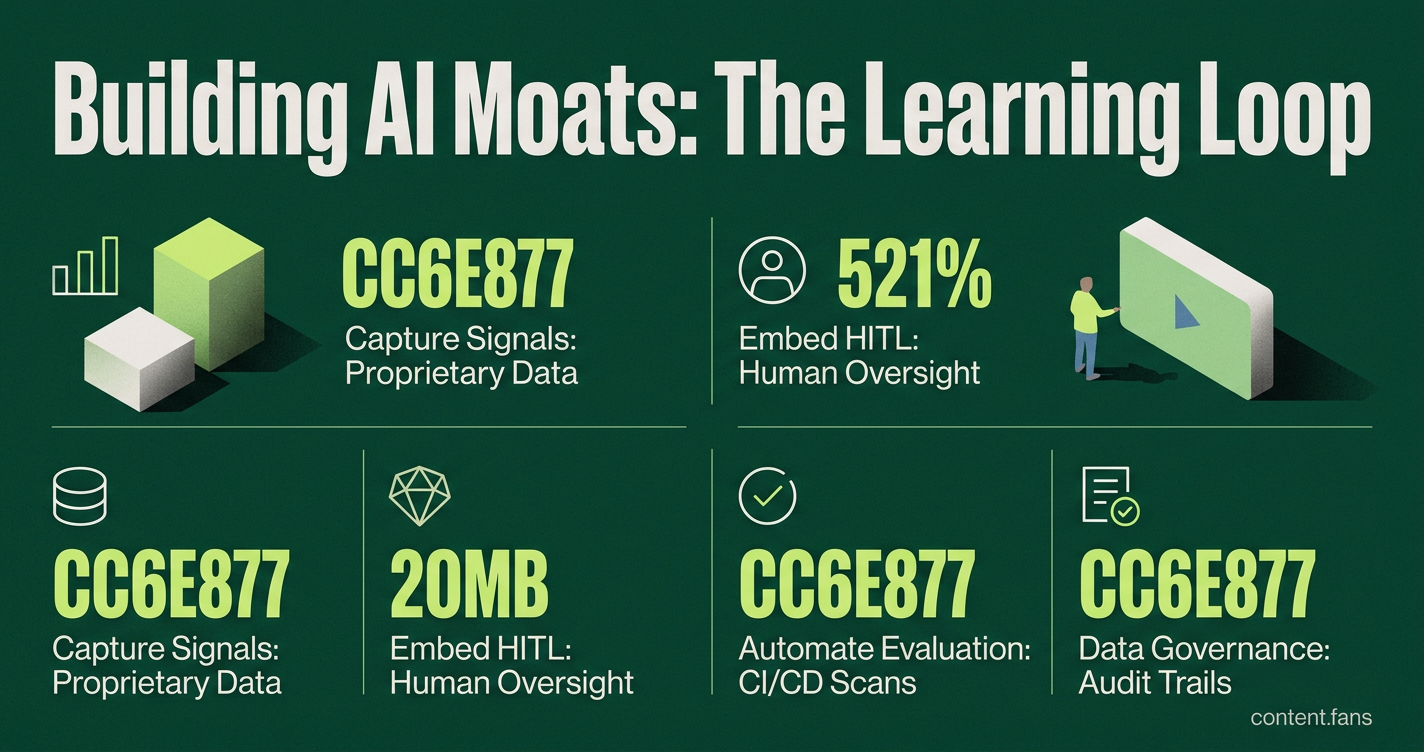
The solution lies in creating a proprietary learning loop - an internal system that continuously refines AI performance using the company's unique data, human expertise, and feedback. This approach ensures that even if the underlying AI model is replaced, the accumulated knowledge and competitive edge remain in-house.
Building the Learning Loop
Enterprise playbooks emerging to pass Nadella's test focus on three core actions:
- Capture Proprietary Signals: Collect and utilize internal data - such as user logs, domain-specific labels, and business outcomes - that competitors cannot access.
- Embed Human-in-the-Loop (HITL) Oversight: Implement "tiered HITL by risk," a practice from Kognitos that uses human checkpoints for high-stakes or uncertain decisions to retain institutional knowledge.
- Automate Continuous Evaluation: Integrate bias, security, and policy scans directly into CI/CD pipelines, ensuring every model update is rigorously tested before deployment.
A Guidepoint Security white paper reinforces this, noting that governance built on transparency and trust is becoming a competitive asset. Similarly, federated governance models allow for agility while maintaining central oversight on regulations like the EU AI Act, according to a ThinkIA brief.
Data Governance as a Moat
A proprietary data advantage is only valuable if the data is trustworthy. Leading organizations are adopting "AI Bills of Materials" to create a complete audit trail for each model, tracking its training sources, lineage, and test results. MarketingAgent.blog advises coupling this audit layer with firm "red-line" policies - for example, zero tolerance for brand safety violations - that automated systems must never breach.
This table illustrates how specific governance levers contribute to a company's competitive moat:
| Governance lever | Operational focus | Moat contribution |
|---|---|---|
| Central policy registry | Live mapping of global rules | Faster compliance, fewer rollbacks |
| Tiered HITL | Risk-based human oversight | Retains tacit knowledge inside the loop |
| Continuous scans | Bias, security, policy | Early fault detection lowers incident cost |
| Audit log & lineage | End-to-end traceability | Builds customer and regulator trust |
Early Signals and the Path Forward
According to industry reports, market leaders are deploying AI first on high-stakes tasks where feedback is rich and easily measured. This confirms an emerging consensus: the true value of AI correlates with the density of proprietary feedback, not the size of the model.
MIT economist Christian Catalini, who first framed the test, agrees. He argues that a company's real advantage is its "workflow memory" - the institutional knowledge that persists even if the AI model is swapped out. Firms that protect this memory through robust data governance, human oversight, and continuous measurement are best positioned to thrive as AI becomes a commodity.
The takeaway is clear: invest in the loop. The infrastructure that captures, verifies, and refines knowledge is the true scarce asset, and it is the key to building a lasting competitive advantage.
What is "Nadella's test" and why does it matter?
Nadella's test asks what value stays inside your company if the foundation model is removed. If the answer is "very little," you are renting your moat. The test forces boards to treat proprietary data, verification steps, and human judgment as the real assets, not the model itself.
How do learning loops create a durable moat when models keep getting cheaper?
A learning loop is the repeatable cycle of data capture, human review, outcome measurement, and retraining that stays on your servers. Even as base-model API prices continue to fall significantly according to industry reports, firms that own the loop keep compounding institutional memory while competitors start each quarter from scratch.
Which part of the loop should enterprises build first?
Start with private evaluation data sets. According to industry reports, many Fortune-500 retailers have seen significant lifts in conversion after swapping to their own labeled examples for rank-tuning, while rivals using public benchmarks saw no change. Private evals also create the feedback signal that powers every later loop step.
How much human judgment is enough without slowing the system?
Emerging tiered HITL standards show:
- Tier 1 (low risk): auto-approve with minimal random audit
- Tier 2 (medium): async review within several hours
- Tier 3 (high): hard-block until a qualified human signs off
Companies using this model report high automated throughput while maintaining strong compliance on regulated decisions.
Where does governance fit into the loop?
Governance is the clockwork that keeps the loop honest. Embedding bias scans and policy checks inside CI/CD pipelines prevents broken or non-compliant models from ever reaching production, turning governance from a cost center into a competitive differentiator that speeds up safe releases.