
Nadella Warns Enterprises: Own AI Workflow, Data to Avoid Commoditization
Serge Bulaev
Microsoft CEO Satya Nadella warns that generative AI may quickly become a commodity, making it harder for companies to stand out. He suggests businesses should keep control of their own data, workflows, and feedback loops so their systems stay valuable even if the AI model changes. Analysts say value might shift away from the models themselves to the ways companies use and improve them with human judgment and outcome tracking. Experts suggest that collecting feedback and verifying AI outputs may lead to better results, though this may vary by industry. Nadella's main message appears to be that owning data and learning processes helps companies avoid losing their advantage to outside AI providers.

As generative AI rapidly becomes a commodity, Microsoft CEO Satya Nadella warns enterprises must own their AI workflow and data to maintain a competitive advantage. This challenge, known as "Nadella's test," posits that a company's real defense is its proprietary learning loop, not the underlying AI model. Industry reports suggest that businesses risk ceding value to a few AI platforms if they relinquish control over their data, workflows, and evaluation processes Observer, VentureBeat. Passing this test means designing systems where swapping foundation models has minimal impact, because compounding value comes from proprietary data and feedback.
Nadella's Test: When Models Become Commodities, Build the Learning Loop Around Them
Nadella's test challenges businesses to build a durable competitive advantage by focusing on their unique data and processes rather than the underlying AI models. It emphasizes creating a proprietary 'learning loop' where the system continuously improves through internal feedback, making the choice of a specific large language model secondary.
According to industry reports, Microsoft's strategic guidance reinforces this by positioning frontier models as a utility layer. Commentary on Nadella's shareholder letter suggests value is migrating to the proprietary stack combining company data, human oversight, and outcome tracking VentureBeat. Analysts view this as a strategic pivot away from model-dependent demos to resilient, workflow-centric deployments that endure vendor shifts.
From Utility Model to Proprietary Loop
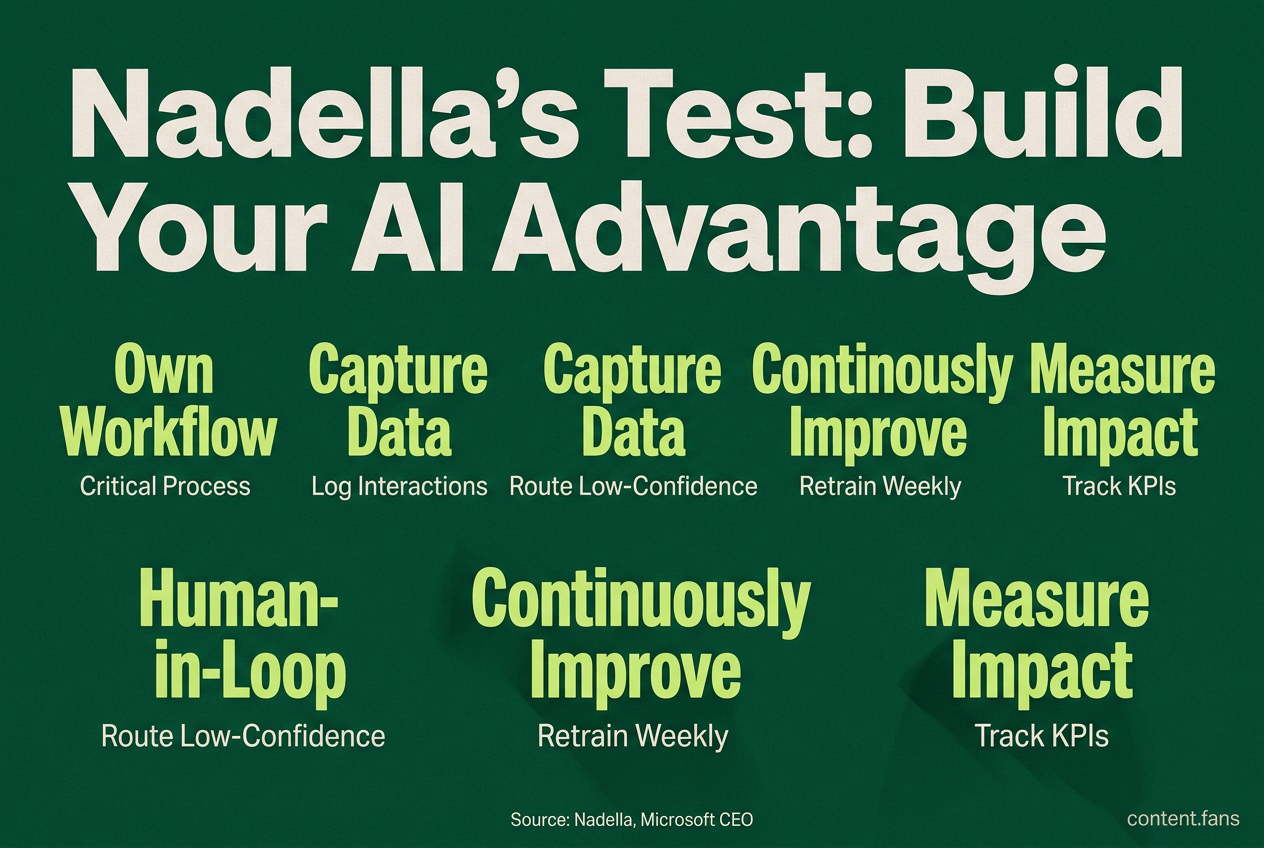
Building this proprietary loop involves five key steps:
- Own the workflow: Select a critical, auditable business process for AI integration.
- Capture data: Log all interaction and correction data at every stage.
- Human-in-the-loop: Route low-confidence AI outputs to human experts and record their resolutions.
- Continuously improve: Use the verified data to retrain or fine-tune models on a frequent basis, such as weekly.
- Measure impact: Track key performance indicators (KPIs) like cost per transaction, error rates, and customer retention to validate the loop's effectiveness.
VentureBeat reports that Microsoft now urges customers to treat model choice as interchangeable, advising them to invest instead in identity-first security, zero-trust governance, and hybrid orchestration that keeps sensitive knowledge in-house. The Street notes that Nadella has repeatedly cautioned boards that failure to keep such sovereignty could "hollow out entire industries" by letting external providers capture the learning signals.
Verification Becomes the Scarce Input
As the cost of AI generation plummets, the cost of verifying its output remains high, making verification the new scarce resource. Enterprises can gain an edge by automating this process with structured feedback and human-in-the-loop reviews. Indeed, estimates from MIT Sloan indicate that firms combining AI generation with human audit layers achieve up to double the accuracy improvements of purely automated systems. The principle is clear: trusted, verified data compounds in value, whereas unchecked AI output degrades future performance.
Early adopters are already implementing these strategies. In finance, some firms are using post-trade reconciliation exceptions to build supervision datasets. In healthcare, clinician edits on AI-generated documentation are tagged as gold-standard feedback for monthly model retraining. These use cases demonstrate how a robust learning loop can create a defensible moat, even if the company switches to a cheaper, alternative language model.
The core message from both Nadella's warnings and economic analysis is unmistakable: protect your data, verify AI outputs, and maintain a constant feedback loop. While the AI engine can be rented, the institutional knowledge it helps build is a proprietary asset that cannot.
What exactly is "Nadella's test" and why does it matter right now?
"Nadella's test" is the practical question "What value remains if we unplug the foundation model tomorrow?"
MIT economist Christian Catalini coined the phrase to crystallize Satya Nadella's warning: if your entire AI edge sits inside a third-party model, you rent the advantage but never own it. The test matters now because model APIs are becoming increasingly cheaper and more interchangeable; firms that pass the test keep proprietary data, human judgment loops, and workflow integration even as models change.
How do I know if my current AI stack would pass the test?
Run a quick self-audit against two checkpoints:
- Data replacement cost: Could a competitor recreate your training or feedback data in under 90 days using public sources or synthetic generation?
- If the answer is yes, the moat is thin. - Workflow dependency: If you swapped GPT-4o for Claude 3.7 tomorrow, would frontline staff need re-training, new prompts, or different UIs?
- Extra re-work equals high model lock-in.
Industry reports add a third metric: share of customer interactions that flow through AI-embedded workflows you control. Leaders already track this weekly; laggards still count monthly demos.
What three concrete investments best reinforce the moat?
-
Instrumented feedback pipelines
Build a closed loop where every AI output triggers an immediate micro-feedback (approve, edit, escalate). The loop should feed a private vector store updated in hours, not quarters.
- SaaS leader Intercom did this with ~1,600 daily agent corrections, cutting answer error rate by 27 % in eight weeks. -
Rights-audited proprietary data layer
Tag each record with provenance, retention policy, and usage rights in the same metadata store that your orchestration layer queries.
- This turns compliance into a competitive shield - especially in regulated sectors like finance or healthcare. -
Workflow-embedded orchestration
Instead of a chatbot bolt-on, redesign the frontline process so AI moves work between humans and machines inside the same ticket, case, or ticket-like object.
- When models change, only the routing rule adapts; the business process stays intact.
How fast will the competitive gap widen between firms that pass the test and those that do not?
Industry reports show:
- Firms with production-grade learning loops are significantly more likely to report substantial EBIT uplift from AI.
- The gap accelerates exponentially because every interaction improves their private system, while rivals relying on generic models see flat or declining marginal returns.
Translation: delays in building proprietary loops can cost significant relative margin over time.
Can small or mid-size companies still build durable moats, or is this a Fortune-500 game?
Absolutely. Catalini's analysis and recent case studies show moats scale with data uniqueness, not firm size. Three tactics level the field:
- Vertical focus: A 200-person supply-chain SaaS firm locked in chemical shippers by capturing dock-door sensor data no public dataset covers.
- Human-in-the-loop density: A 45-person legal-tech startup records attorney redlines, creating a 3.2 M-annotation corpus that no foundation model provider can access.
- Governance-as-a-service: Mid-size firms outsource model hosting but keep evaluation, version control, and liability tagging in-house via low-code orchestration tools.
The takeaway: Own the feedback and verification layer - not the GPU bill - and you can outrun much larger competitors.