
Nadella urges firms to build own AI models, 76% still buy
Serge Bulaev
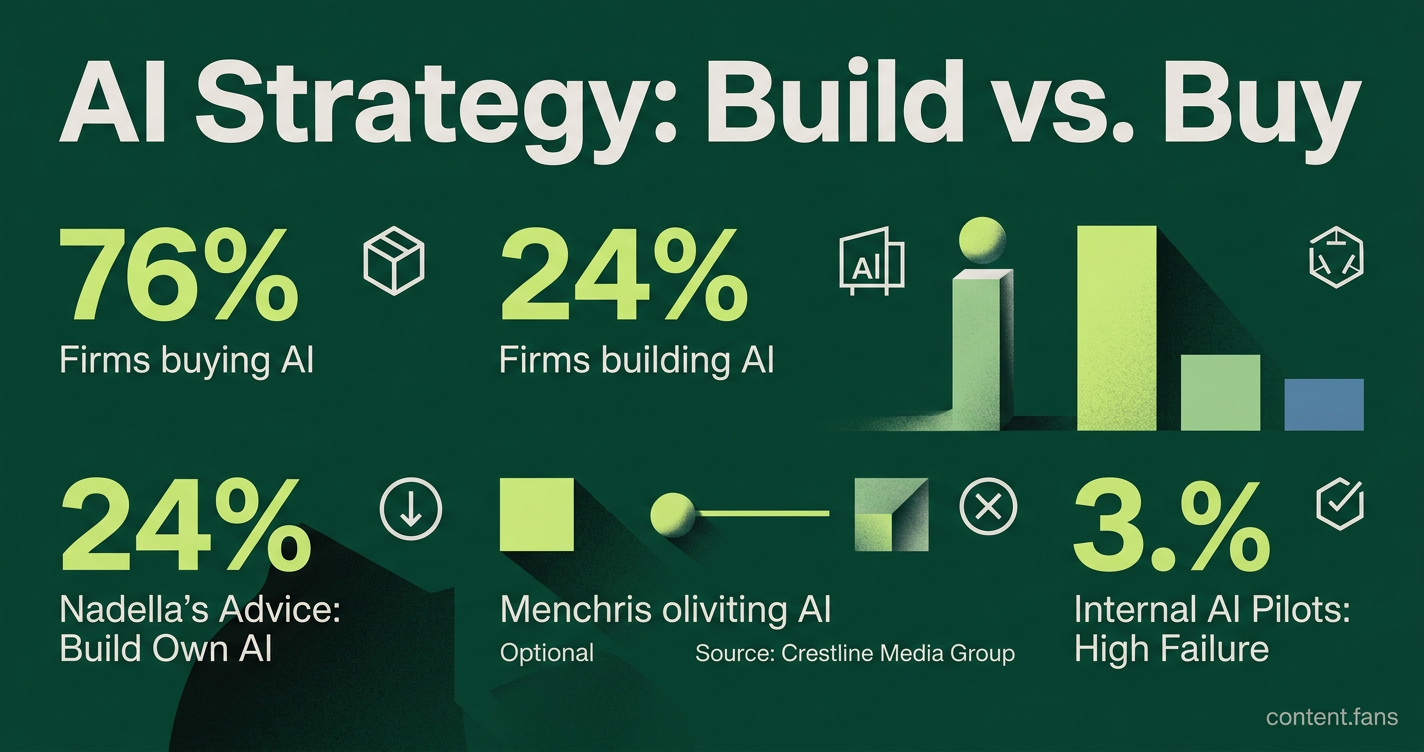
Satya Nadella suggests companies should build their own AI models instead of relying on outside vendors, saying that renting models may risk losing a competitive edge. However, market studies show that by 2025, 76% of firms still use external AI services instead of building from scratch. Reasons for renting include high costs, fast changes in technology, and complex integration. Microsoft appears to be making its cloud service Azure neutral, letting customers run different models while still using Microsoft's infrastructure. This situation may mean companies are moving toward a mix of using their own data with outside AI tools as a practical solution.

Microsoft CEO Satya Nadella has urged companies to build their own AI models to protect their competitive advantage, warning that outsourcing a company's "learning loop" threatens its strategic position. According to industry reports, Nadella has advocated that companies should develop proprietary AI capabilities rather than rely solely on external providers. Despite this high-profile advice, market data shows most enterprises are choosing to buy, not build. This report unpacks the build-vs-buy dilemma by contrasting Nadella's strategy with the market's pragmatic reality.
What Nadella Actually Said
Satya Nadella advises companies to develop proprietary AI models to protect their competitive advantage. He argues that a firm's unique value comes from its "learning loop" - its ability to improve from its own data and operations - a core function that should not be outsourced to third-party vendors.
Nadella's message has been consistent across multiple platforms, suggesting a deliberate strategic campaign. In various statements, he has elaborated that companies can buy tools but should not outsource their learning capabilities, warning that reliance on a single "black-box" model leads to strategic irrelevance. This view has been echoed in Microsoft communications which envision AI's future as systems of multiple, orchestrated models, emphasizing that the proprietary learning layer must remain in-house.
The Market Reality: Build vs. Buy
Despite Nadella's warnings, enterprise behavior shows significant challenges with internal development. While a substantial portion of companies attempted to build their own models in recent years, current data shows that a significant majority now opt for vendor-supplied models. A Crestline Media Group brief reports on this trend toward purchasing rather than building AI solutions. Current data shows approximately 24% build versus a majority that buy, with a growing number adopting hybrid strategies.
Why Many Firms Still Rent Models
Several key factors explain why companies continue to favor external AI solutions:
- High Costs and Low ROI: Many internal AI platforms became costly experiments, with industry reports indicating that in-house AI pilots fail at very high rates, failing to deliver a clear competitive advantage after significant investment.
- Pace of Innovation: In-house teams struggle to keep up with the relentless pace of model releases from frontier labs like OpenAI and Anthropic, creating a perpetual "catch-up" cycle.
- Integration Complexity: Integration represents a major cost driver for AI projects, with enterprises discovering that connecting systems and managing governance consumes substantial development resources rather than focusing on core model development.
- Regulatory Demands: In certain sectors, regulatory pressure favors the use of auditable open-weight models. These are often hosted on external clouds to balance transparency with cost.
Microsoft's Dual Role
Nadella's advice may seem contradictory given Microsoft's role as a major AI provider. However, the company has strategically repositioned Azure as a model-agnostic "AI factory." Instead of locking customers into its own models, Microsoft provides the infrastructure to run AI from any provider, including OpenAI, Google, and Meta. This pivot has positioned Microsoft to maintain its partnership with OpenAI while opening the platform to competitors. By promoting Azure as neutral infrastructure, Microsoft profits from the compute needed to train and run custom models, regardless of their origin. Industry analysts note this strategy shifts Microsoft from a product-focused approach to a platform-centric one, capturing value across the entire AI stack.
Tension and Takeaways
The core tension in enterprise AI remains: executives desire proprietary control over their "learning loops," but most companies lack the resources to build and maintain frontier-grade models internally. The hybrid model, now gaining popularity, offers a pragmatic solution. This strategy involves using internal data pipelines to fine-tune external models - either via API or using open-weight checkpoints - reconciling the need for strategic control with today's economic and technical realities.
What exactly did Satya Nadella say about companies building their own AI models?
According to industry reports, Nadella has advocated that companies should build their own AI models, emphasizing the importance of maintaining control over their learning processes. He has framed this as a fundamental business imperative, with industry analysis noting that "a firm is a learning system" and that outsourcing this learning process threatens the company's competitive position. His message has been direct about the risks of dependency on external providers.
Nadella distinguishes between AI models as commodity tools - which can be purchased - and the proprietary learning loop that must remain internal. He envisions companies using open-weight, cost-efficient models fine-tuned with their own data and operational traces, rather than depending on a handful of frontier providers.
Why does Nadella warn against relying on external AI providers?
The Microsoft CEO identifies a concentration risk that threatens economic differentiation. He has noted concerns that if AI power consolidates into a small number of frontier models that have learned everything differentiated in the economy, then competitive advantage becomes difficult to maintain - meaning no firm could sustain unique value through proprietary data or processes.
This extends beyond technical dependency to existential business risk. Nadella's argument centers on institutional knowledge: the accumulated learning from a company's specific context, customer interactions, and operational patterns. When firms rent this capability from external providers, they potentially forfeit the compounding value of internal learning working together over time.
What does the data actually show - are companies building or buying AI?
Despite Nadella's advocacy, enterprise behavior has moved toward purchasing solutions. A significant majority of AI use cases are now purchased rather than built in-house, representing a shift from more balanced approaches in previous periods. Only a minority of companies still pursue exclusively internal development.
Several factors drove this shift:
- Uneconomical returns: Significant investment in internal platforms often failed to deliver promised competitive advantages, with industry reports indicating very high failure rates for in-house AI pilots
- The catch-up problem: Internal teams cannot match the pace of improvement from OpenAI, Anthropic, and Google, who release better models regularly
- Integration overhead: Enterprises discovered that substantial AI development resources are consumed by connecting systems and managing APIs - work that commercial platforms now handle more efficiently
How does Microsoft reconcile this advice with its own business model?
Microsoft has executed a strategic pivot from exclusivity to infrastructure agnosticism. Rather than advocating for a single proprietary solution, the company now positions Azure as the "universal AI factory" where enterprises can run models from multiple vendors.
Microsoft has maintained its partnership with OpenAI while positioning Azure as a platform that supports models from Google, Meta, Mistral, and others through Azure AI Studio and Foundry. This model-agnostic approach allows Microsoft to capture value across the entire stack - infrastructure, models, and applications - regardless of which specific AI solutions customers choose.
The economic logic is straightforward: model training and high-frequency inference are compute-intensive, and owning that infrastructure lets Microsoft capture a significant share of the value chain across multiple AI solutions.
What practical path forward do these conflicting signals suggest?
The emerging consensus points toward a hybrid approach that combines internal capabilities with external solutions. The critical distinction is owning the learning loop, not necessarily building the base model.
Industry analysis suggests companies should treat underlying models as flexible, swappable commodities while ensuring their proprietary data, context, and processes feed into a customized system that captures institutional knowledge. This aligns with the growing shift toward AI agents - task-specific systems that orchestrate multiple models rather than depending on any single one.
For regulated industries, open-weight models (like Llama or Qwen) deployed in private clouds address the auditability requirements that "black box" APIs cannot satisfy - preserving data sovereignty while avoiding the full cost of ground-up model development.