
Nadella Defines AI 'Learning Loop' as Lasting Company Advantage
Serge Bulaev
Satya Nadella suggests that combining human judgment with company-owned AI, called the "learning loop," may give companies a lasting advantage. This approach links employee knowledge with AI systems trained on their own data, creating something competitors cannot easily copy. Experts warn that just renting AI tools might increase risks and loss of control. Case studies like Tesla, Walmart, and Microsoft appear to show that continuously learning from daily operations can make organizations stronger. However, Nadella emphasizes that people remain key, as human oversight and judgment guide the AI's improvement.

Microsoft CEO Satya Nadella defines the AI 'learning loop' as a company's most durable competitive advantage. This strategic framework combines proprietary company data with human judgment to create a self-improving system that competitors cannot easily replicate. While renting generic AI tools presents risks, building an internal loop has proven effective for firms like Tesla and Walmart, which turn daily operations into compounding value. Nadella stresses that human oversight remains central to guiding this powerful cycle.
Satya Nadella's concept of "The Learning Loop" has evolved from a slogan into a core strategic principle. According to industry reports, he argues that the key opportunity is not in the base AI models themselves, but in building a proprietary loop where human and AI capabilities compound, creating an inimitable asset.
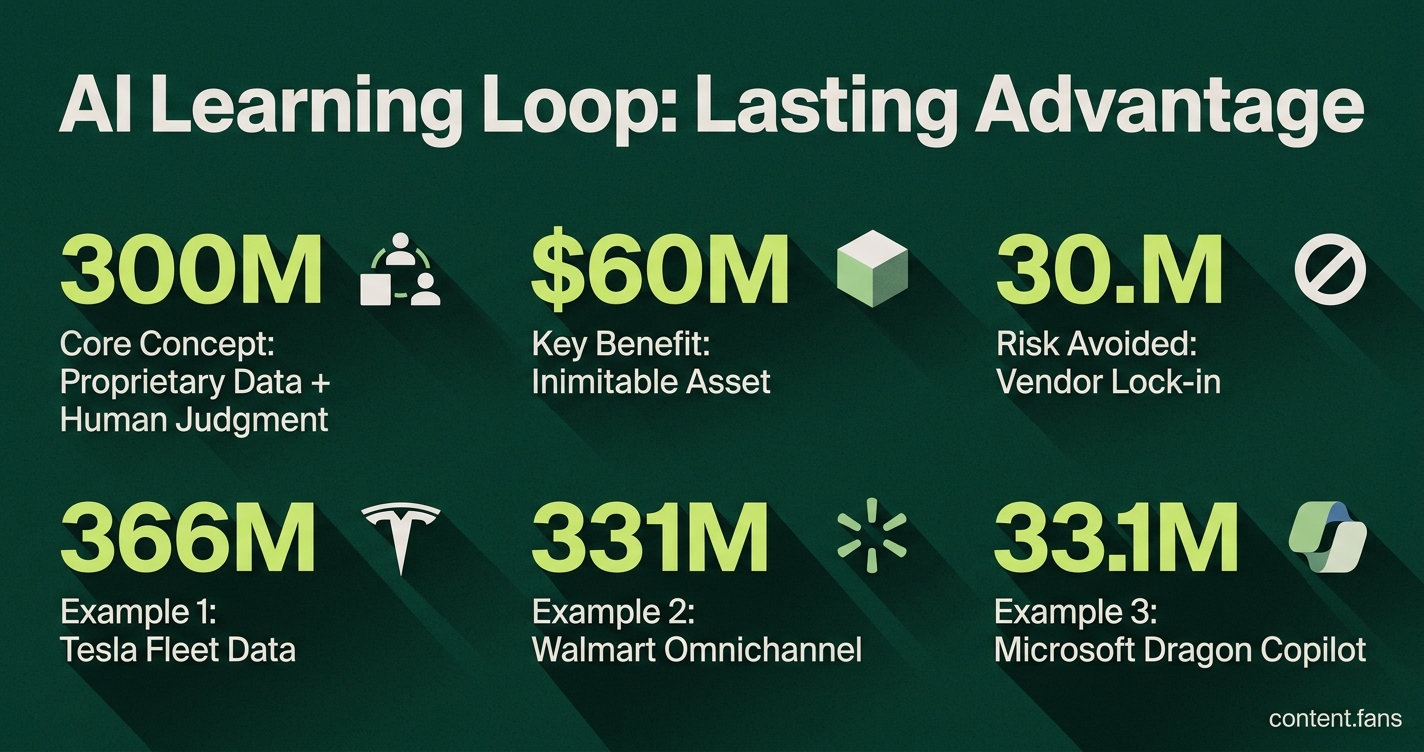
Industry sources suggest Nadella distinguishes between human capital (employee judgment and context) and token capital (the company-owned AI trained on proprietary data). The learning loop captures every interaction, feeding it back into the system to continuously sharpen the AI, turning operational experience into a compounding advantage.
This strategy is critical as powerful foundation models become commoditized. While the advantage of using one generic model over another diminishes, a unique, internal learning loop retains its value. Firms treating AI as a simple utility risk vendor lock-in, ceding control over their technology roadmap and costs. KPMG warns this dependency can obscure key business drivers and risks KPMG.
Learning loops in practice
An AI learning loop is a system where a company's proprietary data, operational workflows, and employee feedback are continuously used to refine its AI models. This creates a proprietary asset that compounds over time, as each interaction makes the AI smarter and more aligned with the business.
Several case studies illustrate how looping data, models, and workflows can compound.
• Tesla is widely described as using fleet data and over-the-air software updates to create a data flywheel, though the specific implementation details of their training infrastructure remain proprietary.
• Walmart integrates store and ecommerce signals into a single analytics platform. According to estimates, the omnichannel loop sharpens inventory decisions and personalization across its global network.
• Microsoft's Dragon Copilot records ambient clinical conversations and drafts notes inside the Epic EHR, with industry reports suggesting significant reductions in documentation time across many hospitals.
These examples suggest that durable loops blend proprietary data with workflow access. The more tightly the model aids day-to-day tasks, the richer the feedback it receives.
Strategic design questions
Firms exploring the concept face three design choices:
- Identify high-frequency workflows where judgement drives value.
- Instrument those workflows so feedback is captured in structured form.
- Build governance that lets teams refresh models quickly while auditing bias and drift.
Missing any element weakens compounding. Aon cautions that concentration risk grows when companies depend on external APIs for core decisions; outages or policy shifts upstream can stall the loop.
Human capital remains the governor
Nadella's framework firmly positions people as the loop's governors. Human experts are essential for setting evaluation criteria, handling ambiguous cases, and approving model redeployments. Token capital accelerates their work but never replaces that oversight. This balance reflects industry thinking that human oversight cannot be eliminated from AI systems.
What to watch
Analysts will monitor how boards budget for token capital alongside traditional R&D. Industry reports suggest companies like Bayer expect significant annual savings from their generative AI platforms once integrated across drug discovery and marketing. Such figures may influence peers, yet long-run advantage will hinge on how well each company captures and reuses its own judgement inside an adaptive loop.
What exactly is Satya Nadella's "learning loop," and why does he call it the last durable advantage?
The learning loop is the continuous system that sits on top of any AI model and captures three things: workflow data, human judgment, and usage feedback. Every time an employee corrects an AI suggestion, rates a draft, or alters a generated report, that signal is written back into the loop and the model improves for your firm only. Because foundational models can be rented or swapped, competitors can buy the same raw horsepower, but they cannot buy the proprietary history of decisions, internal feedback, and process knowledge that your loop has stored. According to industry reports, the real opportunity lies not in picking the best model, but in building a learning loop on top of models where human capital and AI capabilities compound.
How is "human capital" different from "token capital" in Nadella's framework?
- Human capital = the judgment, relationships, and pattern recognition locked inside your employees' heads.
- Token capital = the AI capability you own in the form of prompts, evaluations, fine-tuned weights, or reinforcement-learning environments that are trained on your specific workflows and data.
Together they create a compounding asset: human capital provides context and correction, and the AI (token capital) codifies and scales that expertise. Rivals can rent the same base model tomorrow, but they cannot copy the years of human-in-the-loop refinements your system has absorbed.
Which companies already show measurable gains from building learning loops?
| Company | Learning Loop in Action | Reported Advantage |
|---|---|---|
| Tesla | Cars stream real-world driving data → models retrained → software updates roll out → better autonomous performance → more data collected. | Vertical data flywheel widens moat versus slower automakers. |
| Walmart | Omnichannel data from thousands of US stores + e-commerce funnelled into shared models → real-time pricing, inventory, and personalization tuned 24/7. | Retailer claims the loop "cannot be bought by pure-play e-commerce rivals". |
| Bayer | Internal platform VOX reuses prompts, knowledge bases, and evaluation checks across drug discovery, patent drafting, and marketing. | Significant projected annual savings once fully deployed. |
| Microsoft Dragon Copilot | Captures clinician corrections to AI-generated clinical notes inside Epic across many hospitals and feeds them back into model updates. | Substantial reduction in documentation time and lower burnout. |
| Data sources: McKinsey on strategic moats, 2026; Berkeley Center for Competition and Innovation, 2024-10 |
What risks do firms face if they choose to rent rather than own their AI?
Organizations that rely solely on rented models can incur five acute threats:
1. Vendor lock-in - roadmap, pricing, and feature releases dictated by the provider.
2. Model drift - performance changes can degrade your business process overnight.
3. Hidden costs - unexpected API price hikes or usage caps can overturn unit economics.
4. Opacity & liability - hallucinations or biased outputs become your legal exposure.
5. Loss of strategic insight - KPMG warns you may "no longer understand the engine driving your own margins," because the logic lives elsewhere.
KPMG Canada, 2026
How can a company start building its own learning loop with minimal disruption?
- Pick one high-frequency, high-value workflow (e.g., customer-support ticket triage) and instrument it to capture:
- every AI suggestion,
- agent correction or approval,
- and customer outcome. - Store the triplets (prompt, feedback, score) in a private vector or graph store.
- Fine-tune open-source or small models on this data weekly; keep larger rented models for fall-back only until the loop outperforms them.
- Expose the learned capability back to the same workflow through an internal API, so human capital and token capital compound with every single interaction.