
Munich Court Rules Google Liable for AI Overviews' False Statements
Serge Bulaev
A Munich court has ruled that Google may be legally responsible for false statements made by its AI Overviews feature. The court said these AI-generated summaries are treated as Google's own statements, not just search results, and ordered Google to pay most of the court costs and face fines if it repeats the mistake. This decision suggests that AI-generated answers might be seen as the provider's own speech under the law. The ruling is only a preliminary injunction and might change if appealed, so it is not yet final. Experts note that this could affect how other companies handle answers created by AI systems.

A German court has ruled that Google is legally liable for false statements made by its AI Overviews feature, setting a major precedent for generative AI liability. In a preliminary injunction, the Munich I Regional Court found that these AI-generated summaries are Google's own speech, not just search results, according to a DW report. The order, published June 11, 2026, suggests courts may hold platforms directly accountable for AI-synthesized text.
Why the verdict matters for platforms
The verdict matters because it treats AI-generated summaries as a platform's own speech, establishing direct liability. This moves beyond traditional safe harbor protections for search engines, creating a new legal risk for any company using AI to synthesize and present information as a definitive answer.
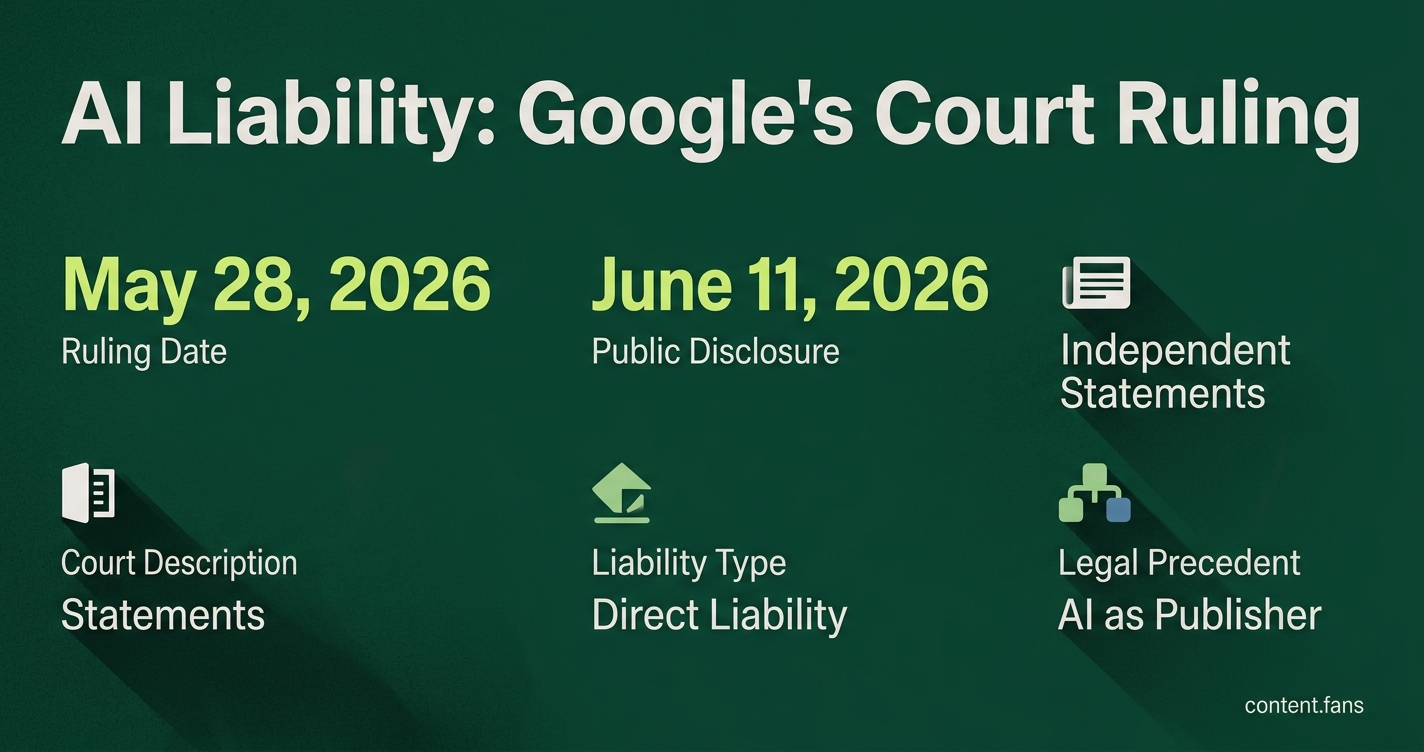
The court determined that an AI Overview is "a self-contained statement with independently understandable content," not a simple search preview. As a result, Google faces potential penalties for repeat offenses and must pay a significant portion of court costs. Experts cited in The Next Web suggest this legal logic could extend to all AI answer engines and chatbots that generate their own prose.
Legal analysts highlight two immediate takeaways:
- AI Content as Publisher Speech: When a system generates original text, it can be legally considered the publisher's own statement.
- Links Are Not a Shield: Citing sources with outbound links does not absolve a platform of liability if the AI-generated summary itself contains the false information.
Key Details of the Munich Ruling
| Item | Reported figure or wording |
|---|---|
| Date of injunction | 28 May 2026 |
| Public disclosure | 11 June 2026 |
| Court description of output | "Independent, new, and substantive statements" |
This is only a preliminary injunction, not a final judgment. The specific penalty amounts and cost allocation details are not confirmed by the provided sources.
Early precedent, limited certainty
This is only a preliminary injunction, not a final judgment. Google has announced it will appeal the decision, leaving its long-term impact uncertain. However, even though initial German court orders can be overturned, they often influence company product policies while the appeal is pending.
Practical implications for AI product teams
Legal experts recommend that AI product teams immediately review three critical areas:
- Defamation Screening: Implement automated pipelines to screen for potentially defamatory content in any AI feature that generates prose.
- Clear Disclosures: Use explicit language to inform users whether content is machine-generated or editorially approved.
- Expedited Takedowns: Establish rapid-response procedures for removing problematic content, especially concerning individuals or regulated subjects, that are faster than standard notice-and-takedown protocols.
Any business using LLMs for customer support, content summaries, or voice assistants could face similar legal challenges if their AI presents information as fact.
Wider European context
The Munich court's focus on content authorship contrasts with the EU's Digital Services Act (DSA), which largely relies on a "notice-and-action" framework for intermediaries. By attributing the AI's text directly to Google, the German ruling takes a stricter stance. The provided sources do not support details about upcoming EU Product Liability Directives, though the EU AI Act is expected to have provisions taking effect in August 2026.
What happens next
For now, the injunction requires Google to remove or amend the specific AI Overview within Germany. While the company appeals, other plaintiffs may bring similar lawsuits. However, legal experts emphasize that any future case will still depend on proving that an AI-generated statement presented a specific, verifiable falsehood about an identifiable person or entity.
What exactly did the Munich court decide about Google's AI Overviews?
The Munich I Regional Court issued a preliminary injunction on May 28 2026 and declared that Google is liable for false statements produced by its AI Overviews feature. The judges rejected Google's claim that the summaries were merely "previews" and ruled that the AI-generated text constitutes an "independent, new, and substantive statement" that must be treated as Google's own content. The court therefore barred Google from repeating the specific false claim and set potential penalties for non-compliance, while also ordering Google to pay a significant portion of the procedural costs (source).
Does the ruling apply to every AI-powered search feature?
The decision focuses on systems that synthesize source material into new prose before presenting it to the user. Because AI Overviews create "self-contained statements with independently understandable content", the court refused to apply the traditional search-engine safe-harbor rules. In practice, any platform that formulates its own wording - whether in an answer engine, chatbot, or customer-support bot - could now face publisher-style liability for defamatory or otherwise unlawful claims (reported by TNW).
Is this decision already final across all jurisdictions?
No. The ruling is a first-instance preliminary injunction, not an appellate judgment, and Google has already announced it will appeal. Until a final judgment or further harmonisation across EU courts, the precedent is persuasive but not binding everywhere. However, the reasoning may influence how national courts interpret AI-related regulations as they develop.
How might platforms adapt their product design after the ruling?
AI developers are reviewing two areas:
- Liability Flags - internal systems that detect high-risk topics (health, finance, biographies) and trigger human review before an Overview is shown.
- Citation Density - increasing inline links and source panels so each factual sentence is directly traceable to a third-party page, making it easier to argue the summary is not a new publication but a collage of existing material.
Industry reports suggest that design improvements can significantly reduce unsupported claims in AI-generated content.
What should businesses using generative AI do now?
Risk managers and product teams can take three immediate steps:
- Audit Content Liability - classify every generative feature (chatbot, FAQ generator, summariser) by whether it creates new wording or merely indexes.
- Implement Human Oversight Loops - for any feature in the "new wording" bucket, add pre-publication review for sensitive topics or at least near-real-time escalation.
- Track Regional Laws - monitor both the EU AI Act rollout schedule and U.S. state-level AI statutes (Texas TRAIGA, Colorado AI Act, Utah AI Policy Act) that mirror the Munich ruling's reasoning.