
Munich Court Holds Google Liable for AI Overview Misinformation
Serge Bulaev
A Munich court ruled that Google may be held directly responsible for false information shown by its AI Overviews tool. The court said that the summaries created by the AI are considered Google's own statements, not just links to other sites. This decision appears to mean that Google could face legal consequences under German defamation and unfair competition laws as soon as a false claim is shown. Google has said it might appeal the ruling, but there is no confirmed schedule yet. Experts suggest this case could influence how other courts in the EU view AI-generated content and may lead to new rules for how such tools are designed and monitored.
A landmark decision from a Munich court holds Google liable for AI Overview misinformation, establishing that the company is directly accountable for false statements generated by its AI tools. The ruling, issued in May 2026, marks a pivotal German case that attaches liability to a generative feature, treating AI-generated summaries as Google's own content and blurring the line between search platforms and content creators.
Key findings from the ruling
The court found Google directly responsible for AI-generated summaries because they constitute new, substantive statements, not just links. This means Google can be sued under German defamation and competition laws for false claims, as traditional safe harbor protections for search engines were deemed not to apply.
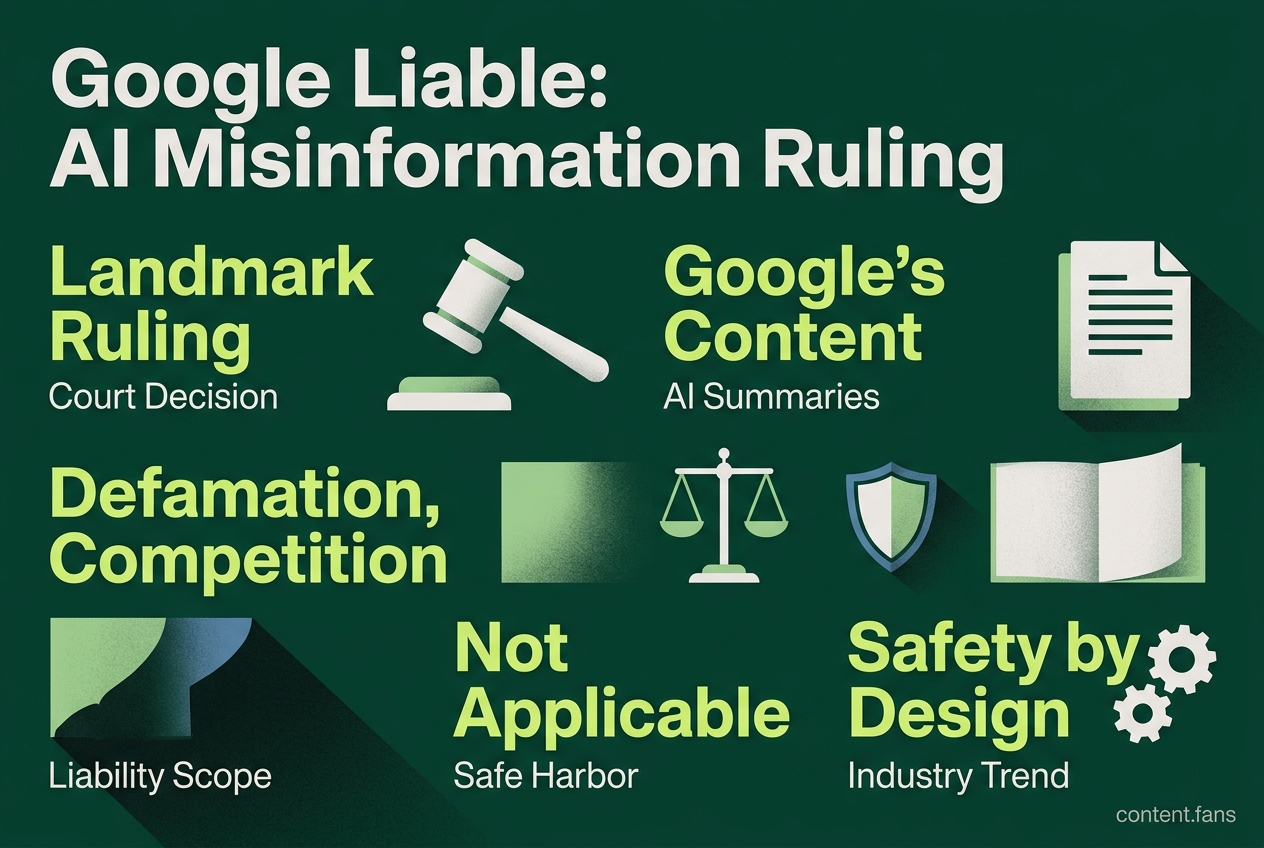
- The case (Ref: 26 O 869/26) stemmed from complaints by two publishers who alleged AI Overviews falsely associated their businesses with scams and subscription traps.
- According to Deutsche Welle, the court defined the AI summaries as "independent, new, and substantive" content attributable directly to Google, not merely repurposed information.
- A temporary injunction on May 28, 2026, requires Google to stop publishing the false claims and cover a significant portion of legal costs.
How the case unfolded
The lawsuit was initiated after publishers found AI Overviews were damaging their brands by linking them to unethical practices. Google defended its tool by pointing to source links and disclaimers, but the court dismissed this argument. Judges concluded that because the AI-generated text presents an authoritative narrative controlled by Google, it is not protected by the safe harbor provisions that typically shield search engines.
Following an oral hearing on April 23, 2026, the court released its written decision weeks later. While Google has indicated it may appeal the ruling, an official schedule for an appeal has not been confirmed.
Immediate legal implications
By classifying AI Overviews as Google's own statements, the ruling exposes the company to immediate liability under German defamation and unfair competition laws. This precedent could shape how other EU courts handle AI-generated content, particularly with key decisions pending like CJEU reference C-250/25 on LLM training. Legal experts advise that platform operators must now meticulously document their safety guardrails, disclaimers, and takedown procedures, as system design may be scrutinized in future negligence claims.
Product and moderation impact
The Munich verdict reinforces the growing industry trend of "safety by design" for generative AI systems. Analysts highlight that the court's focus on interface choices, such as placing the AI summary prominently at the top of search results, sets a new standard. To mitigate risk, companies are now expected to implement stronger content refusal logic, more prominent warnings, and regular post-deployment audits.
Developers are already creating new compliance checklists that include:
* Logging alternative phrases considered during text generation.
* Documenting the rationale behind the selection of specific safety guardrails.
* Establishing clear escalation protocols for content involving individuals or small businesses.
Although this case centered on defamation, legal commentators predict the same logic could be applied to copyright infringement, such as an AI reproducing protected works. The ruling clearly signals that generative AI tools integrated into consumer products will face a higher level of legal scrutiny than conventional search engines.
What exactly did the Munich court decide in June 2026?
The Regional Court of Munich issued a temporary injunction ordering Google to stop repeating specific false claims made by its AI Overviews and to cover a significant portion of the legal costs. The court ruled that AI-generated summaries are Google's own content because they create "independent, new, and substantive statements" rather than neutral search results. Google must therefore accept liability when those statements are false or defamatory.
Why did Google's usual search-engine defenses fail?
Google argued users could click through to the cited links and should know AI outputs might be unreliable. The court rejected both points, ruling that AI Overviews are presented as self-contained facts, not merely pointers to third-party material. This means traditional platform exemptions for search engines do not apply.
Who brought the case and what was at stake?
The dispute was filed by two Munich publishers who discovered that AI Overviews incorrectly associated them with scams, subscription traps, and dubious business practices. By treating the AI text as Google's own utterance, the court gave the publishers a direct path to demand takedowns and damages.
How does this ruling fit the wider 2024-2025 legal trend in Europe?
Across Europe, courts are increasingly treating AI output as a product design issue rather than just speech. Key developments include:
- Munich - OpenAI case (2026): A Munich ruling involving OpenAI and copyrighted lyrics addressed training and output copyright issues.
- Hamburg case (2024): Courts have examined text-and-data-mining privileges, though specific outcomes regarding research protections remain under review.
- CJEU reference C-250/25 (pending 2025): the EU's top court may soon decide whether LLM training itself counts as illegal reproduction, potentially harmonising the patchwork of national decisions.
What practical changes should platform and product teams make now?
Law firms and compliance advisors recommend shifting from content-policy thinking to safety-by-design engineering:
- Build robust guardrails and refusal rules - weak limits are already being framed as design defects.
- Add age gates and parental controls where minors or vulnerable users are foreseeable.
- Provide clear, prominent warnings that AI outputs may be unreliable and offer easy human escalation paths.
- Keep detailed records of alternative safeguards that were considered and tested; documentation is now a key defensive asset.
- Plan continuous post-market monitoring to catch and correct false or harmful summaries after launch.
These steps reduce exposure to the growing body of product-liability style claims that treat an AI summary as an unsafe product rather than protected speech.