
Munich Court Holds Google Liable for AI Overview Defamation
Serge Bulaev
A Munich court issued a preliminary order that holds Google responsible for false statements made by its AI Overviews in search results. The court said these AI summaries seem to be Google's own statements, linking two publishers to scams and causing possible defamation. Google plans to appeal, but must follow the ruling for now unless a higher court changes it. The court's decision may influence how other EU countries handle similar cases and could lead to stricter rules on AI-generated content. This case might also mean AI companies will need to verify or label AI-generated statements to avoid misleading users.
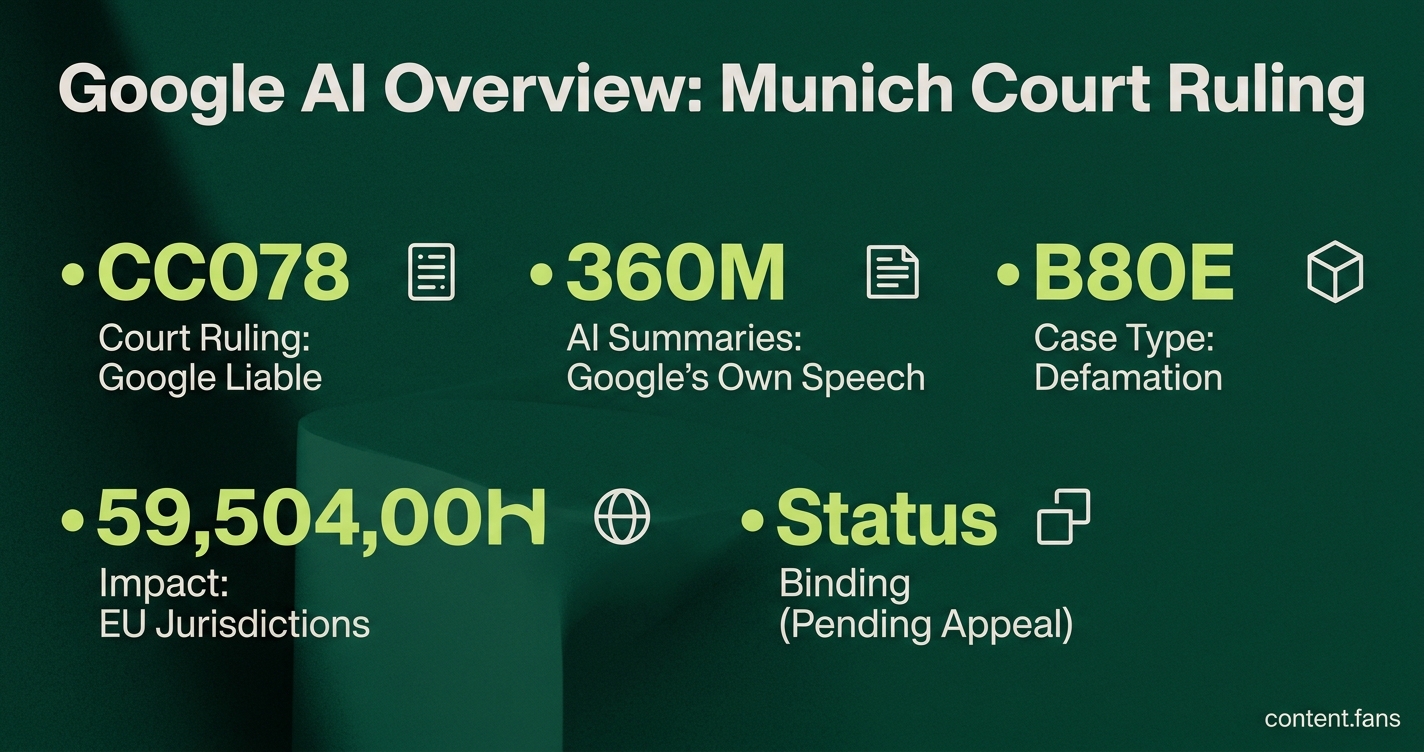
A landmark preliminary injunction from the Munich court holds Google liable for AI Overview defamation, establishing that the company is directly responsible for false statements generated by its AI search feature. According to reporting from PPC Land, the late May 2026 ruling treats AI summaries as Google's own speech, not neutral third-party content.
The court determined that AI Overviews generate "independent, new, and substantive statements." Because these statements falsely linked two Munich publishers to scams, the court found Google directly liable for defamation. While Google has confirmed it will appeal, the order is binding unless suspended by a higher court.
How the Munich case unfolded
- 20 Jan 2026 - first screenshots of the disputed Overviews recorded by the plaintiffs.
- 2 Feb 2026 - formal cease-and-desist notice sent to Google.
- 23 Apr 2026 - oral hearing in case 26 O 869/26.
- 28 May 2026 - injunction granted, with potential fines for each violation and legal costs assigned to Google.
The Munich court ruled that Google is directly responsible for defamatory content produced by its AI Overviews. It determined these summaries are Google's own statements, not neutral search results, ordering it to stop the false claims and holding it accountable for potential damages and legal fees.
The court rejected Google's argument that users could simply check cited sources, emphasizing that the platform "controls the final text" it publishes (link). This reasoning is poised to influence other EU jurisdictions as they evaluate liability for AI-generated content versus hosted third-party material.
Immediate implications for product design
The ruling suggests several urgent adjustments for AI search features:
1. Tighter thresholds before an Overview appears, especially on defamation-sensitive queries.
2. Stronger cross-checks that every sentence aligns with a verifiable source.
3. Fallback to links-only results when confidence is low.
4. Entity-specific safeguards for named individuals and companies.
5. Human escalation paths for disputed claims.
Interaction with the EU AI Act
While this case centers on defamation, the injunction arrives as the EU AI Act's rules on generative AI are being phased in. The Act's mandate for labeling synthetic content, combined with the Munich court's liability logic, intensifies pressure on providers to verify or withhold AI outputs that could mislead users.
Comparison with other German cases
Legal observers draw parallels to recent Munich decisions involving AI providers, where courts have shown willingness to hold AI companies directly responsible for harmful content their systems generate.
What happens next
As a preliminary injunction, the order can be revised or overturned on appeal. Google's challenge will test whether higher German courts agree that AI Overviews constitute the company's own speech. For now, the ruling is a key indicator that European courts may hold platforms accountable for AI-generated statements, regardless of disclaimers.
What did the Munich court decide about Google and AI Overviews?
The Munich Regional Court issued a preliminary injunction declaring that Google can be held directly liable for defamatory statements generated by its AI Overviews feature. The court ruled that AI Overviews are "independent, new, and substantive statements" attributable to Google itself rather than neutral representations of third-party content, and ordered Google to cease repeating specific false claims tying two Munich publishers to scams and fraud. Google was directed to pay a significant portion of the legal costs and faces potential fines for future violations. Google has already announced its intention to appeal.
Why does the ruling matter beyond Google?
For any platform that synthesizes information into automatically generated answers, the decision sets a significant early-stage precedent: the court rejected the traditional safe-harbor argument that the feature merely surfaces links and placed responsibility on Google for the exact wording produced by the model. This shifts default risk toward providers of retrieval-augmented generation (RAG) systems and signals that disclaimers alone may not protect against liability. While still at the injunctive stage and not yet binding across the EU, the reasoning is already being studied by product, policy, and legal teams at major tech companies.
How could this change Google Search and similar services?
Expect tighter pre-publication moderation and more conservative generation policies:
- Query-level gating - AI Overviews may be withheld entirely for reputation-sensitive keywords such as "fraud," "scam," or named entities.
- Entity-aware blocking - special rules for people and companies to prevent defamation.
- Higher evidence thresholds - only answers that can be cross-verified against cited sources will surface.
- Fallback to links-only - users might see classic blue links instead of a generated paragraph when the model is uncertain.
- Jurisdiction-specific behavior - EU users may experience more limited AI answers than users elsewhere.
User-experience teams are already modeling refusal rates and engagement impacts to prepare for these changes.
Is this part of a broader EU trend?
Yes. The Munich injunction joins other recent Munich decisions involving AI companies where courts have treated memorized and reproduced copyrighted content in AI models and outputs as copyright infringement. EU AI Act obligations are being phased in with various transparency duties taking effect at different stages. Together, these cases show German courts moving toward greater platform accountability for both training data and final outputs of generative systems. Growing regulatory pressure exists to identify or watermark synthetic text in search results.
What should product and compliance teams do now?
- Map defamation risk - catalog queries that frequently combine entities with negative terms.
- Design escalation paths - create human review workflows for high-risk outputs.
- Review source grounding - strengthen the link between every generated sentence and verifiable references.
- Monitor appeals - the case may evolve; set alerts for updates in the Munich appellate court.
- Plan for regional variants - build the technical ability to serve stricter EU answers without affecting global users.