
MSPs Turn Internal AI Agents Into Recurring Revenue
Serge Bulaev
Managed service providers (MSPs) may be turning their own AI assistants into a steady source of income by offering them as subscription services. Reports suggest that this shift helps MSPs handle support tickets faster and improve profits. Many MSPs appear to be packaging these AI tools for clients, often starting internally and then selling versions to customers. Some studies estimate that service-desk automation might cut ticket numbers by 40-60 percent, but only about two-thirds of users see clear benefits. There may still be concerns about security and workflow design, so extra features like audit logs and human oversight are sometimes added to reassure clients.

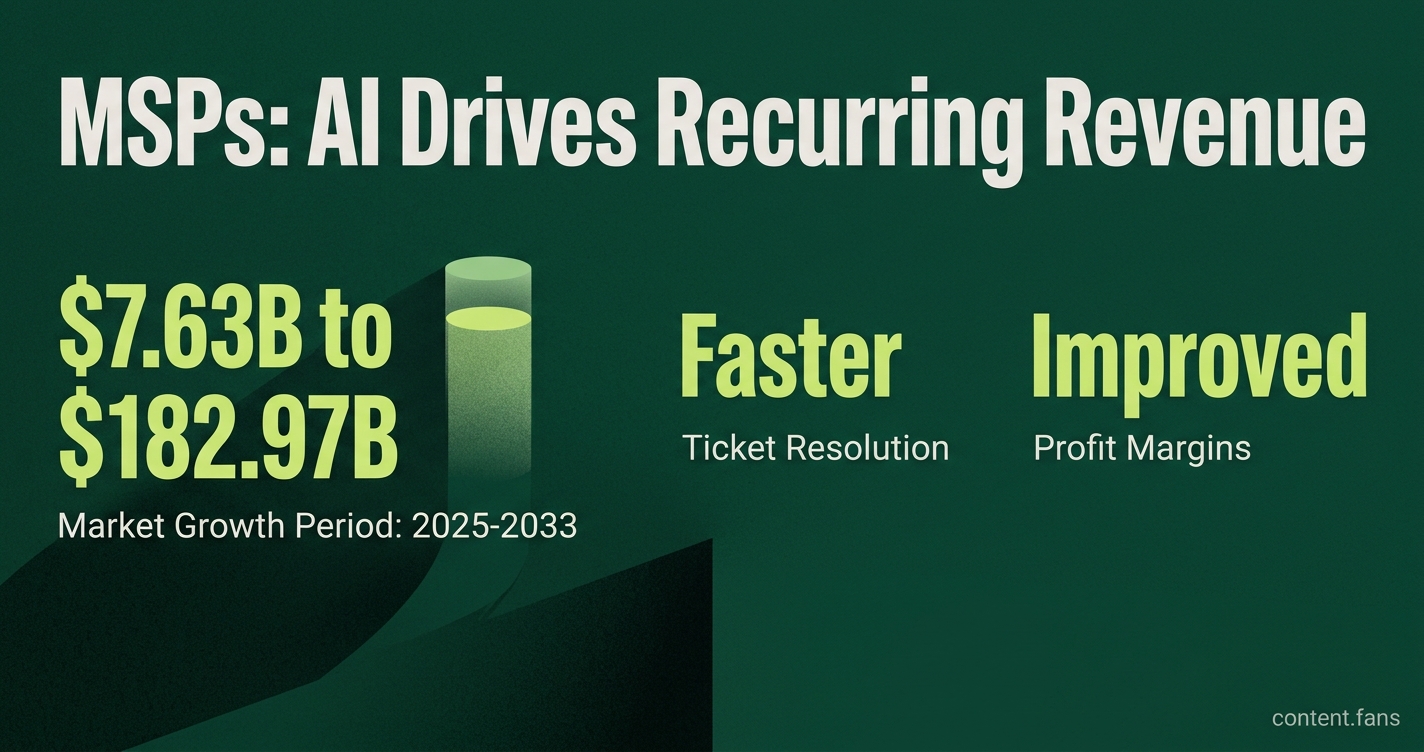
Managed service providers (MSPs) are successfully turning internal AI agents into new recurring revenue streams by productizing their own automation tools. Early adopters of this strategy report significant gains, including faster support ticket resolution and improved profit margins, marking a strategic shift from one-off projects to predictable subscription income.
How "MSPs hit the agentic AI jackpot" plays out on the ground
MSPs are creating new revenue by packaging internal AI agents, like HR or help-desk bots, into scalable, managed subscription services for their clients. This approach transforms internal efficiency tools into a sellable product, complete with monthly support, tuning, and outcome-based pricing models that generate predictable income.
According to Matt Linn in the Thread Service Magic Blog, a common strategy involves building an internal tool, like an HR chatbot, and then productizing it for clients. Before commercializing an AI agent, providers should confirm it can scale, requires minimal support, and delivers measurable results. Industry reports suggest that service-desk automation can significantly reduce ticket volume. Furthermore, a growing number of MSPs are increasing AI spending, bundling agents with onboarding, tuning, and governance to create new managed service line items.
Key Building Blocks for AI-Based Recurring Revenue
Profitable AI service models are built on four key pillars:
- Internal-First Development: Perfecting agents internally using platforms like Microsoft Copilot Studio before client deployment.
- Repeatable Deployment: Using standardized patterns for delivery, such as Microsoft Teams or web widgets.
- Managed Support: Offering monthly packages that include monitoring, support, and prompt engineering updates.
- Outcome-Oriented Pricing: Shifting billing from hourly labor to value-based fees tied to performance outcomes.
The Managed Services Journal reinforces this, observing that top-performing firms treat AI agents as "digital workers" and favor value-based pricing. The market potential is enormous; a Grand View Research study projects the AI agents market will grow from USD 7.63 billion in 2025 to USD 182.97 billion by 2033, signaling massive demand for MSP-managed help-desk, HR, and workflow automation bots.
How Internal Efficiency Paves the Way for External Services
Mastering internal AI automation is the first step. Industry reports indicate that automated triage and predictive maintenance can lead to significantly faster resolution for common tickets. Studies also suggest that automating after-call work can substantially reduce handle time. These internal efficiency gains free up technicians for higher-value advisory roles, directly building the business case for offering AI optimization as a managed service tier.
Overcoming Common Client Adoption Barriers
Despite the opportunity, client adoption can be challenging. A 2025 PwC survey found only two-thirds of adopters realize clear productivity gains. Additionally, Joget highlights IDC data indicating many pilots fail due to security and workflow design issues. To overcome these hurdles, successful MSPs proactively bundle their AI agents with security features like audit logs, role-based access controls, and human-in-the-loop oversight to build client trust.
Today's pioneers typically start by productizing a help-desk chatbot before expanding to HR self-service or automated reporting. Key success metrics focus on reduced ticket volume, faster mean time to resolution (MTTR), and maintaining a stable headcount during growth.
What exactly is an "AI agent" in an MSP context?
Think of it as autonomous digital labor that lives inside the tools you already use - Teams, PSA, RMM, CRM.
Unlike a chatbot that waits for questions, an agent wakes up on a schedule or trigger, pulls the data it needs, takes action (reset a password, open a ticket, update an asset record), and writes back the outcome.
Thread calls this the jump from "cool demo to sellable product": if the same agent script runs for >1 client and you can support it month-after-month, you have a recurring SKU instead of a one-off script.
How fast is the market for agent-powered MSP services growing?
The global AI-agent segment is projected to swell from USD 7.63 billion in 2025 to USD 182.97 billion by 2033, a 49.6% CAGR.
Industry reports indicate that many MSPs are planning to raise AI spending this year, and early adopters already report significant reductions in level-1 tickets.
In short, clients are moving from "tell me about AI" to "how many agents can you manage for me monthly?"
Which internal automations should we productize first?
Start with the workflows already saving your own technicians' time:
1. HR/agent in Teams that surfaces PTO balances and handbook answers
2. Help-desk triage agent that tags, prioritizes, and suggests KB articles
3. Patch-verification agent that checks endpoints post-update and auto-closes tickets
Package each with a fixed onboarding fee + monthly support retainer; the Thread blog shows partners flipping exactly these three use cases into USD 5-15 per-seat monthly SKUs.
How do we price and deliver agent services so they feel "managed"?
Move from hours to outcomes.
Managed Services Journal notes that top-quartile MSPs now bill for:
- per-agent monthly fee (covers hosting, prompt tuning, security reviews)
- outcome credit (e.g., every password reset handled without a human earns the client a rebate against their managed-services bundle)
Include a lightweight governance dashboard (audit trail, escalation queue, confidence scores) so the client sees continuous value - and you lock in 12- to 36-month contracts.
What adoption hurdles should we prepare for - and how do we clear them?
- Pilot-to-production gap: many enterprise AI pilots struggle to make it to live deployment; shorten the cycle with a 30-day "agent-in-a-box" template tied to one data source and one KPI
- ROI proof: PwC finds a significant portion of adopters see measurable productivity gains; arm your sales team with a one-page calculator showing ticket avoidance, MTTR reduction, and labor savings
- Security & oversight: clients worry about rogue automation; offer human-in-the-loop approvals, role-based scopes, and immutable audit logs as standard, not add-ons