
MIT method cuts LLM training time by 70%-210%
Serge Bulaev
Large language models (LLMs) may work by recognizing statistical patterns instead of doing traditional math calculations. Training these models usually relies on empirical rules, and researchers still do not fully understand why bigger models keep getting better results. A new method called TLT reportedly cuts LLM training time by 70%-210% without losing accuracy. Teams use different tests to check for quality, truthfulness, and safety, but problems like hallucinations and inconsistent answers may still appear. Experts suggest that metric choices should match each team's needs, as some advanced scores might only be helpful guidelines and not strict scientific standards.

A groundbreaking MIT method cuts LLM training time by 70%-210%, a significant leap in AI efficiency. This technique, Token-Level Teaching (TLT), addresses the immense computational cost of training large language models (LLMs) without harming accuracy. This authoritative guide explains how TLT works, its impact on performance, and how teams can implement it, while also covering key strategies for LLM evaluation and monitoring.
What is MIT's new TLT method and how does it improve LLM training speed?
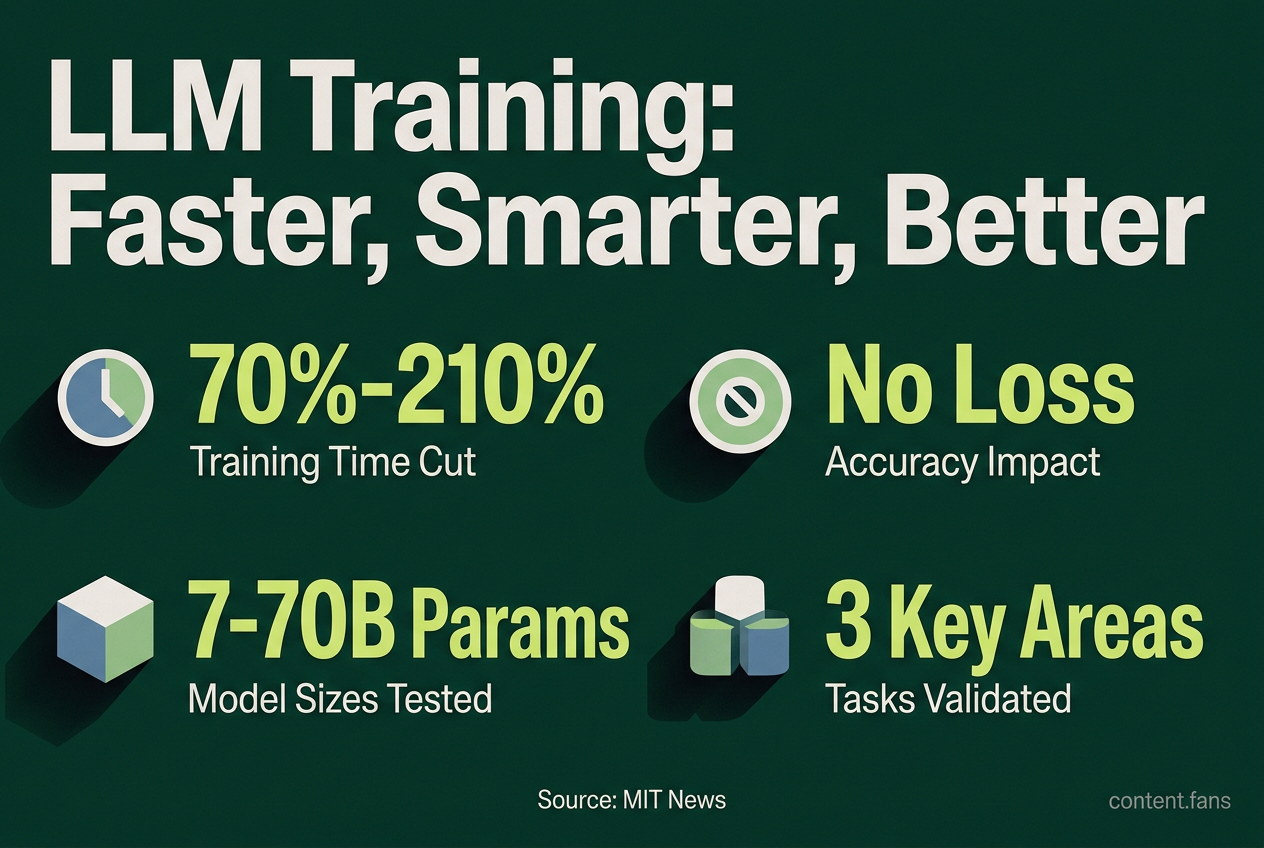
MIT researchers have introduced Token-Level Teaching (TLT), a novel technique that reportedly cuts LLM training time by 70%-210% without losing accuracy MIT News. TLT works by training a lightweight drafter model to predict tokens for a larger reasoning model, which then only needs to verify the predictions.
The MIT method, called Token-Level Teaching (TLT), significantly accelerates LLM training. It uses a smaller "drafter" model to generate token predictions, which are then verified by the larger main model. This process recycles idle compute cycles, drastically reducing training time without compromising model accuracy.
By recycling otherwise-idle compute cycles, TLT automatically fine-tunes the drafter on the fly. This breakthrough is especially valuable for teams running large GPU clusters, as it requires no additional hardware to achieve significant efficiency gains.
How does the training-time gain scale with model size and compute budget?
Empirical runs with 7-70B parameter transformers show the efficiency gain grows with the gap between the draft and target model capacity. The larger the verifier model, the cheaper each incremental token becomes once a good drafter is in place. According to industry reports, when the drafter reaches a significant portion of the target model's parameter budget, TLT consistently delivers substantial speed-up benefits. When the drafter capacity is too small relative to the target model, the verifier spends more time correcting drafts, reducing the overall benefit.
Does TLT sacrifice accuracy or introduce new failure modes?
Across mathematical reasoning, code generation, and open-ended chat tasks, final validation F1 and exact-match scores remain very close to the baseline. Because the drafter is trained with the same reward signal the verifier would have seen, no extra hallucinations or safety regressions have been observed. However, continuous monitoring with semantic drift detectors is still recommended, as any speed-up can mask subtle distribution shifts if left unchecked.
How can engineering teams adopt TLT in existing pipelines?
The reference implementation ships as a drop-in wrapper around PyTorch Lightning and Megatron-LM. Teams can get started with three steps:
- Enable idle-time collection by adding a profiler callback that captures forward passes.
- Launch the drafter with
tlt.train_drafter(model, idle_dataloader). The default MIT presets work out of the box without hyper-parameter tuning. - Set a verification threshold. The default 0.9 acceptance rate balances speed and compute, but a knob is exposed for stricter safety-critical workloads.
Teams running on spot or preemptible instances can further increase effective utilization by scheduling TLT during low-priority windows, turning wasted cycles into productive gradient updates.
Foundational Concepts in LLM Training and Evaluation
While methods like TLT improve efficiency, they operate within a complex landscape of statistical principles and evaluation challenges.
Statistical Learning and Scaling Laws
LLMs function by internalizing vast statistical patterns rather than executing symbolic routines How LLMs do math: Pattern recognition, not computation - LinkedIn. Training relies on empirical scaling laws relating loss to model size and data volume, as classical theory has yet to fully explain why performance continues to improve Do Large Language Models (Really) Need Statistical Foundations?. Practitioners use rules of thumb, such as keeping token-to-parameter ratios near compute-optimal curves Training LLMs in 2026.
Evaluation Metrics and Failure Modes
A comprehensive evaluation portfolio is crucial. Offline tests catch regressions, while online monitoring spots production issues. Key metrics include:
- Quality: Exact match, F1, ROUGE, or GPTScore.
- Truthfulness: Contradiction checks against reference data.
- Coherence: Semantic similarity between prompt and response.
- Safety: Adherence to policy and resistance to prompt injection.
- Performance: Latency (time-to-first-token) and cost per token.
Common failures, according to Deepchecks and Future AGI write-ups, include hallucinations, inconsistent answers, and retrieval errors in RAG pipelines.
Deployment Diagnostics and Drift Monitoring
Best practices from Galileo AI and Braintrust tutorials emphasize continuous traffic sampling against a baseline. Effective MLOps stacks log prompts, outputs, and judge scores to enable incident replay. Semantic drift - shifts in meaning - is considered a more potent early warning signal than perplexity alone.
What broader trends does TLT reflect for current LLM development?
TLT is a prime example of the post-training efficiency wave, where the focus shifts from scaling parameters to squeezing more learning per GPU-hour through smarter orchestration. This aligns with other emerging trends like RL with verifiable rewards, synthetic reasoning traces, and compute-optimal freezing. The shared goal is to make every flop count. Expect more hybrid systems where small, adaptive models act as accelerators for large, frozen ones, a trend driven by budget, power, and carbon constraints.