
MINT.ai and Uplane detail AI operational layer for marketing
Serge Bulaev
MINT.ai and Uplane describe a framework for using AI in marketing that may help teams move from small pilot projects to everyday operations. Case studies suggest that having creative management, ad serving, and measurement on one data foundation might lead to better and faster results. The approach includes five layers: collecting data, unifying customer IDs, orchestrating workflows, AI-driven decisions, and activating plus measuring campaigns. Experts say a phase-based rollout - starting with assessment and a small pilot - could help teams scale up safely. Good governance and privacy controls appear to be important, and some reports suggest integration depth, not just the number of tools, determines success.

Scaling AI in marketing from pilot to production requires a unified AI operational layer for marketing. MINT.ai and Uplane have detailed a framework that provides repeatable steps for building this layer. Case studies demonstrate that integrating creative management, ad serving, and measurement on a single data foundation allows AI models to learn from cleaner signals and optimize results more rapidly.
Recent case studies highlight the framework's success. MINT.ai implemented an AI operational layer that unified media planning across multiple markets for a CPG giant, significantly boosting spend transparency and reporting agility (MINT.ai case studies). Similarly, Uplane's 2025 playbook shows how a subscription brand substantially increased its creative testing frequency, identified winning ads significantly faster, and achieved meaningful reductions in cost per acquisition (Uplane playbook). These results confirm that deep system integration, not the sheer number of tools, drives performance gains.
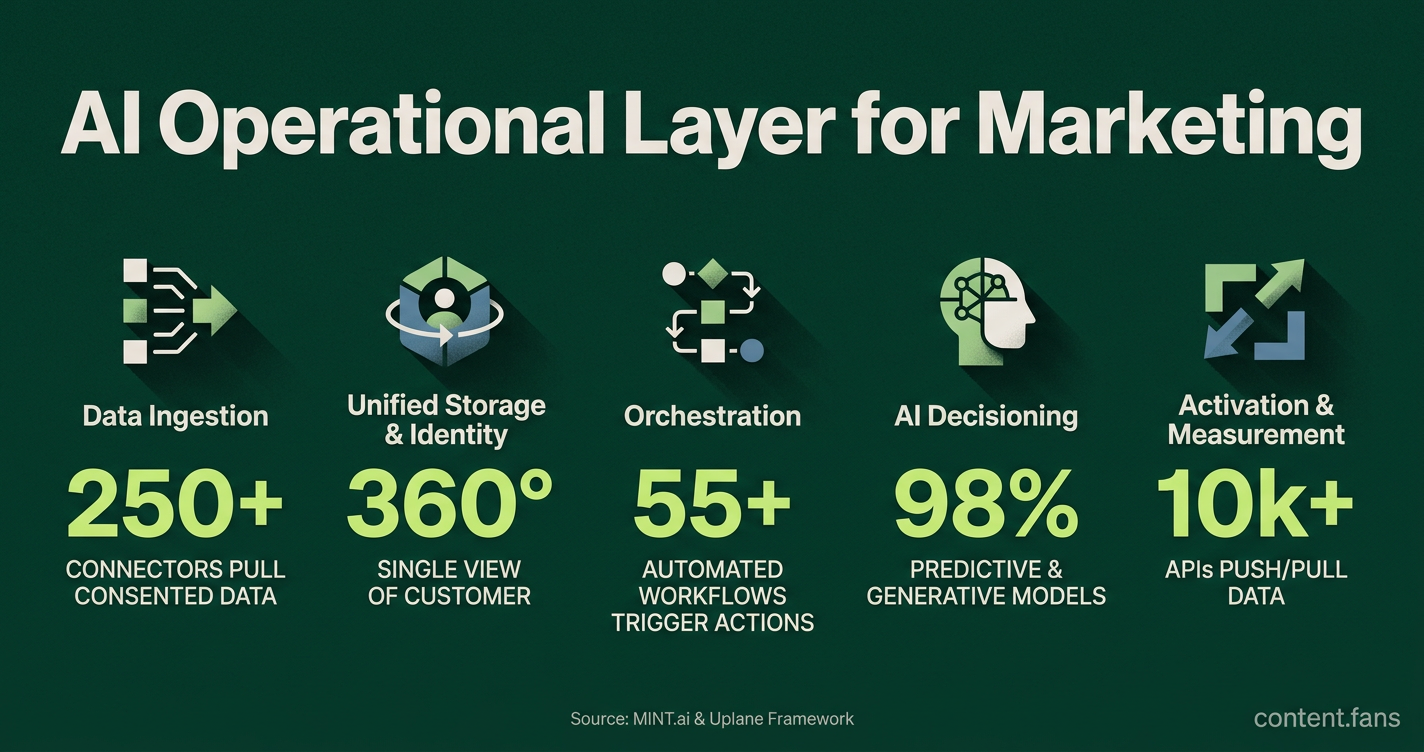
Five-layer reference architecture
This reference architecture provides a structured approach for centralizing marketing data and workflows. It enables AI-driven decisioning by connecting data ingestion, identity resolution, campaign orchestration, and activation on a single platform, creating a high-velocity feedback loop for continuous optimization and improved campaign performance.
- Data Ingestion Layer: Connectors pull consented data from CRM, analytics platforms, and media logs into a central cloud data lakehouse.
- Unified Storage and Identity Layer: Customer IDs are resolved across all channels to create a persistent, single view of the customer.
- Orchestration Layer: Automated workflows trigger actions like creative generation, audience updates, and budget reallocations based on AI model outputs.
- AI Decisioning Layer: Predictive and generative models analyze data to rank creatives, forecast campaign outcomes, and recommend the optimal channel mix.
- Activation and Measurement Layer: APIs push automated decisions to ad platforms and pull back near-real-time performance data to close the loop.
Industry reports suggest that market leaders leverage this layered architecture to build real-time audiences and fluidly reallocate budgets across channels, maximizing ROI.
Phase-based rollout
A phased rollout ensures a scalable and manageable implementation:
- Assess: Begin by mapping all current data flows, classifying datasets by sensitivity level, and defining clear success metrics. MINT's projects often start with a four-week audit to identify data redundancies and compliance risks.
- Pilot: Select a single region or business unit for an initial launch. For example, a Uplane client in the travel sector first connected its CRM, web analytics, and paid media to an orchestration hub. Keeping pilots under 90 days is crucial for maintaining stakeholder momentum.
- Scale: Systematically expand to more channels and integrate additional AI models. Industry data suggests that a significant portion of firms that successfully scale their AI initiatives use API-first platforms, which allow for swapping components without major architectural rewrites.
Governance considerations built in
A privacy-by-design approach is essential. Following recommendations from industry contributors, organizations should establish a cross-functional Data Governance Council. This council is responsible for approving vendor access, mandating privacy impact assessments, and overseeing data retention schedules. Integrating these controls from the start prevents costly retrofits.
A design checklist should include:
- Verify Consent: Ensure consent strings are passed with user IDs across the entire data pipeline.
- Anonymize Data: Mask or pseudonymize sensitive fields before they are accessed by AI models.
- Maintain Audit Trails: Log all automated model decisions and any manual overrides for full auditability.
- Review Contracts: Scrutinize vendor contracts to prohibit unauthorized data reuse for external model training.
Furthermore, MMA Global's framework highlights that upcoming regulations like the EU AI Act will likely require marketers to document model lineage. Maintaining a searchable catalog of all datasets and experiments is a proactive step that can significantly shorten future compliance cycles.
Performance loops that feed themselves
With the operational layer in place, powerful, high-velocity feedback loops emerge. Industry case studies demonstrate substantial improvements in click-through rates and significant reductions in cost-per-purchase by adjusting creatives and bids hourly. Similarly, a Uplane retail case saw testing cycles accelerate significantly once the decisioning and activation layers shared a common taxonomy. This evidence suggests model freshness is driven more by unified data pipelines than by algorithm complexity.
The architecture also integrates critical human-in-the-loop safeguards. Following Google's agentic design patterns, workflows can automatically route sensitive creative themes to a manual review queue within the orchestration layer. This allows enterprises to enforce brand safety standards without interrupting routine campaign optimizations.
Looking ahead for 2025 budgets
Looking toward 2025 budgets, industry research on agentic AI emphasizes "governed autonomy" as a key design principle. Marketing teams that adopt a composable, microservices-based architecture with centralized governance can achieve meaningful reductions in time-to-market for new AI applications. As vendors increasingly provide policy-aware APIs, integrating new channels becomes a simpler task, avoiding costly platform rebuilds.
What exactly is a "unified operational layer" in AI-driven marketing?
A unified operational layer is the connective tissue that links Creative Management, Ad Serving, and Measurement into a single pipeline. Instead of three siloed stacks, teams get one governed environment: creative assets, campaign settings, and performance data flow through the same pipes so AI models always learn from the most recent, highest-quality engagement data [1][2][7].
- Creative Management - stores modular assets, variants, and metadata
- Ad Serving - holds delivery rules, bids, budgets, and audience signals
- Measurement - streams back Impressions, Clicks, Conversions, and Revenue
When these three domains share a single schema and IDs, AI can re-optimize in minutes rather than days.
How do MINT.ai and Uplane prove this layer works in practice?
Recent results show the value:
- MINT.ai deployed the layer for a Telco with significant annual spend and delivered media-planning unification across multiple markets with full spend transparency and weekly re-forecasting [1].
- Uplane enabled a consumer-subscription brand to substantially increase testing frequency, cut the time to spot winning creatives significantly, and lowered CPA meaningfully the next quarter [2].
These cases confirm that once the unified layer is in place, AI optimization becomes repeatable and measurable rather than a one-off experiment.
Which technical pieces must be in place for implementation?
Teams should install four sequential blocks:
- Data Ingestion - real-time connectors to ad platforms, CRM, and analytics
- Centralized Storage - CDP or data lakehouse with a standard customer ID and creative fingerprinting
- Orchestration - workflow engine that triggers re-training, budget shifts, and new variant requests
- Model Access - governed API so any marketer can call an audience predictor or creative-generator without re-coding
Many companies that scaled AI rely on API-first, micro-services stacks so individual components can be swapped out without rebuilding the whole layer [2].
What governance and privacy measures are non-negotiable?
Industry frameworks list must-have safeguards:
- Consent Integration - connect CMP to CRM and ad servers so permissions flow downstream [2]
- Data Minimization - store only fields required for the declared AI purpose
- Human-in-the-loop gates for sensitive creative or targeting decisions [8]
- Vendor Compliance - contractual clauses that prevent partners from re-using data for model training [2]
Creating a cross-functional Data Governance Council (legal, privacy, security, marketing, data engineering) keeps oversight continuous rather than reactive.
How should teams roll this out without overwhelming the organization?
The safest path is the three-phase approach recommended by both MINT and industry experts:
| Phase | Duration | Goal | Key KPI |
|---|---|---|---|
| Assess | 4-6 weeks | Map existing stacks, tag gaps, set governance charter | % of data sources connected |
| Pilot | 8-12 weeks | Launch on one product line, two channels | CPA delta vs. control |
| Scale | 3-6 months | Expand to all markets, add new AI use cases | Time-to-insight < 24 h |
Using a governed pilot limits legal risk while proving ROI before enterprise-wide spend [1][7].
Sources
[1] Case Studies - MINT.ai
[2] AI Marketing Automation Playbook - Uplane