
Microsoft's Nadella updates AI strategy: build learning loops to avoid commodity models
Serge Bulaev
Satya Nadella, Microsoft's CEO, warns that if only a few AI models control most of the value, it may not be accepted by society and could harm entire industries. He suggests that companies should focus on building their own learning loops, where feedback and human oversight help improve models, instead of relying only on outside AI models. Reports suggest that if AI becomes too concentrated, companies might lose control and value to a few big models. Early examples show firms using human checks and their own data to keep improving their AI systems. This approach may help companies stay strong even if AI models themselves become widely available and similar.

Microsoft CEO Satya Nadella's updated AI strategy centers on a stark warning: companies must build proprietary learning loops to avoid the commoditization trap. He cautions that an over-reliance on a few dominant AI models could "hollow out entire industries," a scenario he argues would be politically and socially untenable according to reports from TheStreet and Hindustan Times. Nadella's prescription is organizational, not just technical. When AI models become widely available, the durable advantage shifts from the model itself to the enterprise's unique data, human oversight, and feedback systems. MIT economist Christian Catalini frames this as "Nadella's Test" - what value remains once you remove the underlying model?
Passing 'Nadella's Test': The Frontier Ecosystem
Nadella's strategy advises companies to build a durable advantage by focusing on their unique data, human oversight, and feedback systems. This 'learning loop' creates institutional knowledge that remains valuable even if the underlying AI models become interchangeable commodities, ensuring long-term resilience and control over their own destiny.
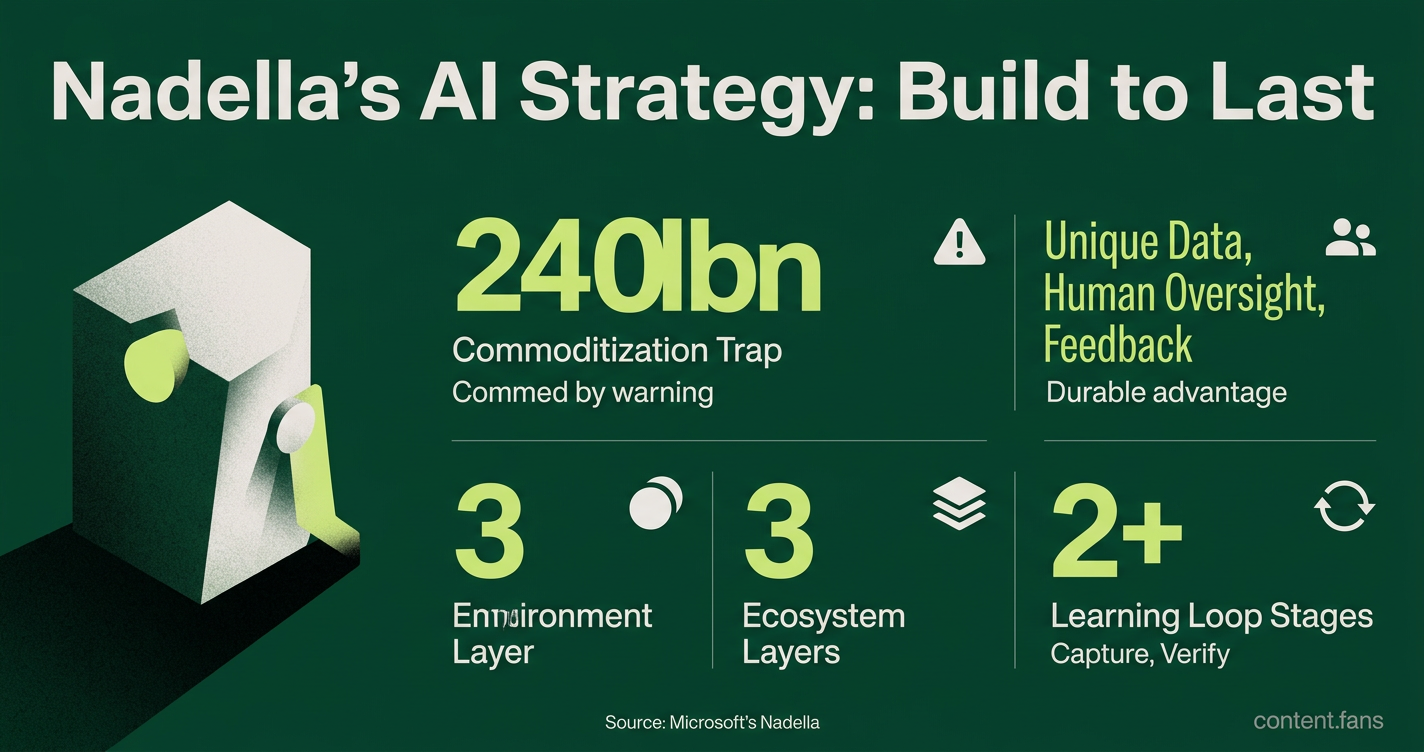
To achieve this, Nadella outlined a three-layer "frontier ecosystem" designed to keep institutional knowledge within the organization:
- An Experience Layer: Embeds copilots and agents directly into daily workflows to capture user interactions.
- A Platform Layer: Allows teams to build with or swap out different AI models without losing historical context or data.
- A "Token Factory": Mints proprietary data, business rules, and human feedback into new training signals for continuous improvement.
The Economic Risk of AI Concentration
Foundation-model markets often exhibit winner-takes-most dynamics. If this power consolidates, most companies may be forced to rent intelligence rather than develop it internally. Nadella warns that companies could end up "ceding value to a few models that eat everything they see." This scenario not only weakens a company's bargaining power but also reduces the incentive to build and verify ground-truth datasets, raising systemic risk.
The Anatomy of a Proprietary Learning Loop
A proprietary learning loop turns every user interaction into a signal for model improvement. This flywheel effect, which Startupik notes is harder to copy than raw model performance, typically involves several stages:
- Capture: Log user queries, system actions, and final outcomes.
- Verify: Route sensitive or ambiguous outputs to subject-matter experts for review and correction. This human-in-the-loop design is critical for high-stakes use cases (Parseur).
- Store: Write verified corrections and feedback into a governed, auditable database.
- Retrain or Retrieve: Feed these high-quality signals back into the model through fine-tuning or retrieval-augmented generation (RAG).
- Measure: Continuously track downstream business metrics to guide further tuning and prove ROI.
Learning Loops in Practice: Early Industry Examples
Across industries, leading firms are already implementing this strategy. Financial services companies are capturing audit trails that link every AI-generated recommendation back to a human approver. In manufacturing, quality-control images are fed into nightly fine-tuning pipelines to improve defect detection. Healthcare providers are adopting a 'sandwich' model - human intent, machine execution, human underwriting - to ensure safety and accountability, a practice aligned with guidance from MIT Sloan. These examples highlight how proprietary workflow data, which Bowmark calls 'the cornerstone' of differentiation, creates compounding value when paired with human oversight.
Key Metrics for Building a Defensible AI Strategy
To gauge their resilience against model commoditization, executives should monitor these key signals:
- Data Moat: The ratio of proprietary data to public data used in your AI systems.
- Learning Velocity: The time it takes for a human correction to be reflected in the model's behavior.
- Governance: The presence of audited verification workflows for all high-stakes AI-driven tasks.
- Agility: The ability to swap foundation models without re-engineering core business logic or losing data.
Experts agree that firms tracking these signals are better positioned to pass Nadella's test. The decisive asset is not the fleeting edge of a single model but the continuous feedback system built on verifiable data and human judgment.
What exactly is "Nadella's test"?
Christian Catalini coined the phrase to ask: when you drop the frontier model, what distinct value remains? The test evaluates whether a firm's AI advantage is tied to the model itself (commoditized) or to its proprietary data, verification systems, and institutional feedback loops (non-commoditized). Firms that pass the test create a durable moat because their core asset is the learning loop, not any specific model.
How serious is the risk of value concentration in a handful of models?
Satya Nadella calls it a "political-economy" risk:
- "The last thing any of us want is a world where every company across every sector is ceding value to a few models that eat everything they see."
- If that happens, entire industries could be "hollowed out", losing bargaining power and internal expertise (TheStreet, Hindustan Times).
In 2025, investors and policymakers pressed companies to increase capital allocation to AI transformation, prove resilience against AI disruption, and avoid over-reliance on a small handful of dominant vendors, rather than specifically demanding proof that they are not 'renting intelligence.'
What does an enterprise learning loop look like in practice?
A closed feedback cycle that compounds value with every interaction:
- Capture - record every human-Machine interaction (approval, correction, outcome).
- Verify - subject-experts label edge cases and approve high-stakes outputs.
- Feed back - turn verified signals into prompt libraries, retrieval-augmented knowledge bases, or fine-tuning data.
- Govern - maintain audit trails for accountability and compliance (MIT Sloan).
Companies that operationalize this loop often see model-agnostic architecture: swap a foundation model and the system still improves because its institutional memory lives in the workflow layer.
Which assets remain moats when base models commoditize?
| Asset | Why it stays defensible |
|---|---|
| Proprietary operational data | Transaction patterns, domain-specific outcomes, and internal taxonomies are impossible for outsiders to replicate (Bowmark) |
| Human-in-the-loop design | Expert review layers create high-quality training labels and customer trust - critical for regulated or high-precision use cases (Parseur) |
| Learning loops | Each correction becomes a new training signal, compounding advantage over time (Startupik) |
What concrete steps should leaders take in 2025-2026?
- Inventory unique data sources - map every workflow that generates outcome-level signals (support tickets, lab results, fraud decisions).
- Instrument human oversight - embed lightweight approval, rating, and comment captures directly into user interfaces.
- Design reversible model integrations - use abstraction layers so new models can be swapped in days, not months.
- Build an internal AI governance board** including security, legal, and subject-matter experts to oversee feedback ingestion and model updates.
- Measure learning-velocity KPIs - e.g., "mean time from human correction to system improvement" instead of simple accuracy metrics.