
Microsoft's Nadella defines AI's next battleground: the Learning Loop
Serge Bulaev
Satya Nadella, Microsoft's CEO, suggests that the next big step for AI is creating a "Learning Loop" that combines human judgment with a company's own AI tools. This loop takes in decisions, results, and details from real work, then uses that data to teach private AI models, so future tasks get better over time. Examples from companies like Valeo and Toyota show that using these loops may already help save time and improve processes. Experts warn that without these learning systems, companies might face high costs and lose control if they only use outside AI tools. Building and owning this loop might give companies an advantage that others cannot easily copy.

Microsoft CEO Satya Nadella has identified the next frontier in corporate AI: the Learning Loop. This framework creates a durable competitive advantage by shifting focus from simply renting AI models to building proprietary systems that continuously learn from a company's unique data and human expertise. A Learning Loop captures decisions, outcomes, and context from daily workflows, feeding this proprietary data back into private models to drive automatic, compounding improvements over time.
Why Nadella Separates Human and Token Capital
The Learning Loop is a system that pairs a company's proprietary data and human judgment with AI tools. It captures real-world decisions and outcomes, then uses that feedback to continuously retrain and improve private AI models, creating an intelligent asset that grows more valuable with use.
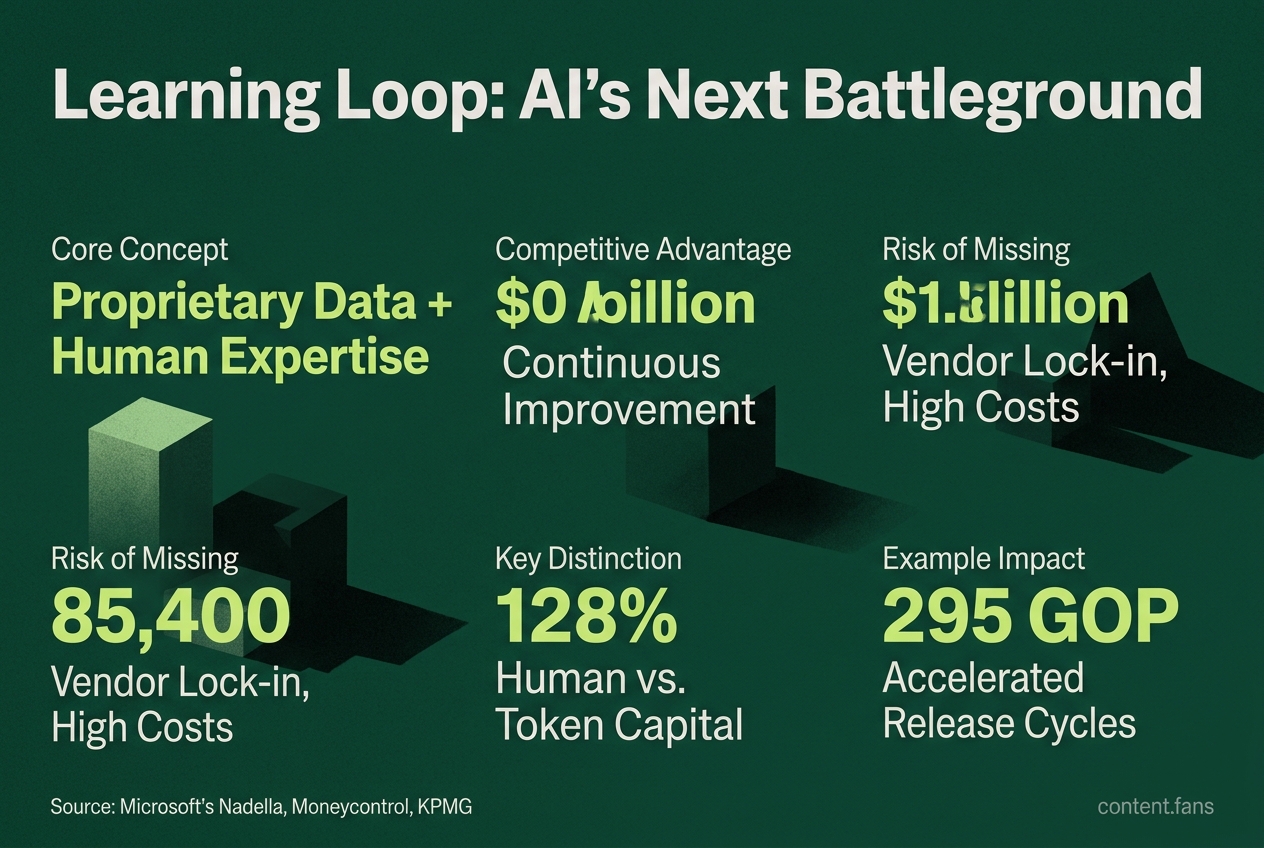
Industry reports suggest Nadella distinguishes between human capital and "token capital." Human capital encompasses the knowledge, judgment, and expertise of employees. Token capital, conversely, refers to the proprietary AI capabilities a company builds and owns. This distinction emphasizes that while AI excels at pattern matching, humans provide the essential, nuanced context. Moneycontrol highlights this synergy as a "cognitive loop," where human and digital systems perpetually reinforce each other to create compounding value.
The Learning Loop in Practice
Leading enterprises are already demonstrating the Learning Loop's operational impact. For instance, automotive supplier Valeo has implemented an AI assistant that generates a significant portion of its code, with each commit training the model on the latest architecture to accelerate release cycles. Similarly, Toyota has deployed a factory platform allowing frontline workers to build lightweight AI, resulting in substantial time savings annually. The value of these loops is durable; the proprietary feedback data remains an asset even if the underlying AI model provider is changed.
- Accenture describes a skills taxonomy called "New Skills Now" and broader skills-driven learning efforts as part of their workforce development initiatives
- Ericsson maintains extensive tailored job profiles updated by real-time usage
- Rivian centralizes verified answers so each question refines the knowledge base
The Risks of a Missing Learning Loop
Conversely, companies that fail to build a Learning Loop risk significant disadvantages. Relying solely on third-party foundation models leads to vendor lock-in, unpredictable costs, and a lack of competitive differentiation. Industry surveys have identified rising token fees as a primary obstacle to scaling generative AI. Furthermore, KPMG commentary warns that such superficial deployments "hardwire dependency" on external providers, ceding strategic control. Without an owned feedback loop, every new AI feature increases operational costs instead of building long-term, proprietary value.
Building the Loop: Practical Priorities
Establishing a proprietary Learning Loop involves several strategic priorities:
- Data Capture: Systematically capture workflow data with clear governance and user consent.
- Human-in-the-Loop Evaluation: Create pipelines for human experts to review, grade, and correct model outputs.
- Internal Signal Storage: Store all reinforcement learning signals internally to maintain vendor independence and an exit strategy.
- Hybrid Model Strategy: Blend proprietary and open-source models to manage costs and mitigate privacy risks.
By taking these steps to harmonize human judgment with token capital, experts believe organizations can build a compounding competitive asset that cannot be simply replicated or rented.
What exactly is the "learning loop" Satya Nadella keeps talking about?
It is the perpetual feedback system in which every employee decision, workflow output and piece of institutional knowledge is captured, labeled with human judgment, and then used to refine the company's private AI stack. The model layer can be swapped out, but the loop keeps compounding because it is fed by real work, not by publicly available data.
How does human capital differ from "token capital" in this framework?
- Human capital = the judgment, relationships, ingenuity and pattern-recognition skills that reside in people.
- Token capital = the AI artifacts a firm owns and can reuse at scale - fine-tuned weights, evaluation pipelines, prompt libraries and workflow automation.
Nadella's point is that human capital becomes more valuable, not less, as AI scales, because judgment is the scarce input that keeps the loop honest.
If anyone can rent GPT-5 or Claude-4, how does owning a learning loop create defensible IP?
Because the loop embeds proprietary context (your data, your standards, your exceptions) in a way that cannot be extracted from the model provider. Industry reports suggest that Nadella warns enterprises which only rent models risk becoming "structurally dependent tenants"; those who own the loop can swap backends and still keep the accumulated advantage.
Are there companies already proving this works?
Yes, according to industry reports.
- Toyota built an internal AI platform that lets factory workers create ML models; the result was substantial time savings annually.
- Valeo started with AI coding assistance, then scaled to many employees; today a significant portion of code is AI-generated and the cycle time keeps dropping as the loop learns.
These examples show measurable acceleration once the feedback cycle is institutionalized.
What are the top risks if we skip building our own loop and just keep renting models?
- Vendor lock-in: Migration becomes more expensive than staying put, even if prices rise.
- Cost volatility: Token-based pricing can spike significantly when usage scales.
- Compliance exposure: Sensitive data in external APIs creates regulatory risk.
- Zero differentiation: Same underlying model means any competitor can replicate your service.
- Black-box updates: Model behavior can change without notice, breaking downstream products.
KPMG sums it up: "renting intelligence is a risky way to run a business."