
Microsoft's 2026 Work Trend Index Reveals How AI Affects Culture
Serge Bulaev
Microsoft's 2026 Work Trend Index suggests that when managers model how to use AI, employees see more value and trust in AI systems. The study indicates that organizational factors may matter more than individual attitudes for most AI impacts. Experts recommend clearly defining what AI can and cannot do, keeping team rituals to preserve culture, and encouraging safe experimentation with AI. Upskilling employees and tracking culture health regularly may help prevent problems and build trust as AI becomes part of daily work.

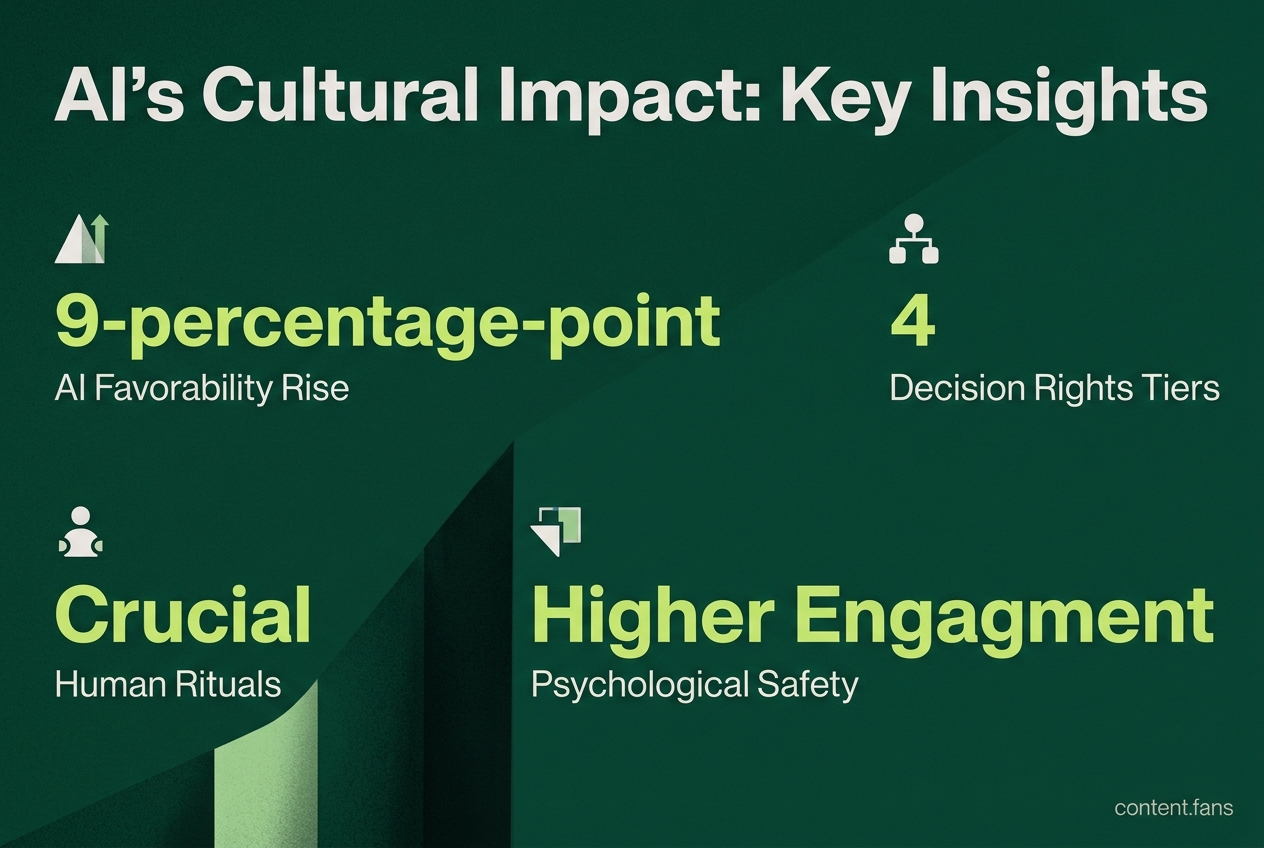
As AI agents become commonplace, Microsoft's 2026 Work Trend Index reveals how AI affects culture, showing that organizational factors - not individual attitudes - drive the majority of AI's impact. Data shows that when managers model AI use, employees report a 9-percentage-point rise in AI favorability (Microsoft Work Trend Index). The implication is clear: culture doesn't follow technology on its own, so leaders need a playbook to steer AI integration successfully.
Define clear decision rights
Effective governance requires clear boundaries. IBM's guidance recommends named accountability for every AI agent, defining what it can decide autonomously, what requires human approval, and what is off-limits (IBM AI Agent Governance). A popular approach uses a four-tier model for decision rights:
To manage AI's cultural impact, leaders should establish clear governance for AI agent decisions and ownership. This involves creating explicit boundaries for autonomous actions, human-required approvals, and forbidden tasks. Documenting these rules in a shared inventory reduces ambiguity and reinforces accountability across the organization.
- Autonomous - low-risk reversible actions.
- Constrained - actions inside pre-set parameters.
- Escalated - human sign-off required.
- Forbidden - no agent autonomy.
Maintaining a live inventory of these tiers prevents 'orphan' agents with unclear ownership and enables security teams to enforce least-privilege access.
Preserve culture through human rituals
As AI blurs roles, human-centered rituals become crucial for preserving shared norms. Teams that maintain practices like human-led code reviews, agent-inclusive retrospectives, and collaborative documentation sprints reinforce a sense of ownership and shared purpose. According to Deloitte's 2026 Human Capital Trends report, neglecting these rituals can lead to 'cultural debt,' which may hinder AI adoption or provoke resistance later on.
Build psychological safety around experimentation
Without clear guidance, AI can create fear. Industry reports show that in such environments, a significant portion of employees report inter-team tension and feel their jobs are threatened (Perceptyx leadership data). In contrast, organizations that promote psychological safety by framing AI pilots as no-penalty experiments achieve higher employee engagement. Managers can build this safety by openly sharing their own learning processes, publishing agent prompts, and soliciting feedback before full-scale implementation.
Upskill continuously to avoid cultural debt
Continuous upskilling is key to preventing cultural debt. For example, Amazon's 2025 Agentblazer Challenge has shown significant growth in relevant certifications by engaging employees in hands-on learning (Amazon upskilling case). Similarly, McKinsey's AI Fellows Program has helped many consultants adopt its internal agent, Lilli, reducing time-to-insight through intensive training followed by peer coaching. These examples show that job-embedded practice and peer coaching are more effective than standalone training sessions.
Track culture health as rigorously as performance
To ensure AI integration is successful, track cultural health with the same rigor as performance using practical metrics:
- Conduct quarterly pulse surveys to measure psychological safety and trust.
- Analyze digital collaboration patterns to identify potential silos.
- Track incidents of AI-related errors and escalations.
- Monitor AI adoption rates across different roles and seniority levels.
- Measure engagement with optional AI upskilling programs.
Monitoring these signals allows leaders to identify where governance or upskilling needs reinforcement, enabling early intervention before friction turns into mistrust.
How does AI-agent adoption actually affect organizational culture?
Microsoft's 2026 Work Trend Index shows that organizational factors (culture, manager support, and talent practices) explain the majority of AI's impact on day-to-day work, while individual attitudes account for a smaller portion. In other words, the tool itself matters less than the environment in which it is introduced. When managers model AI use and create psychological safety, employees report a 9-percentage-point rise in AI favorability. Conversely, in settings where AI is rolled out without clear norms, industry data shows many employees experience tension between teams and a significant portion feel job security is threatened.
What concrete rituals can preserve culture as roles blur?
The article recommends treating human-centered rituals as cultural glue:
- Human code reviews - even when an agent writes 80 % of the code, a peer review keeps craftsmanship and shared standards alive.
- Bi-weekly retrospectives that explicitly ask, "Where did an agent decision feel opaque or unfair?"
- Lightweight 'agent logs' shared in weekly stand-ups so everyone sees what agents did on their behalf.
These rituals work because they re-insert transparency and dialogue into workflows that agents could otherwise make invisible. Great Place to Work cites Adobe's cross-functional "AI@Adobe" group as a best-in-class example of ritualized peer learning that sustains culture while scaling AI.
How should leaders set decision rights and governance for agents?
Enterprise playbooks converge on treating agents as a new class of digital worker:
- Business owner + technical owner - every agent must have two named humans accountable.
- Dynamic decision-right matrix - classify decisions into autonomous, constrained, escalated, or forbidden buckets per workflow instead of enterprise-wide policies.
- Least-privilege, deny-by-default tool access combined with immutable logs and an emergency kill switch.
IBM's AI agent governance guidance and Microsoft's enterprise governance checklist both stress simulation environments and post-incident reviews to catch drift before it erodes trust.
What does effective upskilling look like in 2025?
Recent programs reveal six common ingredients:
- Job-embedded practice: McKinsey's AI Fellows Program pairs an intensive learning week with a multi-week deployment where fellows coach peers; this has scaled Lilli to many users and reduced insight time through peer coaching.
- Role-specific pathways: Amazon's new Agentblazer Challenge funnels call-center reps through Salesforce Trailhead tracks, yielding significant increases in certifications.
- Visible leadership: AstraZeneca's company-wide "thrive in the age of AI" mandate signals that upskilling is not an HR afterthought but a CEO priority.
All programs share one metric-driven feature: success is counted in adoption rate inside real workflows, not course-completion badges.
How can organizations measure cultural health while scaling agents?
Track three complementary signals:
- Quarterly culture-health pulse - 5-question Likert survey on fairness, trust, and psychological safety.
- Cross-team collaboration graph - network analysis of Slack or Teams data to spot isolation pockets among heavy AI users.
- Agent-incident log - simple count per quarter of "agent-created rework" or customer complaints traced back to an automated decision.
Industry reports note that firms combining these dashboards with manager-led retros see higher sustained agent adoption and lower attrition among employees whose roles intersect most with AI.