
Microsoft's 2026 Work Trend Index Highlights "Owned Intelligence" for Enterprises
Serge Bulaev
Microsoft's 2026 Work Trend Index introduces "Owned Intelligence," which means capturing company knowledge in systems that learn from every task. The report suggests that organizations using this approach may see faster productivity growth and higher revenue compared to those running small, separate AI projects. A five-step playbook is recommended for building Owned Intelligence, including digitizing documents, creating templates, and setting up feedback loops. Companies that measure and manage these systems well might have better financial returns. The Index also notes that when managers use these tools and encourage feedback, employees may value AI more and knowledge loss in teams could decrease.

Microsoft's 2026 Work Trend Index introduces "Owned Intelligence," a framework for creating a strategic advantage by capturing institutional knowledge in systems that learn from every task. This playbook provides a checklist for converting scattered organizational know-how into a governed, AI-ready asset that accelerates productivity, revenue, and decision-making.
Why "Owned Intelligence" matters
Owned Intelligence is an enterprise's proprietary knowledge base, captured and refined within AI systems. By documenting AI agent workflows and feedback, organizations create a strategic asset that drives significant productivity and revenue growth, setting them apart from competitors who rely on isolated AI pilots or generic models.
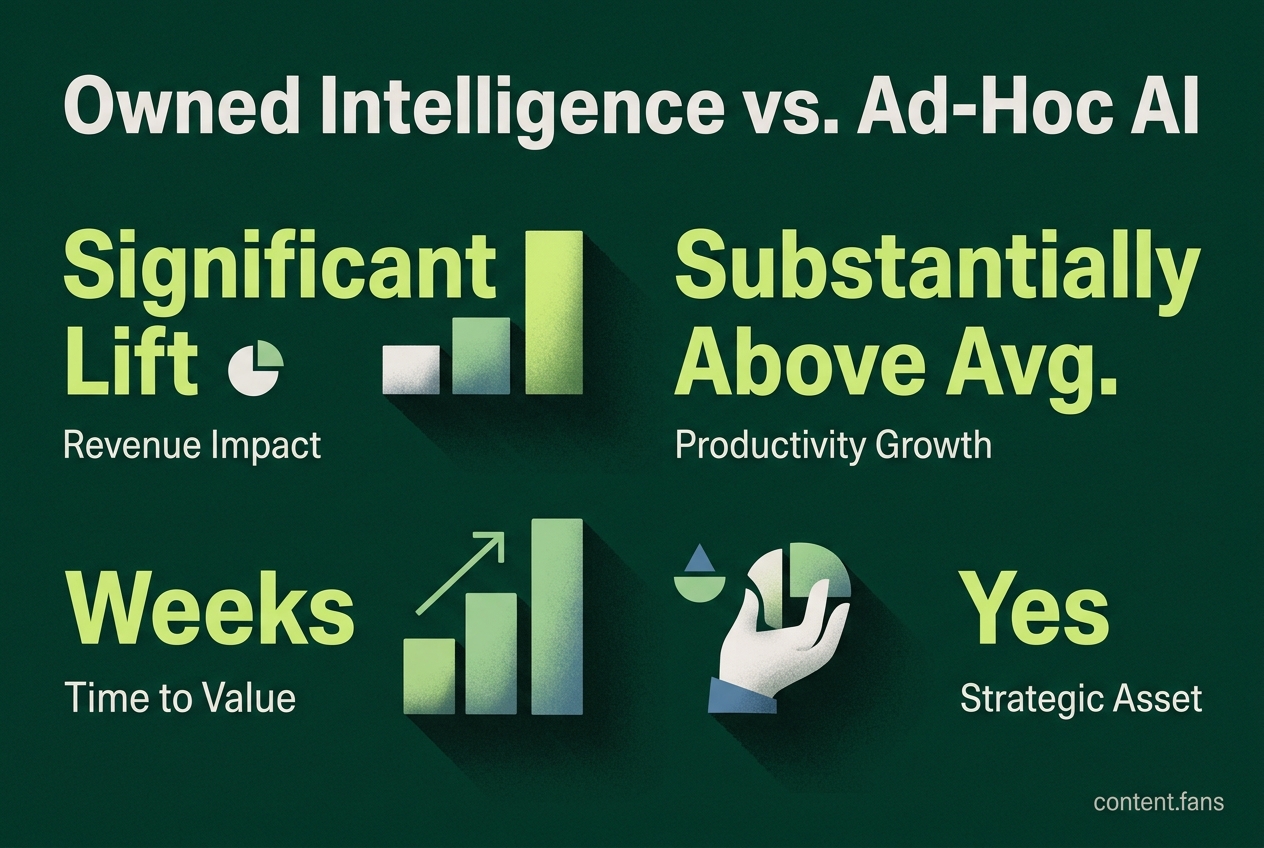
The business case is compelling: frontier organizations report far greater gains by embedding AI agents into core operations rather than running isolated pilots. An overview of the emerging enterprise intelligence layer from Forbes Council notes that sectors integrating AI into workflows see significant productivity growth compared to their peers. Furthermore, industry reports suggest that many executives attribute increased annual revenue to integrated AI, while a significant portion report cost reductions.
A short comparison of reported outcomes:
| Metric | Firms with Owned Intelligence | Peers running ad-hoc pilots |
|---|---|---|
| Annual revenue impact | Many firms see significant lift | Fewer see similar lift |
| Productivity growth | Substantially above sector average | At or slightly above sector average |
| Time to value for new use cases | Weeks | Months |
A five-step playbook
- Digitize and centralize legacy documents in a single, searchable repository governed by role-based access.
- Break content into atomic, template-driven articles with clear metadata so agents can retrieve precise answers.
- Capture tacit context through expert interviews and shadowing; encode the reasoning as decision trees or knowledge graphs.
- Establish feedback loops: every agent output is logged, reviewed, and refined, turning one-off wins into repeatable templates.
- Set ownership and review cadences. Automated alerts flag outdated guidance, while dashboards track impact on cycle time, cost, and quality.
Governance and risk safeguards
Effective governance requires clear data stewards, version control, and defined escalation paths. To protect sensitive data and prevent new knowledge silos from forming as usage scales, organizations must implement robust encryption, role-based permissions, and strategic scalability planning.
Measurement lenses
- Productivity: cycle time per workflow, percentage of tasks auto-completed by agents
- Financials: incremental revenue or cost change directly tied to AI-enabled processes
- Adoption: share of employees engaging with agents at least weekly
Analysis suggests a strong correlation between disciplined measurement and financial performance. Companies excelling in both Owned Intelligence infrastructure and its measurement show significantly better shareholder returns compared to broader market indices.
Culture accelerators
Leadership is a key accelerator. When managers actively model the use of AI agents, the perceived value of AI among employees increases substantially. This cultural shift is reinforced by incentives linked to contributing new knowledge articles or providing feedback on agent accuracy, which reduces "institutional amnesia" and strengthens the learning loop.
1. What exactly is "Owned Intelligence" according to Microsoft's 2026 Work Trend Index?
Based on the Work Trend Index, "Owned Intelligence" refers to institutional knowledge that compounds over time by capturing and codifying every human-AI interaction. Instead of letting AI outputs disappear after each use, leading organizations treat them as signals to learn from, turning one-off wins into repeatable, proprietary playbooks that rivals cannot copy. Organizations with this capability show significantly higher rates of enterprise-wide agent scaling.
2. How does Owned Intelligence translate into measurable business advantage?
Companies that embed Owned Intelligence into their operating model are pulling ahead on hard metrics:
- Significantly higher three-year total shareholder return and faster revenue growth versus peers according to industry studies.
- Substantial automation of manual processes and notable drops in operational costs within the first quarters of agent-based rollout.
- High-skill services firms forecast significant labor-productivity growth in the coming years according to economic research.
3. Which practical steps move an organization from isolated AI pilots to Owned Intelligence?
- Document every agent workflow - capture prompts, human hand-offs, and outcomes in a central template.
- Centralise ontologies - build one governed vocabulary so agents "speak the same language" across departments.
- Create closed feedback loops - route agent performance data back into the knowledge base weekly.
- Assign knowledge owners - give each process a named steward with quarterly review KPIs.
- Measure impact - track reuse rate of codified workflows and tie reductions in ticket volume or cycle time directly to them.
Following this sequence turns sporadic AI wins into compounding institutional assets.
4. What governance guard-rails prevent Owned Intelligence from becoming chaos?
- Role-based access - only vetted users can publish or retire knowledge artifacts.
- Version control & audit trails - every change is time-stamped and attributable.
- Automated freshness checks - AI flags articles not viewed or updated in 90 days.
- Compliance tags - metadata links each artifact to legal, privacy, and industry regulations.
- Escalation path - unclear or contradictory guidance auto-escalates to a human review board within 24 h.
These controls keep the knowledge base accurate, secure, and trustworthy as it scales.
5. How can teams kick-start a six-month Owned Intelligence pilot?
Month 0-1 - Select one high-volume, well-documented process (e.g., customer onboarding).
Month 1-2 - Shadow top performers; record prompts, exceptions, and approval steps.
Month 2-3 - Build a lightweight ontology and publish the first "golden workflow" in a searchable repository.
Month 3-4 - Deploy an agent that references only this sanctioned content; capture usage analytics.
Month 4-5 - Refine content based on analytics; expand to adjacent workflows if reuse rates are strong.
Month 6 - Quantify ROI (time saved, error reduction) and present a scale-up roadmap to the executive board.
Early adopters following this timeline report significantly faster workflow cycles and improved lead conversion, making the next round of funding an easy sell.