
Eric Ries Expands Delaware PBCs for Mission-Driven Startups
Serge Bulaev
Eric Ries suggests that founders consider a simple two-page Delaware Public Benefit Corporation (PBC) filing to help startups lock in their mission early. This filing may require company leaders to balance profit, stakeholder impact, and a specific public benefit. Early adoption appears to help founders keep control over the mission, especially before bringing in outside investors. Some investors might worry that this structure could slow down quick exits, but Ries points to examples that may show long-term benefits. Following the PBC process may help startups clearly state their purpose and responsibilities from the start, while still needing good decision-making and oversight as they grow.

Eric Ries advocates for the Delaware Public Benefit Corporation (PBC) as a crucial tool for mission-driven startups. He recommends a simple two-page filing that legally obligates directors to balance shareholder profits with stakeholder impact and a specific public benefit. This framework, which Ries calls a "counterweight to financial gravity" YouTube timestamp 26:18-28:04, allows founders to embed their mission before seeking outside capital, a move confirmed by companies like NICER in public filings (NICER conversion post).
Why Act Before Outside Capital Arrives
Ries stresses that a founder's leverage diminishes rapidly once external funding is secured. Converting to a PBC early bypasses the complex negotiations and consent thresholds that later-stage investors might impose. Delaying the decision can be problematic, as success often intensifies pressure for short-term returns over long-term mission - creating situations where it becomes increasingly difficult to prioritize mission over immediate financial returns.
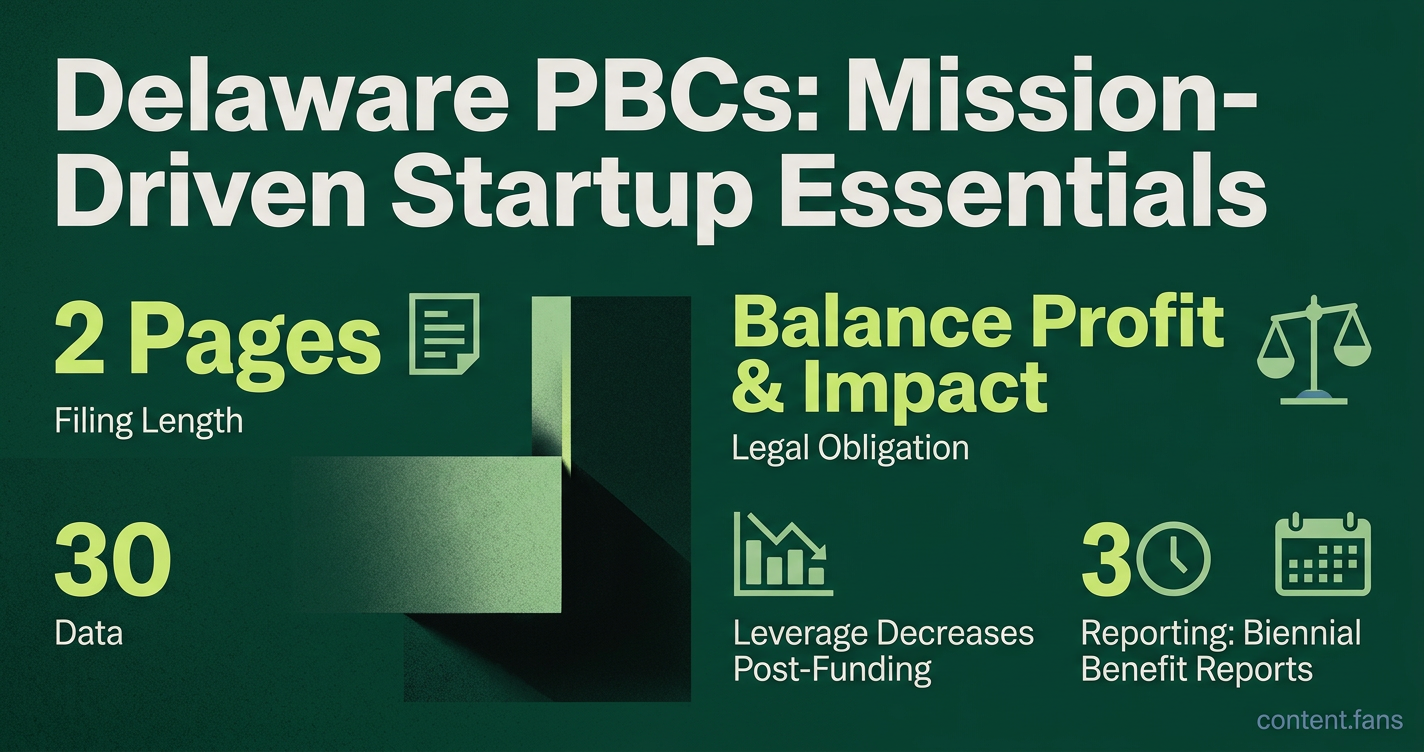
A Delaware Public Benefit Corporation (PBC) is a legal structure that legally requires a company's directors to balance shareholder profits with stakeholder interests and a specific public benefit. This framework helps mission-driven startups embed their purpose into their governance, protecting it from later-stage pressures to maximize short-term returns.
Mechanics of the Two-Page Delaware Filing
The PBC conversion process requires board approval and majority stockholder consent to amend the company's certificate of incorporation. The filing typically includes a concise statement of the public benefit (e.g., "to advance safe artificial intelligence research") and provisions establishing the board's balancing duties. After drafting, counsel files the amended certificate with the Delaware Division of Corporations.
Investor Considerations and Trade-Offs
While some investors focused on rapid exits may view the PBC's balancing duties as a hurdle, Ries points to mission-driven companies like Costco and Anthropic as examples of long-term resilience. Although term sheets rarely prohibit PBC status, founders should proactively disclose the structure in pitch decks to prevent later conflicts, especially regarding investor expectations for liquidation preferences.
Selecting Counsel for PBC Conversion
Corporate law firms increasingly offer PBC conversion services. Founders should seek counsel with demonstrable experience in PBC conversions and familiarity with relevant Chancery Court opinions on director liability.
Maintaining the Mission After Filing
While the statute mandates biennial benefit reports to stockholders, proactive boards strengthen their commitment through additional governance. These measures can include appointing independent directors to represent stakeholders, establishing triggers for mission-related risk review, and conducting annual charter audits. Such steps signal a serious, ongoing commitment to the company's stated purpose.
Key Takeaway for Early-Stage Founders
Converting to a Delaware PBC is a foundational step, not a complete solution. It provides a legal anchor by clarifying fiduciary duties while a company's cap table is simple. However, this structure must be supported by robust internal processes, like independent board challenges and evidence-based decision-making, to truly safeguard a startup's mission as it scales.
What exactly is the "two-page Delaware filing" Eric Ries urges founders to submit?
It is a Public Benefit Corporation (PBC) charter amendment filed under 8 Del. C. § 361-368. The document is literally two pages and converts a conventional Delaware C-corp into a PBC, legally forcing directors to balance shareholder return with a defined public benefit and stakeholder interests. Once filed, the clause can be removed only by a super-majority of shareholders and affected stakeholders, so mission drift becomes far harder.
When is the best time to make the PBC election - and what happens if I wait?
Ries's rule of thumb: file before the first priced round or any material traction. After success arrives, "financial gravity" (his term for the internal pull toward short-term profit) strengthens and investor resistance hardens. He notes that a significant portion of venture-backed founders face governance challenges as companies mature, illustrating how late-stage governance changes rarely survive board pressure.
How do investors typically react to a pre-seed or seed-stage PBC charter?
Most VCs now see early-stage PBC status as a neutral or even positive signal that the team is thinking long term. Recent developments in Delaware corporate law provide additional flexibility for stockholder agreements regarding governance decisions, giving investors clarity on control while the mission commitment stays intact. Counsel still advise transparent cap-table notes that spell out fiduciary duties to both shareholders and the stated public benefit.
What specific language goes into those two pages?
Required items are short but non-negotiable:
1. A sentence declaring conversion to a PBC.
2. An explicit public-benefit purpose (one or more specific goals such as "ethical AI deployment" or "open scientific research").
3. A clause that eliminates the default "shareholder primacy" rule and replaces it with the tri-partite duty owed to shareholders, stakeholders, and the stated benefit.
4. Amendment protection provisions as determined by the company's governance structure.
A competent Delaware counsel can draft and file the certificate of amendment in under a week for routine legal fees plus the state's $394 PBC conversion charge.
Who should founders turn to for implementation, and what should they budget?
Look for Delaware-barred corporate lawyers who have experience with PBC conversions; ask for redacted samples to verify language consistency with the statute. Expect:
- Legal bills: $3k-$7k for a plain-vanilla amendment, more if side letters with investors are negotiated concurrently.
- Board process: one unanimous written consent and an updated stock-purchase agreement summary.
- Post-filing hygiene: refresh data-room files and disclose the new duty matrix in future pitch decks so later-round VCs are not surprised during diligence.
For deeper background on Ries's perspective on startup governance and mission protection, refer to his published works and speaking engagements on building sustainable companies.