
Anthropic, Costco Adopt 5 Strategies to Protect Company Mission
Serge Bulaev
Anthropic, Costco, and Novo Nordisk use formal rules to keep their company missions strong, even when short-term profits might compete with long-term goals. They use tools like special voting shares, benefit corporation charters, foundation ownership, strict rules for changing company purpose, and special board committees. Evidence suggests these methods may help protect mission, but some investors seem unsure and certain stock indexes might exclude companies with unequal voting rights. Research also suggests that benefit corporation status alone may not fully protect a company's purpose. Experts say it is often easier and cheaper to these rules early, before taking outside investment.

To protect a company mission from the pressures of quarterly targets, leading firms like Anthropic, Costco, and Novo Nordisk use formal governance structures. These mechanisms give long-term purpose real authority, not just marketing gloss, and provide founders with concrete strategies to embed their vision before seeking outside investment. While many legal devices exist, each comes with trade-offs regarding control, investor appeal, and stock index eligibility.
5 Core Legal Tools for Mission Protection
Founders can protect their company's mission using five core legal tools: dual-class shares with super-voting power, Public Benefit Corporation (PBC) charters, foundation ownership, "mission lock" clauses in bylaws, and dedicated board committees mandated to oversee stakeholder interests alongside profits.
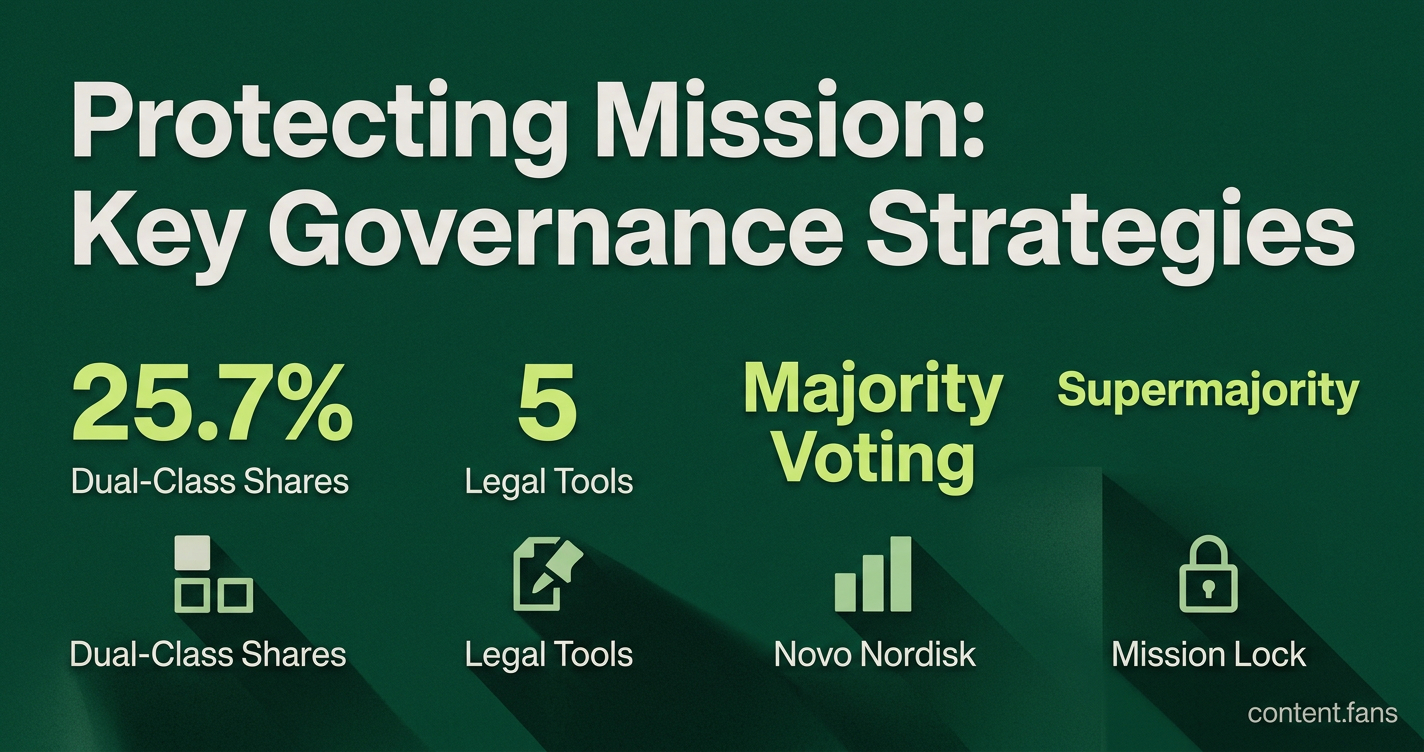
- Dual-Class Shares: Grant super-voting power to insiders, with CII reporting that 25.7% of 35 companies in 1H 2024 had dual-class structures, though rates vary by period.
- Public Benefit Corporation (PBC) Charters: Legally require a company to pursue a stated social objective alongside profit, as detailed in Britannica's overview of the form.
- Trust or Foundation Ownership: Place majority voting rights with a mission-aligned foundation, as exemplified by Novo Nordisk.
- "Mission Lock" Clauses: Require a supermajority vote in the charter or bylaws to alter the company's stated purpose.
- Dedicated Board Committees: Give directors an explicit duty to weigh stakeholder outcomes in their decision-making.
How Industry Leaders Implement These Strategies
According to industry reports, Anthropic has established governance structures designed to give mission-aligned entities influence over decisions that could compromise the company's goal of building safe AI. Costco presents a different model. Despite a conventional single-class share structure, it codifies principles like employee wage floors and membership pricing in board-approved guidelines that researchers note have successfully withstood multiple activist campaigns.
Novo Nordisk demonstrates long-term durability. According to industry reports, the Novo Nordisk Foundation holds a significant portion of voting power while owning a minority of the economic interest. Analysts report this structure enables sustained reinvestment in R&D, even when peers cut their budgets.
Market Realities: Investor and Index Reactions
Mission-focused governance structures receive a mixed response from the market. Industry reports suggest that while governance proposals generally receive moderate shareholder support, social proposals typically attract lower levels of backing. This indicates many investors still prioritize traditional accountability and may undervalue perpetual dual-class stock structures. Consequently, S&P Dow Jones has excluded companies with unequal voting rights from its main indices, a move that industry analysts suggest can impose valuation penalties by reducing demand from passive funds.
Public Benefit Corporations encounter their own challenges. Industry research suggests that a significant majority of traded PBCs also employ additional tools like supermajority rules or dual-class shares, indicating that PBC status alone may not be sufficient to protect a company's mission against hostile actions.
A Founder's Guide to Implementing Mission Locks
Legal experts advise embedding mission-lock language into a company's charter before the first priced equity round. Amending it later requires supermajority or even unanimous investor consent, a significant hurdle that increases with each financing round. A board can further solidify this commitment by creating a standing committee to audit mission performance and publish its findings. While migrating to a PBC is a straightforward filing process, it necessitates updating investor agreements to clarify fiduciary duties.
Costs vary significantly. Simple PBC conversion filing fees are in the low thousands, whereas establishing a custom charitable trust can exceed six figures due to complex tax requirements. However, experts agree that establishing clarity on purpose early on can reduce negotiation time with values-aligned investors and streamline diligence cycles during an exit.
What exactly is a "mission lock," and why do Anthropic and Costco swear by it?
A mission lock is any legally binding device that prevents future boards or investors from watering down the company's social or scientific purpose.
- Anthropic has reportedly embedded its AI-safety mandate into governance structures that can influence changes to the charter.
- Costco keeps membership-first pricing through super-majority (67 %) charter amendments plus a perpetual 25 % insider voting trust.
Early Delaware filings matter: once the cap-table grows, charter changes require 100 % investor consent - an almost impossible bar.
Which governance tool gives the strongest protection - dual-class stock, a foundation, or PBC status?
There is no single winner; layering works best:
| Tool | What it blocks | Solo weakness |
|---|---|---|
| Dual-class shares | Hostile take-over, activist board sweep | Long-term valuation discount (7-year mark) |
| Corporate foundation | Asset diversion, spin-off pressure | Needs annual funding; cannot operate the business |
| Public-benefit-corporation charter | Share-law suits for ignoring profit | Weak default rules; easy to amend if 51 % holders agree |
Many publicly traded PBCs bolt on extra devices (super-majority votes, golden shares, dual-class) to plug the gap, according to industry research.
How expensive or time-consuming is it to set these structures up before a Series A?
- Delaware PBC filing: $244 state fee + 2-page charter paragraph; one week if counsel pre-drafts.
- Dual-class creation: adds $15-25 k to a standard incorporation package; must be in place before the first priced round or new investors can block it.
- Trust or foundation: $50-100 k legal + CPA work; can be completed in 4-6 weeks parallel to SAFE rounds.
Rule of thumb: every month you wait after first outside money doubles the negotiation friction.
Do investors automatically walk away from dual-class or PBC companies?
Not in 2025. Industry trends show:
- A growing number of US tech IPOs carry dual-class stock structures.
- Specialist ESG and deep-tech funds now list "PBC preferred" in their investment memos; they see mission risk as equal to financial risk.
- Sunset clauses (auto-convert after 7-10 years) can help reduce IPO valuation discounts while still giving founders early control.
Still, expect price-chip pressure; pitch decks should quantify mission value (customer retention, talent attraction) in hard dollars.
What is the first operational step once we pick a structure?
- Engage Delaware counsel that has done at least three mission-lock formations; ask for sample charter language up-front.
- Draft a board charter that embeds impact KPIs inside every annual operating plan; circulate it with the Series A term sheet so investors vote on mission governance at the same time they vote on economics.
- Add an investor-rights agreement clause requiring any future IPO registration statement to keep the mission provisions "in full force and effect."
Founders who complete those three steps before the first closing significantly increase the probability that the original mission survives the journey to IPO, based on industry research of public PBCs.