
Microsoft Unveils Seven MAI Models, Scout AI, Project Solara at Build 2026
Serge Bulaev
Microsoft announced seven MAI models, a work assistant called Scout, and a new hardware design, Project Solara, at Build 2026. The MAI-Thinking-1 model scored similarly to Opus 4.6, which may mean Microsoft is focusing on cost and control over being the most advanced. Scout is shown as an always-on helper for meetings and coding in Microsoft tools, but details on speed or how many people use it were not given. Project Solara appears to be for business devices and will not be sold by Microsoft itself; partners will make them. Microsoft's system may let users pick different AI models, but it suggests that using their platform could make it harder for companies to switch away later.

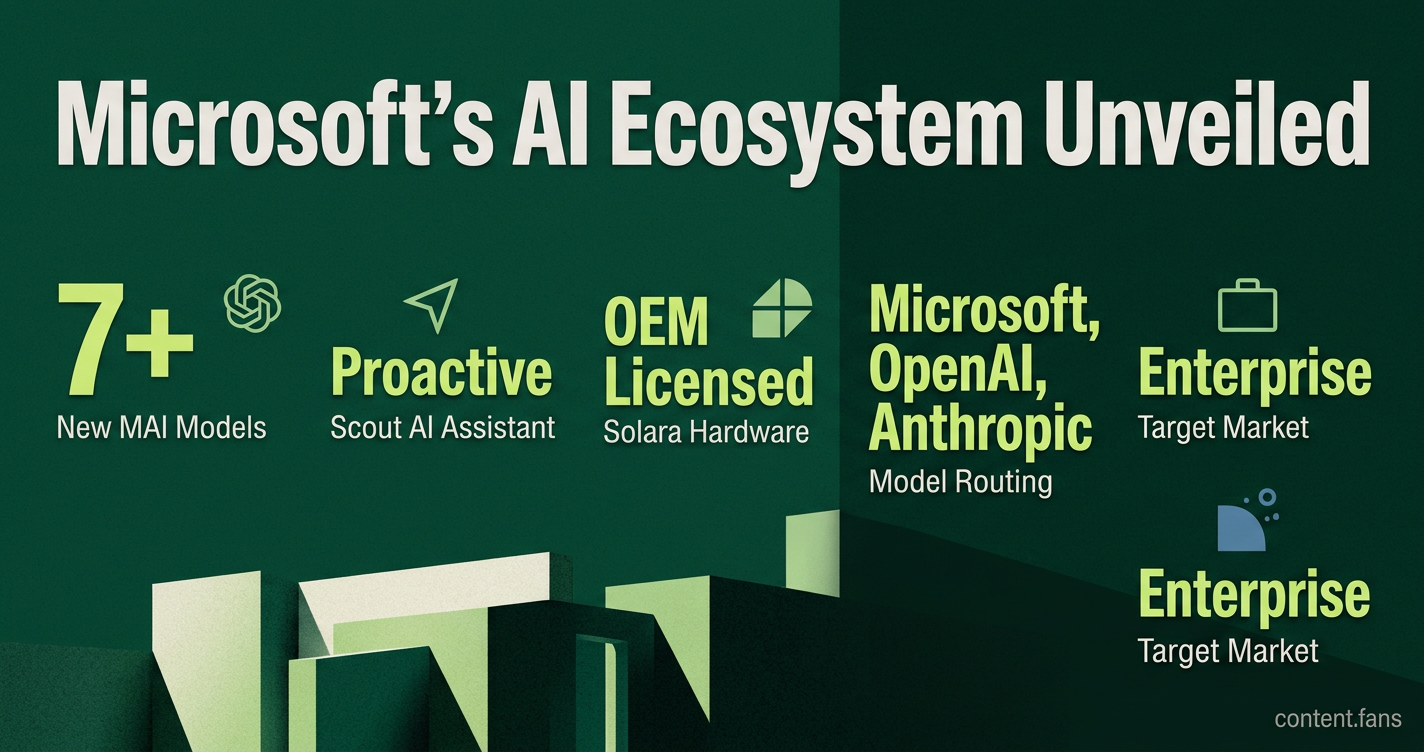
At Build 2026, Microsoft unveiled its new vertically integrated AI stack, featuring multiple proprietary MAI models, the Scout AI work assistant, and the Project Solara hardware platform. This ecosystem allows workflows to route tasks across Microsoft, OpenAI, and Anthropic models, signaling a major strategic shift.
First-party MAI models and early benchmarks
Microsoft announced a comprehensive, in-house AI ecosystem featuring new MAI models, an AI work assistant named Scout, and a reference hardware design called Project Solara. The platform gives enterprises model choice while keeping them within the Azure ecosystem, balancing flexibility with platform control.
According to industry reports, Microsoft's flagship model, MAI-Thinking-1, demonstrated competitive performance on coding benchmarks, positioning it alongside other leading AI models. Analysts suggest this focus on matching, not exceeding, top models indicates a strategy prioritizing cost-efficiency and platform control over leading the frontier model race.
Scout - a proactive personal assistant
Microsoft Scout was described as a proactive personal assistant for scheduling, meeting preparation, and routine tasks via Teams and Outlook, rolling out to Frontier customers. Demonstrations featured Scout summarizing meetings, assisting with code, and routing tasks to the optimal AI model. While Microsoft withheld performance metrics, it stressed that Scout inherits enterprise-grade governance and identity controls.
Project Solara hardware platform
Project Solara is a hardware reference design for "agent-first" devices, which Microsoft will license to OEM partners rather than selling directly. According to Project Solara coverage, internal testing is underway, with enterprise pilots involving partners like Target and Best Buy starting soon. With built-in hooks for identity, compliance, and silicon-level security, Solara is aimed squarely at managed enterprise environments, not the consumer market.
Multi-model routing and platform strategy
According to industry reports, the platform's orchestration layer can route prompts to its native MAI models, OpenAI's GPT, and Anthropic's Claude. This provides model flexibility while ensuring customer data, identity, and workflows remain on Microsoft's platform. This strategy increases long-term platform lock-in, as migrating governed AI workflows becomes prohibitively complex.
Key takeaways for developers and enterprises
- MAI-Thinking-1 leads a new family of proprietary MAI models.
- Initial performance benchmarks are vendor-supplied and await independent verification.
- Scout provides an AI agent layer across Microsoft's productivity and cloud suites.
- Project Solara offers hardware reference designs for OEM partners, now in internal and limited pilot testing.
- The orchestration layer enables multi-model AI workflows under centralized Microsoft governance.
According to industry reports, the announcements at Build 2026 signal a clear shift in Microsoft's AI strategy. The company is moving toward full-stack vertical integration - controlling the models, devices, and orchestration layer - while marketing "openness" as model choice at the workflow level.
What exactly are the new MAI models and how do MAI-Thinking-1's coding claims hold up?
According to industry reports, Microsoft revealed multiple first-party MAI models at Build 2026, with MAI-Thinking-1 positioned as the flagship. It is described as a Mixture-of-Experts reasoning model. Microsoft asserts that MAI-Thinking-1 demonstrates competitive performance against leading models for real-world software engineering tasks, and that in blind human evaluations run by Surge, respondents preferred MAI-Thinking-1 over Claude Sonnet 4.6. These numbers are vendor-reported; as of now independent replication has not appeared, so early adopters should benchmark internally.
How open is Microsoft's new AI stack really?
The messaging stresses "open workflows", meaning developers and enterprises can route prompts to Microsoft, Claude, or OpenAI models within the same orchestration layer. However, all traffic still flows through Microsoft-controlled APIs and governance services. In practice, openness is about model choice, not platform neutrality, giving Microsoft optionality while keeping customers inside its stack.
What is Microsoft Scout and when will it be available?
Microsoft Scout was described as a proactive personal assistant for scheduling, meeting preparation, and routine tasks via Teams and Outlook, rolling out to Frontier customers. Concept devices are already in daily use by hundreds of Microsoft employees, and a private pilot program with AccuWeather, Best Buy, CVS Health, Levi's, and Target is scheduled to begin rolling out in the coming months. No public launch date has been confirmed.
What hardware should developers expect from Project Solara?
Project Solara is not a new Surface line but a pair of reference designs for agent-first devices that Microsoft will license to OEM partners. One design is a wearable puck for frontline workers, the other a managed desk device that replaces traditional PCs with voice-first interaction. Microsoft explicitly says it "won't ship these devices itself", so developers will get SDKs and simulation images before retail hardware arrives.
How might this reshape competitive dynamics in the AI market?
Microsoft's vertically integrated stack reduces per-workload dependence on OpenAI or Anthropic, letting it swap in its own MAI models for cost-sensitive tasks while still offering Claude or GPT variants when performance justifies the premium. Analysts note that once enterprises embed data, security policy, and agent flows inside Microsoft's cloud, switching costs rise sharply. The strategy pushes competitors to compete less on raw model quality and more on specialized accuracy, inference price, or vertical compliance niches.