
Microsoft Unveils Seven MAI Models, Project Solara, and Scout at Build 2026
Serge Bulaev
Microsoft announced seven new AI models, Project Solara, and Microsoft Scout at Build 2026. The MAI models may help with images, voice, coding, and reasoning, but independent tests have not yet confirmed their performance. Project Solara appears to let devices act as AI agent hosts, possibly making AI experiences more "ambient and shared." Microsoft Scout, described as a workplace autopilot, might help manage meetings and tasks but also raises some privacy concerns. Experts suggest these moves show Microsoft wants more control over its AI stack, but details about how well these new tools work are still uncertain.

At Build 2026, Microsoft unveiled its comprehensive in-house AI strategy, introducing seven new MAI models, the ambient AI concept Project Solara, and the workplace agent Microsoft Scout. These announcements signal a major push to own its full AI stack, from foundational models to cross-device agents, while maintaining support for third-party platforms like GPT-4.
This strategic pivot may indicate Microsoft's long-term goal of reducing dependency on external AI providers. However, key performance benchmarks for the new models are, for now, based solely on the company's own reporting.
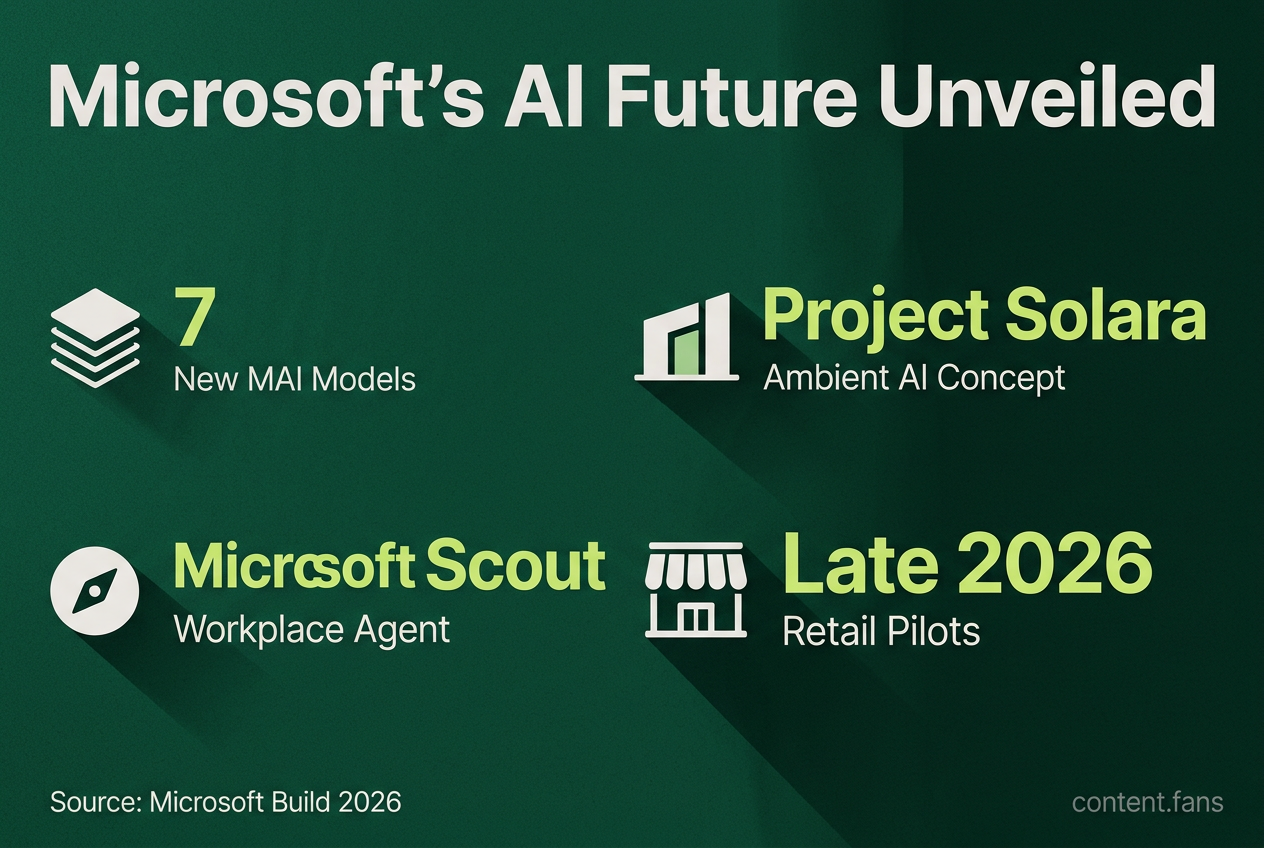
Seven MAI models aimed at image, voice, code, and reasoning
Microsoft announced seven proprietary MAI models designed for various tasks including reasoning and coding. It also revealed Project Solara, an agent framework for ambient, cross-device AI experiences, and Microsoft Scout, an autonomous agent intended to automate workplace tasks within the Microsoft 365 ecosystem.
The new models include MAI-Code-1-Flash, a low-latency coding assistant integrated into the GitHub Copilot picker, and MAI-Image-2.5 for rapid image generation. All seven models have been released in private preview via Microsoft's Foundry platform, though their performance claims await independent verification (TestingCatalog recap).
Project Solara extends agents beyond the PC
Project Solara was introduced through reference designs that position devices as dedicated agent hosts. Reports from the event describe wall-mounted displays and wearable badges with low-power agent cores designed for persistent, ambient tasks (TechRadar live coverage). Microsoft plans for partners to adapt these blueprints for retail pilots by late 2026. Industry analysts suggest Solara marks a strategic shift toward "ambient and shared" AI experiences that transcend the traditional desktop.
Microsoft Scout: an always-on workplace autopilot
Microsoft also previewed Microsoft Scout, an "Autopilot" agent integrated into Microsoft 365. Unlike a standard chatbot, Scout operates autonomously in the background to scan communications, identify project bottlenecks, manage calendars, and automatically schedule tasks. The company highlighted its robust governance framework, noting that Scout operates under a scoped Entra identity, adheres to Purview data policies, and can be configured to require human approval for specific actions.
A short list of advertised Scout skills:
- Cross-time-zone meeting coordination
- Generation of briefing packets before calls
- Automatic reservation of focus time
- Proactive nudges on overdue deliverables
However, privacy experts caution that the always-on nature of Scout inherently increases the potential for data exposure. While Microsoft's use of a containerized runtime and redacted credential logs are seen as important mitigating controls, they are not considered absolute guarantees against privacy risks.
Early analyst takeaways
Analysts widely interpret these announcements as Microsoft's most significant move to date toward owning its entire AI stack. While publications like TestingCatalog describe the MAI model family as "solid but not frontier-leading," others argue it strategically positions Microsoft within the larger AI ecosystem. The consensus is that AI agents, rather than chatbots, were the central theme of the event. Nevertheless, the true capabilities of the new MAI models remain unconfirmed pending third-party benchmarking.
What exactly are the seven MAI models and how are they positioned against Claude and OpenAI?
Microsoft revealed a balanced family of seven MAI models that span image, voice, transcription, reasoning, and coding. The flagship MAI-Thinking-1 is a 35-billion-parameter reasoning model with a 256 K context window and is publicly claimed to match Claude Opus 4.6 on the SWE-Bench Pro coding benchmark at 52.8 %, while human raters preferred it over Claude Sonnet 4.6 in blind side-by-side tests. Microsoft's own numbers are the only ones available today, so independent verification is still pending.
How does Project Solara change the way AI works outside the PC?
Project Solara is Microsoft's new agent-first platform built to make AI ambient and cross-device rather than confined to a single laptop or phone. The company showed two reference device designs that treat shared surfaces - conference-room displays, kiosk-style hubs, and even wearable endpoints - as places where agents continue tasks started elsewhere. Early analyst reactions from The Verge and TechRadar interpret the move as Microsoft positioning itself for a post-PC interaction model where agents follow users across rooms and physical objects.
What is Microsoft Scout and why is it called an "always-on workplace autopilot"?
Microsoft Scout is a new autopilot agent that runs 24/7 inside Microsoft 365, proactively scheduling meetings, blocking time for deliverables, and identifying stalled decisions without user prompts. Instead of waiting for a chat command, Scout watches activity across Outlook, Teams, OneDrive, and the browser, then executes multi-step workflows on its own. Microsoft is pitching it as turning reactive task handling into delegated background automation.
What privacy and governance controls come with an always-on agent like Scout?
Scout uses governed Entra identity, so every action is traceable to a real employee, and credentials are scoped to the exact task. Purview policies enforce data-loss prevention and sensitivity labels before any information is accessed or shared. Sensitive actions can require human approval through Teams chat, and all logs are redacted from standard diagnostics, a structure Microsoft says keeps the agent auditable while still useful.
When can developers start experimenting and how open is the ecosystem?
The seven MAI models are in private preview on Azure Foundry, giving Azure subscribers early access to the same endpoints Microsoft itself uses. Workflows built in Copilot Studio, Visual Studio, or GitHub can freely mix Microsoft, Claude, or OpenAI models; the keynote emphasized no lock-in, targeting developers who want both optionality and first-party integration.