
Microsoft unveils Magentic: AI agent stack for smaller models
Serge Bulaev
Microsoft has introduced a new AI agent system called Magentic, made up of MagenticLite, MagenticBrain, and Fara1.5. This system may allow smaller models (4B-27B parameters) to do tasks in browsers and file systems that used to need much larger models. The models work together for planning, acting, and securing user data, all inside a safe sandbox. Early reports suggest the 9B Fara1.5 model reaches about 65 percent success on a benchmark, and the system is available for developers but might still be in pilot stages for wider use.

Microsoft Research has unveiled MagenticLite (along with MagenticBrain and Fara1.5), a new agentic stack for smaller models enabling complex browser and file system tasks previously reserved for large-scale language models. The stack is co-designed for Small Language Models (SLMs). The Fara1.5 family specifically includes 4B, 9B, and 27B parameter versions.
This agent stack emerged from a holistic codesign process that optimized the model, harness, and interface in tandem. As detailed in the Microsoft Research Blog, this signals a strategic shift from escalating parameter counts to pursuing system-level efficiency.
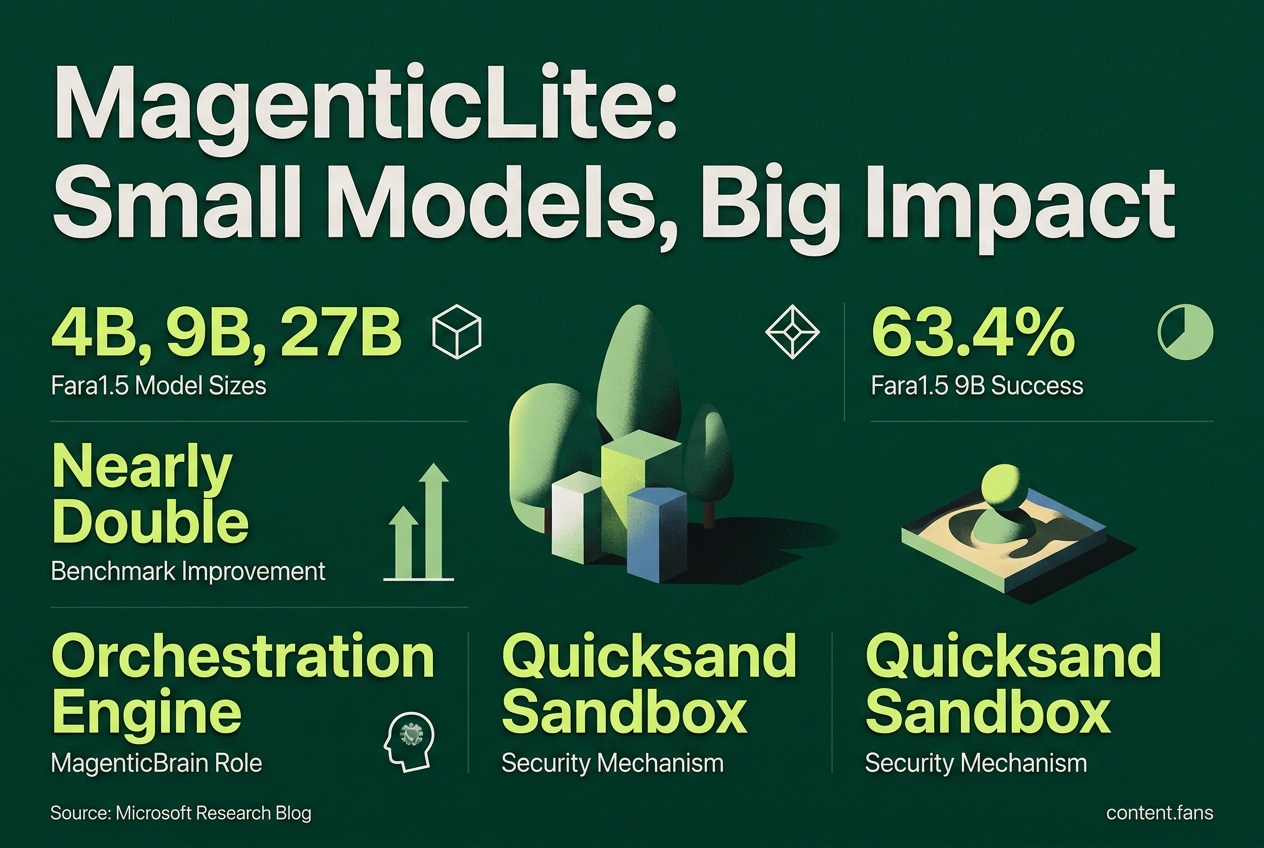
Magentic unifies planning, delegation, and execution into a single workflow for tasks across both web and local files. To ensure security and contain side effects, all operations are executed within Quicksand, a QEMU-based sandbox designed to protect user data.
MagenticLite: The User-Facing Harness
MagenticLite is the user-facing application layer of the Magentic stack. It interprets user requests, breaks them down into actionable steps, selects the appropriate tools, and manages the entire execution process. It also routes commands and handles security through an integrated sandboxed environment for safe operation.
As the primary application layer, MagenticLite is responsible for interpreting unstructured user requests, breaking them into concrete steps, and selecting the right tools for the job. It supervises the workflow, handles error recovery, and routes browser and file commands through a single process to minimize latency. Security is managed via the Quicksand sandbox, which enforces navigation allow lists and includes an immediate pause control.
MagenticBrain: The Orchestration Engine
MagenticBrain serves as the stack's central planner and coder. It is a specialized orchestrator for planning and delegation that operates within a structured context window. This window contains the system prompt, tool schemas, user goal, and recent action history. Instead of free-form text, it generates structured tool calls and signals task completion, demonstrating its specialized tuning for reasoning over tool schemas.
Fara1.5: The Browser Execution Model
Fara1.5 is a family of models (4B, 9B, and 27B) specifically trained for executing computer-use tasks like form filling, booking travel, and cross-site shopping. The 9B model achieves a 63.4% success rate on the Online-Mind2Web benchmark, nearly doubling the performance of its predecessor. Each inference step uses conversation history and the three most recent screenshots to predict the next action, with its training focused on rapid, short-horizon corrections.
Training Pipeline and Data Generation
The Fara1.5 models were trained using a curated dataset that combines real web trajectories with synthetic environments and visual grounding tasks. This blend is key to helping the smaller models generalize effectively without requiring massive token budgets.
Availability and Future Scope
The entire Magentic stack is available to developers through separate projects, allowing them to integrate MagenticLite, MagenticBrain, and various Fara1.5 models based on hardware needs. While consumer availability is still in the pilot phase, Microsoft is already exploring extensions for desktop software automation beyond the browser.
Magentic Stack: At a Glance
- MagenticLite: Application harness secured by the Quicksand sandbox.
- MagenticBrain: Specialized orchestrator with structured tool calls.
- Fara1.5: 4B, 9B, and 27B computer-use models; the 9B model scores 63.4% on Online-Mind2Web.
- Data Pipeline: Trained on curated datasets combining real and synthetic data.
- Distribution: Available via GitHub and research publications.
Performance details show that the 27B Fara1.5 model outperforms competing systems on certain tasks. However, smaller models still face challenges with unusual GUI elements.
What is the Magentic stack and what are its three main components?
Microsoft's Magentic is an AI agent stack co-designed for efficient Small Language Models (SLMs). It moves away from monolithic frontier models toward a unified, three-part architecture:
- MagenticLite: The user-facing application harness that coordinates workflows.
- MagenticBrain: A specialized orchestrator that handles reasoning and task delegation.
- Fara1.5: A family of execution models (4B-27B) for performing browser-based tasks.
The entire system operates securely inside the Quicksand sandbox. As noted by Microsoft Research, this modular design is a deliberate shift toward specialized, composable AI components.
How does the Magentic stack compensate for using smaller models instead of frontier-scale LLMs?
Instead of relying on massive parameter counts, Magentic achieves high performance through system-level codesign. This approach uses several key strategies:
- Curated Context: MagenticBrain uses structured tool schemas, avoiding the need for huge context buffers.
- Specialized Delegation: The orchestrator delegates browser tasks to Fara1.5 and handles other tasks itself, optimizing resource allocation.
- Visual Grounding: Fara1.5 focuses its attention by processing only the three most recent screenshots.
- Intelligent Uncertainty: When needed, the agent can pause to ask for user input rather than hallucinating.
This architecture allows the 27B Fara1.5 model to compete with larger rivals, while the 9B model achieves a 63.4% success rate on the Online-Mind2Web benchmark.
What concrete performance improvements does Fara1.5 deliver over previous models?
Fara1.5 delivers significant performance gains on key benchmarks, validating Microsoft's focus on smaller, optimized models.
| Model | Online-Mind2Web Score | Relative Improvement |
|---|---|---|
| Fara-7B (previous) | 34.1% | Baseline |
| Fara1.5-9B | 63.4% | +86% |
| Fara1.5-27B | 72% | +111% |
On this benchmark, the Fara1.5-27B variant surpasses both OpenAI Operator (58.3%) and Gemini 2.5 Computer Use (57.3%). These results are attributed to refined training approaches. Microsoft notes, however, that performance on long-tail web tasks remains a challenge for the smaller models.
What is Microsoft's strategic positioning with this release compared to competitors?
With Magentic, Microsoft is strategically shifting the AI agent narrative from "bigger is better" to practical, efficient system design. Key aspects of this strategy include:
- Hybrid Deployment: Architecting for on-device operation to improve cost, speed, and data privacy.
- Open Research Access: Fara1.5 was released as open-weights on GitHub and arXiv by Microsoft Research to encourage testing and adoption.
- Safety-Centric Architecture: Building in enterprise-grade safety features like sandboxing and user oversight controls from the start.
- Challenging Cost Assumptions: Demonstrating that specialized 9B-27B models can match or exceed the capability of larger parameter models, which aligns with industry trends where SLMs deliver significant cost reductions for agentic tasks.
What are the current limitations and future roadmap for the Magentic stack?
Current Limitations:
- Long-Tail Tasks: The models can struggle with novel or uncommon website UIs.
- Pilot Status: The stack is currently for developer testing and not yet integrated into commercial products.
- Browser-Focused: The agent's capabilities are primarily centered on web automation.
Future Roadmap:
- Desktop Expansion: Microsoft plans to extend the agent's control to desktop applications and enterprise software.
- More Model Sizes: The 4B and 27B variants of Fara1.5 are expected to be released soon.
- Production Pathways: MagenticLite is being positioned as the go-to vehicle for deploying consumer-facing agents in the future.