
Frontier Model Forum unveils 4-layer AI agent security framework
Serge Bulaev
The Frontier Model Forum suggests using a four-layer security framework to protect AI agents. These layers include securing the underlying infrastructure, controlling tools and data, monitoring agent actions in real time, and setting clear rules for governance and response. Each layer appears to focus on a different area of risk, and together they may help catch problems that one layer misses. Regular testing and close tracking of important metrics are also recommended to make sure the protections work as expected.

The Frontier Model Forum's issue brief discusses security layers for AI agents and related controls, providing a defense-in-depth strategy essential for deploying autonomous systems. This emerging best practice, detailed in recent guidance (Frontier Model Forum brief), uses overlapping controls to reduce the blast radius of compromises - a point also emphasized in a report for the U.S. Department of War (Department of War PDF).
The sourced framing highlights layers such as the model, agent system, harness, and external tools, with security controls that define boundaries around agent behavior. The layers are designed to be mutually reinforcing, ensuring that a gap in one control is compensated for by protections at another level.
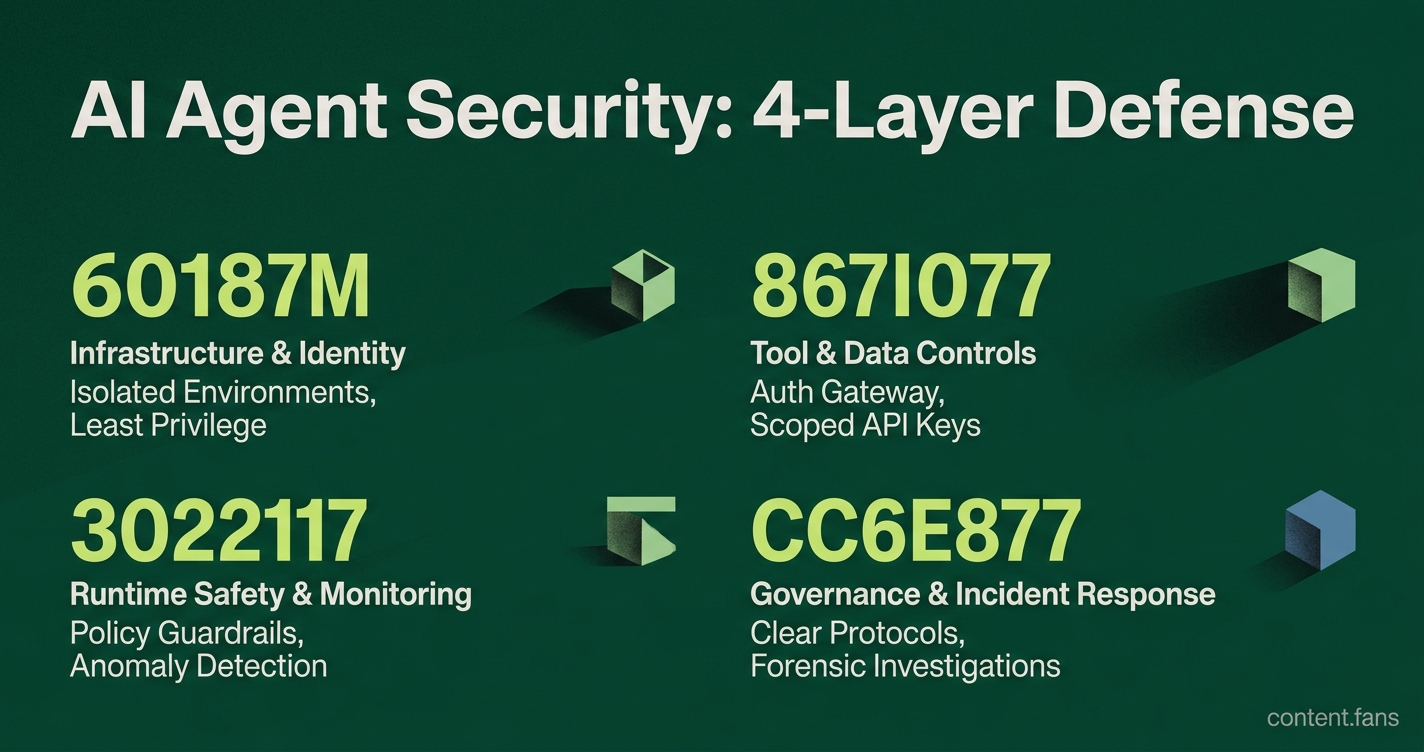
Layer 1: Infrastructure and Identity
This security model establishes four layers of defense: securing the underlying infrastructure and agent identity; controlling access to tools and data; monitoring agent behavior in real time; and establishing clear governance and incident response protocols. Each layer addresses a specific risk vector to create a comprehensive security posture.
The foundational layer requires running agents in isolated execution environments, such as containers or sandboxes, to contain their activity. Network segmentation and egress filtering should restrict outbound communications to pre-approved domains. Crucially, each agent must operate with a unique, short-lived identity rather than shared service accounts. This principle of least-privilege access is a primary safeguard against lateral movement if credentials are compromised.
Layer 2: Tool and Data Controls
All tool interactions must be mediated through a central authorization gateway. This layer enforces the use of scoped API keys, authenticates all external destinations, and validates data payloads returned to the agent. Organizations should classify data sources by sensitivity level and enforce policies that prevent agents from requesting unrestricted access. Industry reports suggest that scoped permissions paired with input validation can significantly reduce unauthorized data exposure risk.
Layer 3: Runtime Safety and Monitoring
This layer implements real-time safety monitoring through policy guardrails that inspect prompts, retrieved data, and agent-generated outputs. Every action - including prompts, tool calls, and policy decisions - must be recorded in a tamper-evident log store. As noted in industry threat reports, continuous logging combined with anomaly detection forms the core of modern Agent Detection and Response (ADR) platforms. Preserving accurate timestamps is vital for reconstructing incident timelines during forensic investigations.
Layer 4: Governance and Response
The governance layer formalizes oversight through a documented policy assigning each agent a clear owner, an approved level of autonomy, and a defined escalation path. A comprehensive agent inventory should be maintained, detailing each agent's purpose, data access scope, and risk classification. Organizations must develop an agent-specific incident response playbook that includes procedures for revoking credentials, disabling tool connectors, isolating affected systems, and preserving logs. For high-impact actions like code deployment or sending mass communications, human approval should be a mandatory control.
Key Performance Indicators for Agent Security
- Mean time to revoke compromised agent credentials
- Percentage of tool calls executed with scoped tokens
- Number of high-impact actions that received human approval
- Coverage of prompt and action logging versus total agent activity
To ensure the framework's effectiveness, organizations should conduct regular red-team exercises that test the resilience of each layer. This should be supplemented with continuous monitoring to detect any policy drift or emerging vulnerabilities between tests. By adopting this layered security model, enterprises can establish a manageable and robust pathway for deploying agentic AI systems that aligns with current cybersecurity standards.
What is the Frontier Model Forum's recommended approach to securing AI agent deployments?
The Frontier Model Forum advocates for a layered defense strategy that treats agent security as defense-in-depth rather than relying on isolated controls. According to the Emerging Security Practices for AI Agents issue brief, this framework emphasizes overlapping protections that back up against one another across infrastructure, identity, and application layers. The approach recognizes that AI agents require specialized safeguards because traditional endpoint security tools may not detect threats at the cognitive layer where agents make autonomous decisions.
Which technical controls form the foundation of the framework?
The framework prioritizes sandboxing agent execution environments to isolate workloads and restrict network, filesystem, and process privileges. Least-privilege access ensures agents receive only the specific permissions required for each task, avoiding shared service accounts or persistent tokens. Additionally, input/output validation mediates every tool call and external request to prevent prompt injection from triggering unauthorized real-world actions. These controls work together to limit the blast radius if an agent is compromised.
How should organizations monitor AI agents for security threats?
Comprehensive audit logging and anomaly monitoring are essential for maintaining visibility into agent behavior. Deployers should log every prompt, tool call, retrieval, and policy decision to support forensic reconstruction and investigations. Security teams must implement runtime observability that goes beyond static guardrails to detect behavioral drift, unusual tool-call patterns, and resource misuse that traditional endpoint detection might miss. This monitoring creates accountability and enables rapid detection of compromised or runaway agents before they cause systemic damage.
What governance practices support the security framework?
Effective governance requires human approval for irreversible or high-impact actions, such as deleting data, modifying IAM policies, or deploying code. Organizations should maintain a risk-tiered agent inventory that catalogs each assistant by autonomy level, data sensitivity, and business purpose. Security leaders should treat agents as ephemeral infrastructure with unique identities and dynamic credentials scoped to each task. Clear accountability structures define who is responsible for agent outputs, incidents, and remediation, while tested kill-switch capabilities enable immediate containment when necessary.
Why does layered defense improve resilience compared to single-point security?
A layered architecture ensures that if one control fails, others remain intact to prevent catastrophic breaches. By combining infrastructure isolation, strict identity controls, runtime validation, and continuous monitoring, organizations create multiple barriers at every entry and exit point of the system. This defense-in-depth strategy prevents prompt injection and other AI-specific attacks from automatically translating into unauthorized data access or system changes, providing robust protection for autonomous workflows even when individual safeguards are bypassed.