
AI Agent Playbook: Governance, Metrics, People Drive Production Scale
Serge Bulaev
The article suggests that moving AI agents from pilot projects to large-scale use may depend on strong governance, clear metrics, and workforce readiness. Many companies appear to struggle with quality, security, and integrating these systems into their operations. It recommends that organizations should set clear rules, measure real business value, and train employees to manage and review AI agents. Firms that follow these steps might be better prepared to scale their AI safely and effectively.

Developing a strategic AI Agent Playbook for governance, metrics, and people is now a critical management priority. While models appear ready for complex tasks, industry leaders report that operational gaps, risk controls, and workforce readiness are preventing agents from reaching production scale. This article outlines a playbook for navigating these challenges, giving executives a clear path from pilot projects to autonomous agents that deliver real business value under strict guardrails.
1. Governance Comes First
Scaling AI agents beyond pilot programs requires a strategic playbook focused on three core pillars: robust governance to manage risk, clear metrics to prove business value, and comprehensive workforce readiness programs. Without these operational foundations, even the most advanced models will fail to achieve production-level impact.
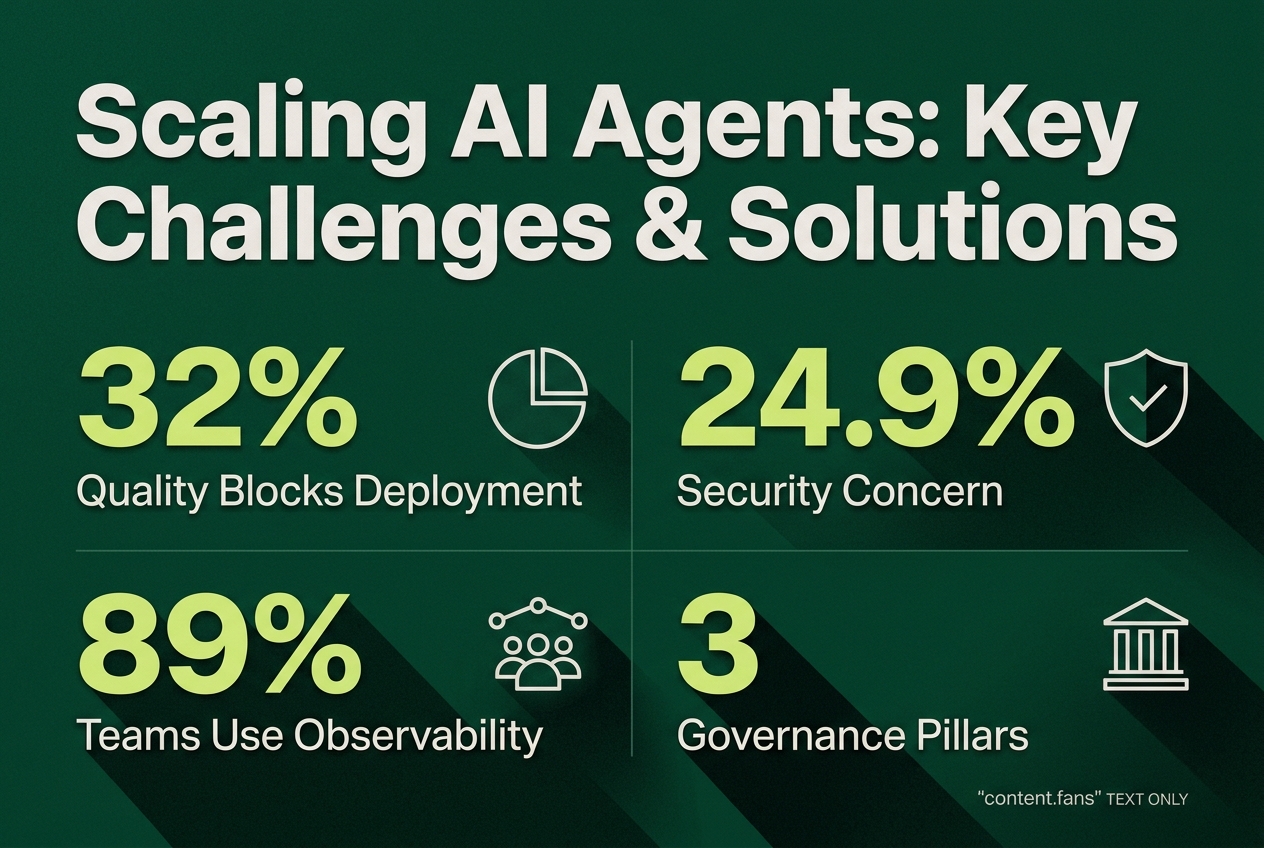
Recent data shows why governance is paramount. A LangChain survey reveals that quality blocks 32% of teams from deploying agents, while security is the second-largest concern for enterprises at 24.9%. These risks often arise because organizations lack a live inventory of their agents, tools, and permissions. Echoing this, the World Economic Forum urges firms to define and enforce clear authorization boundaries as their agent portfolios expand.
A recommended control stack includes:
- Policy: Define which use cases, data sources, and actions require approval.
- Control: Implement runtime checks, least-privilege credentials, and sandboxed tool calls.
- Measurement: Maintain continuous logging and conduct regular production evaluations.
- Review: Mandate human oversight for decisions impacting finance, safety, or compliance.
This layered approach helps eliminate blind spots, as simple observability - though reportedly used by 89% of teams - lacks the depth of formal production evaluation.
2. Metrics Must Show Value, Not Just Activity
Enterprises consistently struggle to prove the ROI of AI agents, with many organizations citing integration with existing systems and data quality issues as major roadblocks according to industry reports. These challenges intensify executive demand for metrics that demonstrate tangible business impact, not just raw activity counts.
A composite framework provides a holistic view:
| Lens | Typical Metrics |
|---|---|
| Reliability | Task success rate, human escalation rate, hallucination rate |
| Efficiency | Cost per task, latency, throughput |
| Business Impact | Hours saved, revenue influenced, CSAT delta, incident rate |
As Fin's KPI guide suggests, relying on isolated KPIs is insufficient; a composite measurement strategy is essential to capture both cost savings and risk exposure accurately.
3. People Readiness Is the Hardest Piece
Technology is only part of the equation; workforce readiness often proves to be the most persistent challenge. BCG research warns that "just because a job remains does not mean employees are prepared for it." The focus of upskilling must shift from coding to directing, auditing, and managing AI agents effectively.
Key capabilities to develop include:
1. AI literacy and understanding of failure modes
2. Advanced prompt and instruction design
3. Workflow decomposition into agent-led vs. human-only steps
4. Systematic evaluation and exception handling
5. Data stewardship and compliance awareness
A practical rollout should start with a skills inventory, followed by pilots in shadow mode. It is crucial to update role descriptions and performance metrics before deployment. As KPMG notes, true readiness is achieved when employees can apply sound judgment and take responsibility for outcomes, not just launch a tool.
Executive Takeaways
The path from pilot to production for AI agents depends on a disciplined, three-part strategy. Organizations that build a comprehensive AI Agent Playbook focused on disciplined governance, multi-layered business metrics, and structured workforce programs are best positioned to scale safely and unlock sustainable value. Success hinges on maintaining a complete agent inventory, enforcing runtime authorization, and measuring impact in concrete business terms.