
Microsoft unveils agent-first Windows OS at Build 2026
Serge Bulaev
Microsoft announced a new version of Windows that focuses on running AI agents directly in the operating system. This agent-first Windows may let assistants automate tasks across apps and services, using new security tools and a special marketplace. Early features will preview in late 2026, mainly for developers, with more advanced agents possibly coming in 2027. Some experts suggest this change could affect how businesses manage and secure their computers. It appears there are still questions about safety and when all features will be ready.

At Build 2026, Microsoft presented a major Windows platform shift toward development and agentic workloads, announcing that Windows is becoming an agent-native runtime, with OS-enforced identity, containment, and enterprise-grade manageability for agents. This fundamental shift redefines Windows as an "agent-native runtime," moving beyond app-level copilots to enable agents that can automate complex, multi-app workflows across the Microsoft ecosystem. According to industry reports, this new architecture could significantly impact enterprise endpoint management.
Key building blocks inside Windows
Microsoft's agent-focused Windows platform represents a fundamental redesign where the operating system itself becomes a managed runtime for autonomous AI agents. Unlike app-specific copilots, these native agents can perform complex tasks across multiple applications, secured by new OS-level controls and distributed through a dedicated agent store.
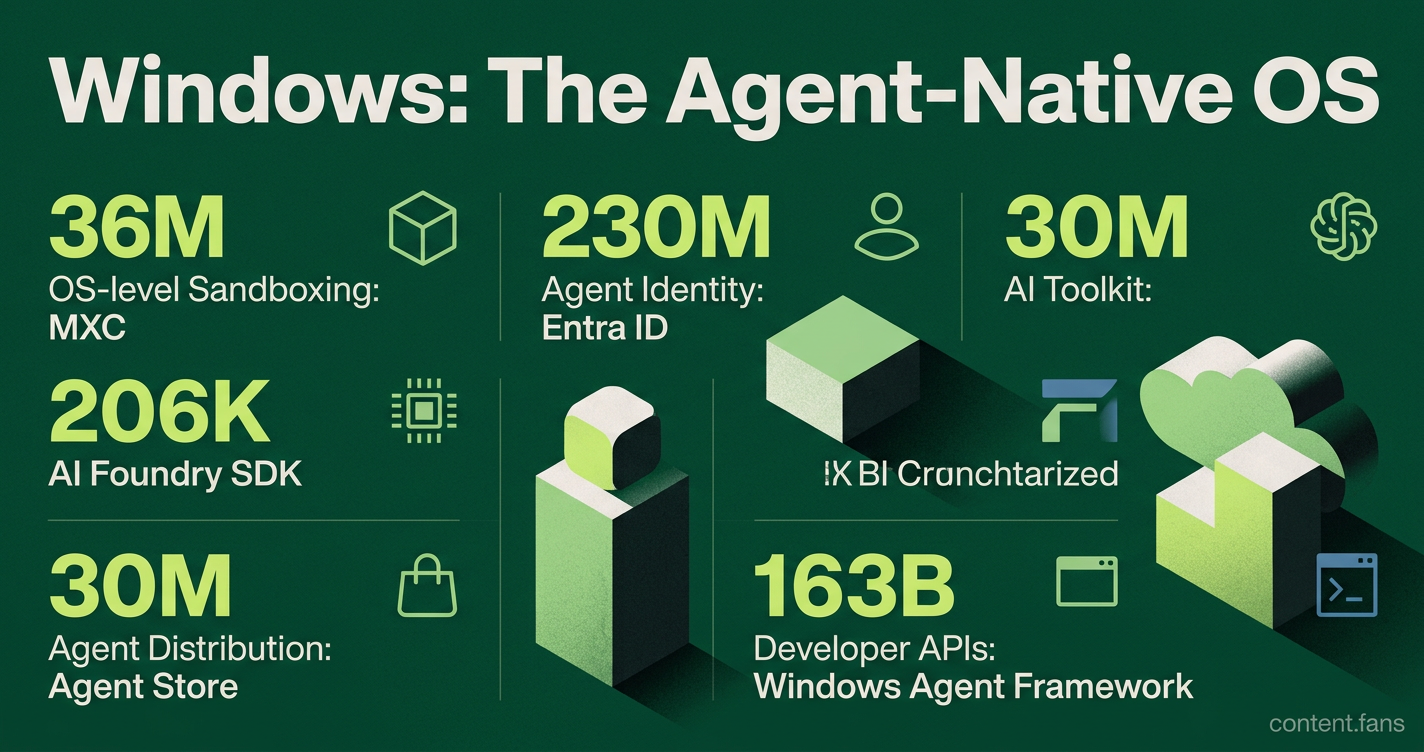
- Windows Agent Framework: According to industry reports, preview APIs are being developed to enable agents to interact with UI elements in human-like ways.
- Microsoft Execution Containers (MXC): An OS-level sandbox designed to constrain each agent's access to the file system, registry, and network, limiting its potential impact.
- AI Foundry for Windows SDK: A toolkit bundling ONNX Runtime, DirectML, and Copilot Runtime to accelerate the local execution of AI models.
- Windows Agent Store: A curated marketplace for discovering and distributing agents, planned to launch with the runtime preview.
Enterprise impact and new governance duties
The introduction of Microsoft Execution Containers (MXC) empowers enterprises to define agent permissions and "reduce blast radius," according to Microsoft's developer blog. Security analysts believe this means managed PCs will soon feature an inventory of agents visible within Intune and Defender. Each agent will be assigned a unique Entra identity, enabling granular conditional access policies and distinct audit trails. Early adoption is expected to focus on engineering workstations before a wider rollout.
Microsoft Build 2026: Agent-Native Windows - governance considerations
According to industry reports, enterprises should consider:
- Updating CMDBs to track agent attributes
- Enhancing endpoint policies to prevent unapproved agent execution methods
- Implementing MXC sandboxing for agents handling sensitive data
- Assigning unique Entra identities to agents for audit trails
- Integrating agent behavioral analytics into existing Defender threat hunting queries
Developer workflow updates
Developer workflows will be enhanced with an Intelligent Terminal featuring an embedded agent pane and expanded support for WSL and Linux containers. This terminal can display AI-generated code suggestions, detailed error explanations, and dependency graphs directly inline, significantly reducing context switching for developers during the build process.
What is shipping when?
According to industry reports, the Windows Agent Framework and MXC are expected to enter preview phases for select enterprises. Early releases may focus on text and structured-data automation, with more advanced capabilities planned for later phases. This suggests early use cases will center on tasks like document parsing rather than full desktop automation. In response to security concerns from regulators and CISOs, Microsoft plans to implement network controls via Entra to restrict agent outbound traffic, similar to existing Copilot Studio policies. The shift to an agent-focused OS signals a demand for new IT skills in container policy, risk analysis, and agent lifecycle management.
What exactly did Microsoft announce at Build 2026 regarding Windows?
According to industry reports, Microsoft revealed that Windows is evolving into an agent-native platform. Instead of treating agents as add-ons inside individual apps, the company is embedding Windows Agent Framework / Runtime directly into the OS so agents can:
- interact with multiple applications the same way a human user would
- run autonomous workflows across files, folders, and even UI elements
- be distributed and updated through a forthcoming Windows Agent Store
The keynote emphasized this represents a foundational shift - not another Copilot button - but a re-architecture of Windows itself.
How do these agents work across apps without user supervision?
According to industry reports, the new Windows Agent Framework may expose APIs that let agents:
- read and write structured data
- take screen-based actions in future iterations
- operate inside Microsoft Execution Containers (MXC) that isolate each agent from the rest of the system
Because the container is enforced by the OS, an agent could potentially open Excel, pull numbers into PowerBI, then export a deck to Teams - all without direct user interaction.
What new enterprise security and governance tools are available?
According to industry reports, Microsoft is integrating agent governance into existing enterprise tools:
- Intune and Defender may surface a local agent inventory, listing AI agents running on managed endpoints
- Entra ID could issue distinct identities to each agent, enabling conditional-access and audit trails per agent
- MXC policies may let admins restrict file system paths, network destinations, or registry keys agents can access
Many of these controls are expected to become available in future preview releases.
How does Microsoft's vision differ from other major tech companies?
According to industry reports, the key difference is depth of integration:
- Google Gemini and Apple Intelligence remain largely cloud-driven assistants accessed through individual apps
- OpenAI-style tools function at the model layer via API calls
- Microsoft's agent-native Windows approach integrates the OS itself as the agent runtime, handling sandboxing, permissions, memory, and telemetry at kernel level
In short, competitors bolt AI onto products; Microsoft is rebuilding the OS so AI becomes more central to the platform.
What timeline should enterprises plan for pilot adoption?
According to industry reports, enterprises should consider:
- Planning for preview phases focusing on text-based automation
- Preparing for expanded capabilities in future releases
- Testing early versions on pilot devices when available
Enterprises should therefore:
1. start inventorying current automation tools now
2. monitor for preview availability announcements
3. prepare updated governance baselines for future planning cycles