
Microsoft Unifies Copilot in Single App, Adds Autopilot Workflow for Summer 2026
Serge Bulaev
Microsoft plans to combine its consumer and enterprise Copilot tools into a single app by summer 2026, according to internal documents. The unified app may include GitHub Copilot, Copilot Chat, Copilot Cowork, and a new Autopilot workflow engine. Microsoft aims to make things simpler for users and reduce repeated work on the backend. Early previews might appear at the Build conference, with private testing for some Microsoft 365 customers. It remains to be seen if this super app will meet the needs of both regular users and companies, as competitors like Google and Amazon are also launching similar features.

Microsoft is developing a unified Copilot super app targeting a launch by the end of summer 2026, but it was not released or fully demonstrated at the Build 2026 conference, adding a new Autopilot workflow engine to consolidate its consumer and enterprise AI tools. This major strategic shift, codenamed "Delivering one Copilot," will merge multiple products to streamline the user experience and introduce powerful agentic automation.
What exactly is Microsoft unifying, and when will it launch?
Microsoft is unifying GitHub Copilot, Copilot Chat, Copilot Cowork, and a new Autopilot agent into a single super app. The consolidation aims to reduce user confusion and backend redundancy. The launch is targeted for the end of summer 2026. Previews were discussed at the Microsoft Build 2026 conference (June 2, 2026), but no full product demo was provided.
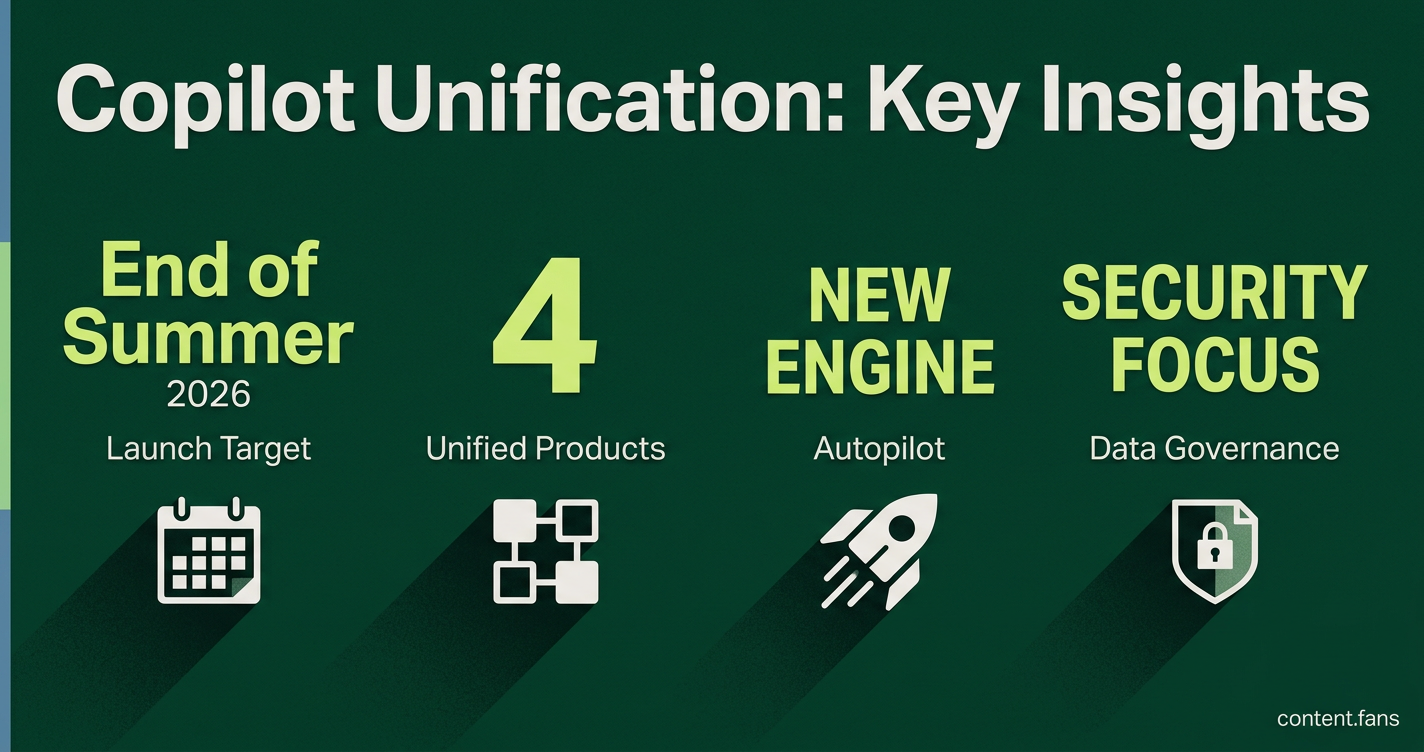
The initiative, led by newly appointed Copilot head Jacob Andreou, aims to resolve user confusion from a fragmented product lineup. A key feature will enable seamless toggling between personal and work Microsoft 365 accounts within the app, a frequent request from early testers.
What does the Autopilot workflow capability actually do?
Autopilot is Microsoft's new engine for autonomous AI agents, designed to handle complex workflow automation with minimal human input. Unlike current Copilot features that assist with single tasks, Autopilot executes multi-step agent scenarios across different applications and data sources. It signals a strategic focus on agentic capabilities and will offer a no-code/low-code platform for users to create sophisticated enterprise automation.
What security risks does combining consumer and enterprise AI create?
The unified app introduces significant data governance and security challenges. Because Copilot inherits a user's exact permissions, it can instantly surface any data they can access, accelerating the exposure of existing risks. This can be dangerous, as a significant number of files are already at risk in many organizations. Microsoft is adding enhanced controls like mandatory sensitivity label enforcement and deeper Microsoft Purview integration. Still, organizations must audit permissions and remediate data oversharing before deployment to prevent widespread exposure.
How are competitors responding to Microsoft's unified agent strategy?
Competitors are adopting distinct strategies in response. Google Workspace subscriptions (e.g., Business Standard, Enterprise) include Gemini Advanced features; there is no separate 'small per-user fee' add-on specifically for bundling Gemini that is marketed as undercutting Microsoft's premium pricing in the manner described. Amazon is focusing on transactional AI through its Bedrock platform, though Amazon Bedrock AgentCore supports agent development, but 'Bedrock AgentCore Payments' as a specific, launched service for executing financial operations is not confirmed as generally available. Meanwhile, OpenAI has shifted from partner to competitor by releasing its own open-source Agents SDK, creating a complex dynamic for its primary investor, Microsoft.
What should organizations prepare before this launches?
To prepare for the launch, organizations should prioritize three key actions. First, conduct a comprehensive audit of all user permissions, as Copilot will expose any existing access control gaps at machine speed. Second, enforce mandatory sensitivity labeling policies to ensure data is classified correctly. Third, review current Microsoft 365 licenses to confirm they align with the requirements of the new unified experience. Proactive governance is critical; treating this as just another product update instead of a security and compliance transformation creates a significant risk of data exposure.