
Adobe's 2026 Report: AI Answers Decouple Rank and Traffic for SEO
Serge Bulaev
SEO dashboards in 2026 show a lot of changes in search rankings, but Google did not confirm any new updates during early August, even though many saw drops in website traffic. Adobe's report suggests that being mentioned in AI-generated answers may matter more for getting traffic than having a high blue-link ranking. Some experts say traffic drops might be caused by routine changes, technical issues, or site errors, not just Google updates. To keep up, teams should check technical health and how often their brands appear in AI answers, since rank and traffic seem to be less connected now.

Industry reports highlight a critical shift where AI answers decouple rank and traffic, redefining SEO success. Despite sharp ranking swings in early August, Google has confirmed no core update, pointing toward deeper changes in how search visibility is earned and measured. This analysis separates confirmed facts from speculation and provides a modern monitoring routine for AI citations, technical health, and brand signals.
August 1 - 6 volatility: confirmed versus reported
Recent traffic drops and ranking volatility are not tied to a confirmed Google core update. Instead, they likely reflect routine algorithm reweighting, unstable Google Discover behavior, or site-specific technical issues. It is crucial to investigate these areas before assuming a major search update is the cause.
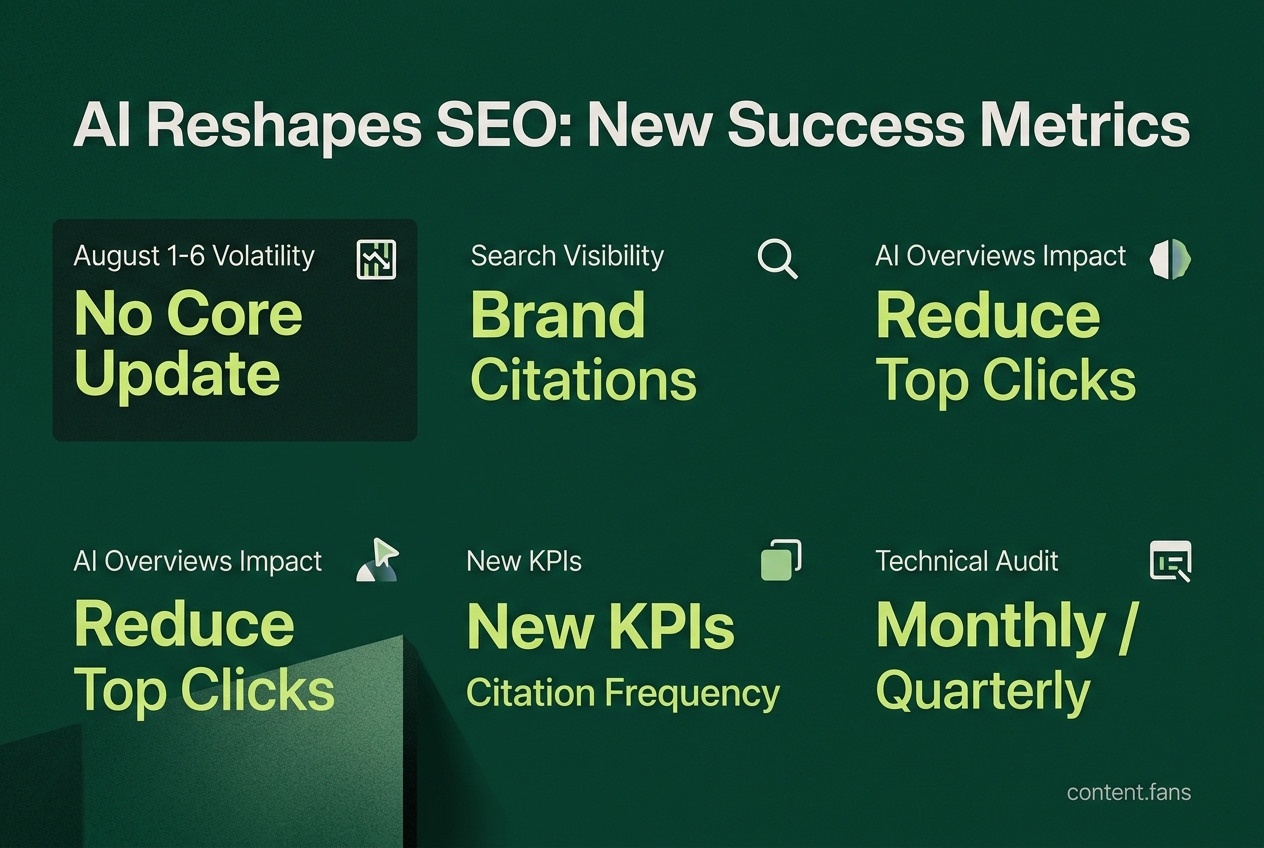
While SEO community trackers noted abrupt traffic drops, analysis from Search Engine Watch confirms no official ranking incident occurred between August 1 - 6. The last recorded Google Search ranking update in the gathered sources is the June 2026 spam update. This discrepancy suggests a volatility spike, not a formal algorithm release. SEOs who lost traffic should consider routine reweighting, crawler issues, or site-specific errors before attributing losses to a major update.
Search visibility inside AI answers
While traditional rankings still have a role, AI Overviews are fundamentally rerouting user attention. According to Adobe's 2026 SEO report, search visibility now depends more on brand citations within AI answers than on blue-link position. This shift requires tracking new KPIs like citation frequency and AI-referred sessions, especially as industry reports show AI Overviews can significantly reduce top-result clicks.
Search visibility checklist for week-to-quarter reviews
To maintain focus when dashboards show volatility, implement a routine monitoring checklist:
- Crawl errors, 404s, and indexing coverage
- Core Web Vitals and mobile usability scores
- Schema validity and answer-friendly formatting
- Brand impressions inside zero-click and AI surfaces
- Review volume, recency, and author credentials
Best practices suggest auditing these items monthly and conducting a full technical review quarterly. Modern frameworks also recommend tracking "pixel visibility" to quantify a brand's total on-screen real estate in search results.
Hitting pause before blaming the algorithm
Unconfirmed traffic loss requires a triage approach before blaming the algorithm. First, investigate technical fundamentals: check server logs for crawl issues, analyze Discover versus web traffic trends, and audit internal linking. If the site is technically sound, shift focus to AI inclusion metrics. With industry reports indicating a growing disconnect between traditional rankings and AI citations, ranking recovery alone no longer guarantees restored visibility.
Ultimately, the August 2026 volatility highlights a critical evolution in SEO: success depends on monitoring technical infrastructure, brand reputation, and AI citation frequency with the same rigor as traditional rank tracking. The next major traffic swing is just as likely to come from outside the core update cycle.
What do industry reports reveal about the relationship between search rankings and traffic?
Industry analysis indicates that visibility will depend less on page position and more on whether a brand is cited within AI-generated responses. According to the Adobe Business Blog's projections for search fundamentals, traditional ranking metrics are becoming insufficient because AI Overviews and AI Mode fundamentally alter how users discover information. Reports emphasize that ranking #1 no longer guarantees traffic when AI systems answer queries directly without requiring clicks to websites.
How significant is the disconnect between traditional rankings and AI citations?
Industry reports suggest the divergence is substantial. A significant portion of AI citations come from sources outside traditional top rankings, meaning strong organic positions no longer ensure AI inclusion. Available original-study summaries indicate that roughly 83% of AI Overview citations may come from outside the organic top 10, but other 2026 analyses report materially different figures, so the exact rate depends on methodology and source. This shift means brands must optimize for machine readability and API compatibility rather than just traditional ranking factors.
Why can't ranking fluctuations be automatically attributed to Google algorithm updates?
While SEO monitoring tools may show volatility, Google has not confirmed an August 2026 algorithm update despite reported traffic swings. Search Engine Watch notes that early August 2026 featured unconfirmed volatility rather than a named core update. Traffic drops during such periods could reflect ordinary ranking reweighting, Discover instability, crawler quirks, or site-specific technical issues rather than broad algorithmic changes.
What new metrics should SEOs track beyond traditional rankings?
Adobe recommends shifting toward citation frequency, share of model, and AI-generated referral traffic instead of relying solely on rankings and clicks. Teams should monitor how much screen real estate a brand occupies in search results including AI surfaces, and track assisted conversions that originate from AI citations. With industry reports indicating AI Overviews can significantly reduce organic clicks on top results, measuring presence inside AI answers becomes critical for evaluating true search visibility.
How should teams monitor site health and brand signals in this new environment?
Comprehensive monitoring requires checking crawlability, index coverage, and structured data on ongoing schedules rather than treating SEO as a one-time audit. For brand signals, track review volume, recency, and author credibility alongside traditional traffic metrics. Establish a cadence where technical health checks occur monthly while quarterly audits compare branded search visibility against competitors. This approach helps distinguish between Google-wide movements and site-specific issues that affect AI citation potential.