
Demand Gen Report Unveils 2026 AI Benchmark Survey for Marketers
Serge Bulaev
Demand Gen Report will launch its 2026 AI benchmark survey for B2B marketers in August. The survey aims to find out where AI may be creating real results in content creation, scoring, campaign optimization, and workflow management. Early findings suggest most marketers already use some AI, mainly for efficiency and better messaging. The survey may show where AI really helps and and where there are still problems, like measuring results or handling data. This could help marketers decide which AI tools might be worth more investment as they plan for 2026.

Demand Gen Report's upcoming 2026 AI Benchmark Survey for Marketers aims to pinpoint where artificial intelligence delivers measurable ROI in B2B marketing. Launching in August, the study will gather insights from demand-generation leaders on AI's performance in content creation, lead scoring, campaign optimization, and workflow orchestration. The findings will help teams decide what to automate versus what to keep human-led. Demand Gen Report has released early registration details for the study's August 6, 2026 launch.
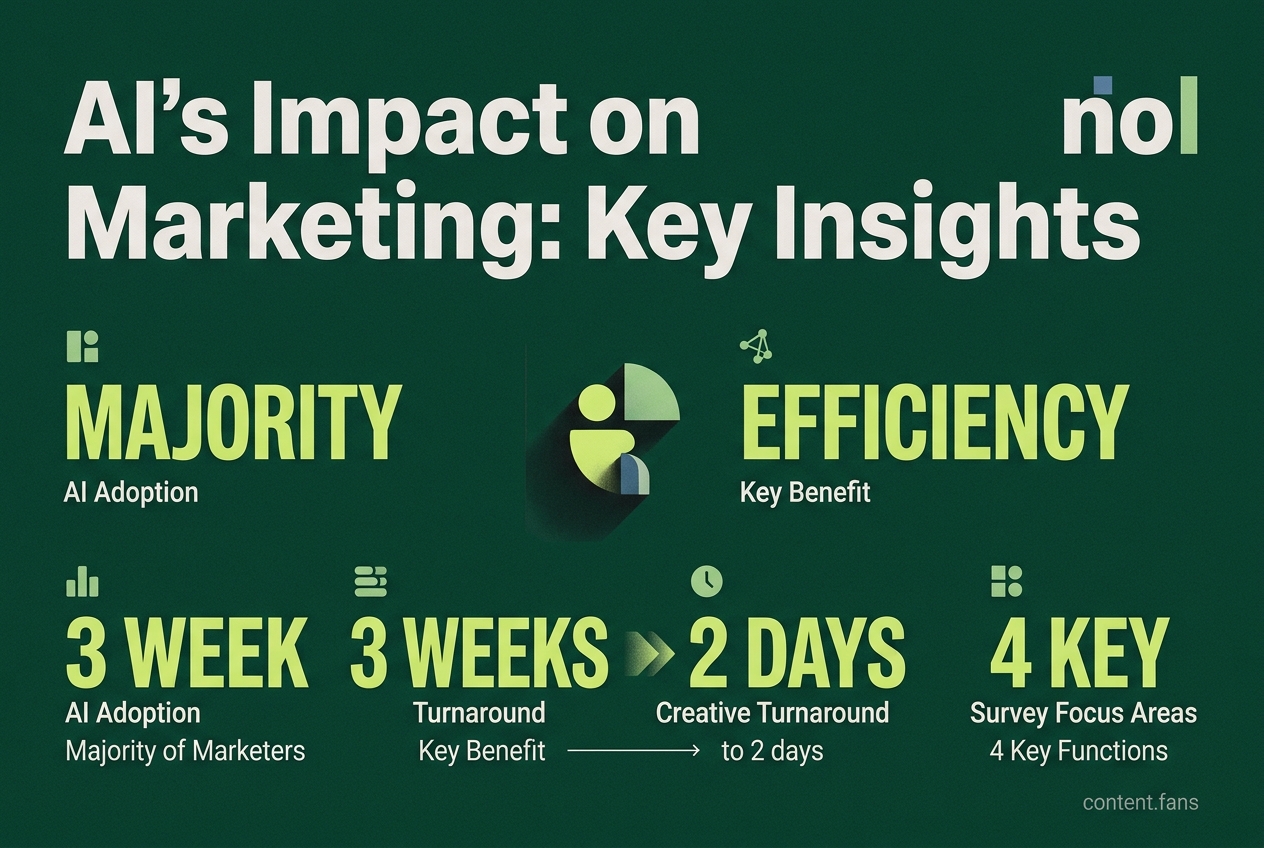
This new benchmark builds upon the outlet's earlier B2B trends research, which revealed that a significant majority of marketers already use some form of AI. According to those Key Insights, many respondents pointed to efficiency as the main benefit, while others use AI to refine messaging and better connect with buyers at critical moments.
What the Benchmark Plans to Measure
The survey will evaluate AI's effectiveness in four key B2B marketing functions: content creation, predictive scoring, campaign optimization, and workflow orchestration. By focusing on these areas, the study aims to provide a clear, data-driven framework for marketers to assess AI's real-world impact on their operations.
Demand Gen Report frames the survey as a reality check on where AI "actually moves the needle" within demand-generation workflows. The core questions will center on four functional zones:
- Content drafting and scaling
- Predictive lead or account scoring
- Campaign optimization
- Workflow orchestration
Crucially, the survey will also explore how marketers verify AI outcomes, a topic the publisher views as essential for separating hype from operational value. The final report will likely identify gaps in data quality and measurement frameworks - issues the earlier trends study already flagged as major barriers.
Personalization at Scale Gains Momentum in ABM
A related ABM Benchmark Survey from the same publisher adds context, with a significant portion of practitioners identifying AI-driven personalization at scale as an effective use case in account-based marketing (ABM). This finding suggests personalization will be a key focus in the broader demand-gen study. Supporting this, case material from Demandbase notes that AI for account-specific messaging cut creative turnaround from three weeks to two days, highlighting significant efficiency gains.
Why Marketers Care Heading into 2026
This survey arrives as marketers critically reassess AI's role in daily execution. Industry context underscores the urgency: many organizations are increasing their content production through decentralized teams, increasing the need for strong governance and clear benchmarks. Similarly, recent polling shows that while many B2B firms prioritize AI for customer experience, a significant portion are held back by skills gaps.
By quantifying where AI is already effective - across content, scoring, optimization, and orchestration - the Demand Gen Report benchmark will provide critical data to guide budget and investment decisions for 2026.
Demand Gen Report has opened its 2026 Demand Generation Benchmark Survey, designed to map how B2B marketing teams are deploying artificial intelligence across their workflows. The survey focuses on four critical areas: content drafting and scaling, predictive scoring, campaign optimization, and workflow orchestration.
Here is what marketers need to know about this initiative and the broader context of AI adoption in B2B marketing.
What specific AI workflows is the 2026 benchmark survey evaluating?
The survey targets four operational categories where AI is currently being tested and scaled:
- Content drafting and scaling - automated generation and adaptation of marketing materials
- Predictive scoring - AI-driven lead and account prioritization
- Campaign optimization - real-time adjustments to targeting and messaging
- Workflow orchestration - coordination of cross-channel marketing activities
According to Demand Gen Report, the goal is to produce an industry benchmark showing where AI is truly delivering value and to help teams determine what to automate, what to keep human, and how to measure AI's impact.
How does this survey connect to account-based marketing strategies?
The demand generation benchmark aligns closely with Demand Gen Report's ABM Benchmark Survey, which found that personalization at scale is where AI has its biggest reported impact in account-based programs.
A significant portion of ABM practitioners identified content personalization at scale as a top AI use case in their programs. This makes personalization a key adjacent theme for the demand generation benchmark as well - suggesting that marketers using AI for demand gen should consider how their efforts feed into account-based workflows.
What does current industry data reveal about AI adoption in B2B marketing?
Demand Gen Report's B2B Trends Research provides important baseline statistics showing widespread AI adoption among marketers, with efficiency cited as a top reported benefit and many using AI specifically to hone messaging and develop campaigns.
These figures suggest near-universal AI experimentation, but with varying degrees of sophistication in application.
What operational results are teams seeing with AI-powered personalization?
Case study evidence from recent implementations shows measurable workflow improvements:
- Demandbase reported reducing team card customization time from three weeks to two days using AI-powered personalization tools
- LinkedIn ABM campaigns with dynamic company logo and name insertion, paired with personalized landing pages, have achieved improved CTRs and reduced cost per lead in many implementations
These examples demonstrate that the most effective implementations move beyond simple token replacement to personalize by company, pain point, buying stage, and role.
What challenges should marketers anticipate when scaling AI workflows?
Industry research identifies several critical barriers:
Data foundation gaps - Many B2B organizations lack unified customer data that can support AI at scale. Scattered or incomplete data undermines trust in AI outputs and complicates impact measurement.
Skills shortages - A significant portion of organizations cite skills gaps as a major barrier to deploying advanced AI effectively.
Governance and security risks - Industry analysts predict that ungoverned generative AI use will cost B2B companies significant enterprise value through losses, settlements, and fines.
Strategic limitations - Recent research found that strategic thinking remains a cited AI limitation, with many outputs requiring significant human correction.
The 2026 benchmark survey opened on August 6, 2026, and will aggregate responses from demand generation leaders into a clearer picture of where AI actually moves the needle in B2B marketing operations.